# Marketing investment: if you invested millions in production, how much do you invest in monetization?
Source: https://unrivals.com/blog/marketing-investment/
Site: UNRIVALS · Language: en · Updated: 2026-09-27
> A new factory gets approved with a feasibility study, while the marketing that has to sell its output usually gets approved as a new website and a few campaigns. Why production capacity doesn't sell itself, and which line is missing from the investment plan.
---
A marketing investment is the money a company puts into the infrastructure that turns the value it produces into something the market demands, prefers and pays the right price for. At a production company, this infrastructure covers brand, positioning, portfolio, distribution, the commercial system and demand generation, meaning everything that turns the factory's capacity into revenue.
**TL;DR.** A new factory gets approved with a feasibility study, while the marketing that has to sell its output usually gets approved as a new website and a few campaigns. Production capacity grows the volume you can ship, without growing the volume the market buys or the price it accepts.
The gap between what the factory can produce and what the market actually buys gets paid later, in discounts, in margin ceded to the channel, and in negotiations with large retail.
Many companies carry a hard-to-see asymmetry in their investment plans. A new production facility easily justifies millions of euros, for the building, the land, the equipment, automation, storage, new lines, energy efficiency and certifications. Every element gets analysed, budgeted and engineered rigorously, because it counts as infrastructure the growth needs.
The standard shifts, surprisingly, the moment the same company has to decide how it will sell the extra capacity. Marketing then becomes a new website, a few campaigns, managing social channels and, eventually, a media budget set after every other investment has already been approved.
The company invests several million euros to produce more, then treats almost as an experiment the question of who will buy the extra output, why they'll buy it from this company, and whether they'll pay enough for the investment to deliver its projected return. *The machine, we assume, will take care of the rest.*
## Why doesn't production capacity sell on its own?
Production capacity doesn't sell on its own, because a bigger factory lets the company produce more without forcing the market to buy more.
A more efficient line lowers the unit cost, but it doesn't raise the customer's willingness to pay a better price. A bigger warehouse supports larger volumes, except it creates no demand to turn them into revenue.
The gap looks obvious and still goes missing from investment logic most of the time. **Production capacity is the infrastructure through which the company creates value.** Brand, positioning, portfolio, distribution, the commercial system, demand generation and sales form the infrastructure through which the company turns the value it created into money, and I call this *monetization infrastructure*.
That's why the useful conversation for a company investing in production starts from a different question than "are we doing marketing too?" The right question is how much of the capacity investment is backed by a coherent investment in the capacity to monetize it.
A hypothetical example shows the order of magnitude. **If you invest five million euros to grow production by 40%**, while the commercial infrastructure stays sized for the company as it was before the investment, you've built capacity ahead of the demand and the commercial system meant to absorb it.
## What rigor does the factory get, and what rigor does demand get?
The factory almost always gets more rigor than the demand meant to keep it busy. For a production facility, people calculate hourly capacity, energy use, staffing needs, equipment yield, maintenance costs, depreciation, logistics flows and financing scenarios. Suppliers get evaluated, the project gets staged, and the payback period gets modeled financially.
Monetization infrastructure rarely gets the same level of design. Many companies lack an estimate of the incremental demand the new capacity needs, along with the strategy that would show which segments that demand will actually come from.
A portfolio architecture that protects margin, a differentiation system strong enough to reduce price dependence, or a commercial structure sized for the new target rarely exist either.
| The question | For the factory | For demand, usually |
|---|---|---|
| How much volume needs to be produced or sold? | Hourly capacity, calculated | No estimate of incremental demand |
| Where does the result come from? | Equipment yield, measured | The segments that absorb the volume, undefined |
| How is the margin protected? | Unit cost, maintenance and depreciation, modeled | Differentiation from price, left to the campaigns |
| Who executes? | Staff and suppliers evaluated | The commercial structure from before the investment |
| When is the money recovered? | Staged financial model | Media budget set at the end |
The table shows the same company held to two different standards. The second column almost always carries the intention to "raise visibility," a comfortable phrase precisely because it doesn't force the company to answer the real problem.
**Visibility alone doesn't produce monetization.** Extra bought traffic doesn't automatically raise preference, and extra sales contacts improve neither conversion nor margin. A company can become far more visible without becoming more relevant to the buyer who actually decides.
Marketing starts working as economic infrastructure only once it can be tied to how the company turns the extra capacity into demand, preference, distribution, price and sale. **That link gets designed together with the factory**, in the same file and with the same rigor.
## What does research say about marketing investment?
Academic research has long treated marketing as a company capability, with a measurable effect on performance, and that view reaches well beyond the marketing industry's own talk about itself. The findings are consistent enough that the conversation moves past promotion and into how a company builds its advantage.
A meta-analysis published in 2026 in Industrial Marketing Management synthesized 127 empirical studies and 430 observations, published between 1999 and 2025, and confirmed [the relationship between marketing capabilities and company performance](https://www.sciencedirect.com/science/article/pii/S0019850126000167). **That relationship holds up across a quarter century of research.**
The 2026 meta-analysis
127Empirical studies analysed
Published between 1999 and 2025
430Observations synthesised
From the same studies
Source · Vieira et al., Industrial Marketing Management, 2026
The 127 studies span different markets, industries and years, so the conclusion doesn't rest on one lucky case. That volume is exactly what turns the meta-analysis into an argument a board can use alongside the factory's own numbers.
Another meta-analysis, published in 2008 in the Journal of Marketing by Krasnikov and Jayachandran, compared the effect of marketing capabilities with that of R&D and operations capabilities. Across the research reviewed, the authors found a stronger effect from [marketing capabilities on company performance](https://journals.sagepub.com/doi/10.1509/jmkg.72.4.001).
These studies don't call for arbitrarily moving money from CAPEX into communication, and their practical conclusion is more sober than that. **The investment that creates value and the investment that collects it get designed together.** Otherwise, one of them ends up compensating for the other's weakness, and that compensation usually happens through price, meaning discounts.
## What happens to price when capacity grows faster than differentiation?
When capacity grows faster than differentiation, **the pressure lands on price**, because a new facility almost always arrives with an economic obligation attached. Assets demand use, fixed costs need absorbing, financing gets repaid in installments, and the projected volumes are waiting to be produced and sold. The bigger the investment, the greater the pressure to keep the factory running.
If demand and differentiation haven't grown in step, the company has a handful of quick mechanisms at hand to push volume into the market. Any sales director recognises them, from discounts and promotions to better terms for distributors, volume bonuses, free shipping, or a bigger share of margin handed to the channel.
That's how a paradox appears. **The investment made for efficiency ends up pressing on margin**, exactly because the monetization infrastructure wasn't sized alongside the production one. The factory runs flawlessly, except **the market hasn't yet been given enough reason** to pay for that performance.
## Why does the manufacturer end up dependent on the retail buyer?
A manufacturer ends up dependent on large retail because, after a big investment in capacity, productivity can only be sustained through volume. The equipment only pays for itself when it runs, and the factory only reaches its efficiency once capacity is used in full, the point where unit cost finally looks good too.
On paper, the logic is flawless, but the market raises the question that actually matters, meaning who has enough buying power to absorb those volumes.
For many FMCG manufacturers, the answer points toward modern retail and the large international chains, who understand the economics of production capacity very well. A supplier who has to sell 100,000 units negotiates from a weaker position than one who can calmly choose between selling 60,000 or 100,000.
The productivity circle
Investment
More capacity
Production
The factory needs to run
Volume
The output needs to sell
Large channel
Only retail absorbs it all
Negotiation
This is where the margin goes
The figure shows the circle the manufacturer travels through. It invests to produce more, then has to produce more for the investment to pay off, then has to sell more to absorb that output, and along the way it becomes dependent on the channels that can take on large volumes. The red link is where the negotiation begins.
For a manufacturer dependent on volume, the IKA buyer, meaning the person who negotiates on behalf of the large international retail chains (international key account), can become what more than a few entrepreneurs call, not academically at all, *the fear of fears*.
The retailer does nothing irrational in this negotiation, since each side is optimising its own economics. They negotiate purchase price, promotions, trade contributions, listing terms, payment terms and shelf rotation, using their buying power. The manufacturer negotiates with a factory standing behind them, one whose profitability depends more and more on keeping that capacity in use.
The imbalance becomes clear once **the manufacturer needs the volume more than the retailer needs its brand**.
This is where multinationals with strong brands hold a structural advantage. They come to the negotiating table with an efficient factory and available volumes, and alongside that they bring demand that already exists, awareness, penetration, budgets, data, portfolios and products the consumer explicitly looks for.
The buyer negotiates hard with them too, except removing a brand the consumer actively asks for carries a cost for the retailer as well.
This is one of the economic functions of brand that the shallow conversation about marketing misses entirely. **Brand reduces the manufacturer's vulnerability to the distribution channel**, on top of helping it sell more to the consumer.
When the product is perfectly substitutable in the buyer's mind, the retailer compares mainly on price, terms and margin. I call *cognitive ownership* the situation where a company owns the mental space of the category, so that when the need arises, the market comes to it on its own.
A product with strong [cognitive ownership](/blog/cognitive-ownership/) generates its own demand and changes the negotiation's equation, because the manufacturer brings something more valuable to the table than spare factory capacity, meaning the consumer.
That's why the profitability of an industrial investment can turn into a lottery if you only engineer productivity and assume the extra volume will get absorbed under the same commercial terms. **A 40% bigger capacity doesn't automatically bring 40% more commercial power.** Sometimes it brings exactly the opposite, meaning 40% more volume that now needs selling.
Without a parallel investment in brand, in demand and in commercial power, the manufacturer risks financing, on its own, the infrastructure that makes it more dependent on the buyer. That part never shows up in the equipment spreadsheet.
## What does an authentic product lose when the market has to do the synthesis itself?
An authentic product can lose the very value it was invested to have, when the market is left to connect all its true elements on its own. Food shows the mechanism clearly, because the physical investment, the product and the brand are all visible at once, on the shelf.
At Mirdatod, the producer of Telemea de Ibănești, a traditional Romanian cheese, the strategic raw material is exceptional, with origin, territory, tradition, process, certification and product all present. Telemeaua de Ibănești was registered on 15 March 2016 as a Protected Designation of Origin, [according to Romania's Ministry of Agriculture and Rural Development](https://www.madr.ro/industrie-alimentara/sisteme-de-calitate-europene-si-indicatii-geografice/produse-agricole-si-alimentare.html).
The value is all there, and the difficulty appears once all these true elements start competing for attention. **The consumer has to piece the synthesis together alone**, across producer, origin, characters, mountain, animals, product category, certification and the various messages printed on the pack.
In [our analysis for Mirdatod](https://unrivals.ro/deck/mirdatod), the gap between how valuable the product is and how much of that value its brand actually communicates became the central point. **Certification proves the origin, but it doesn't build ownership of it on its own** in the buyer's mind. That ownership has to be designed.
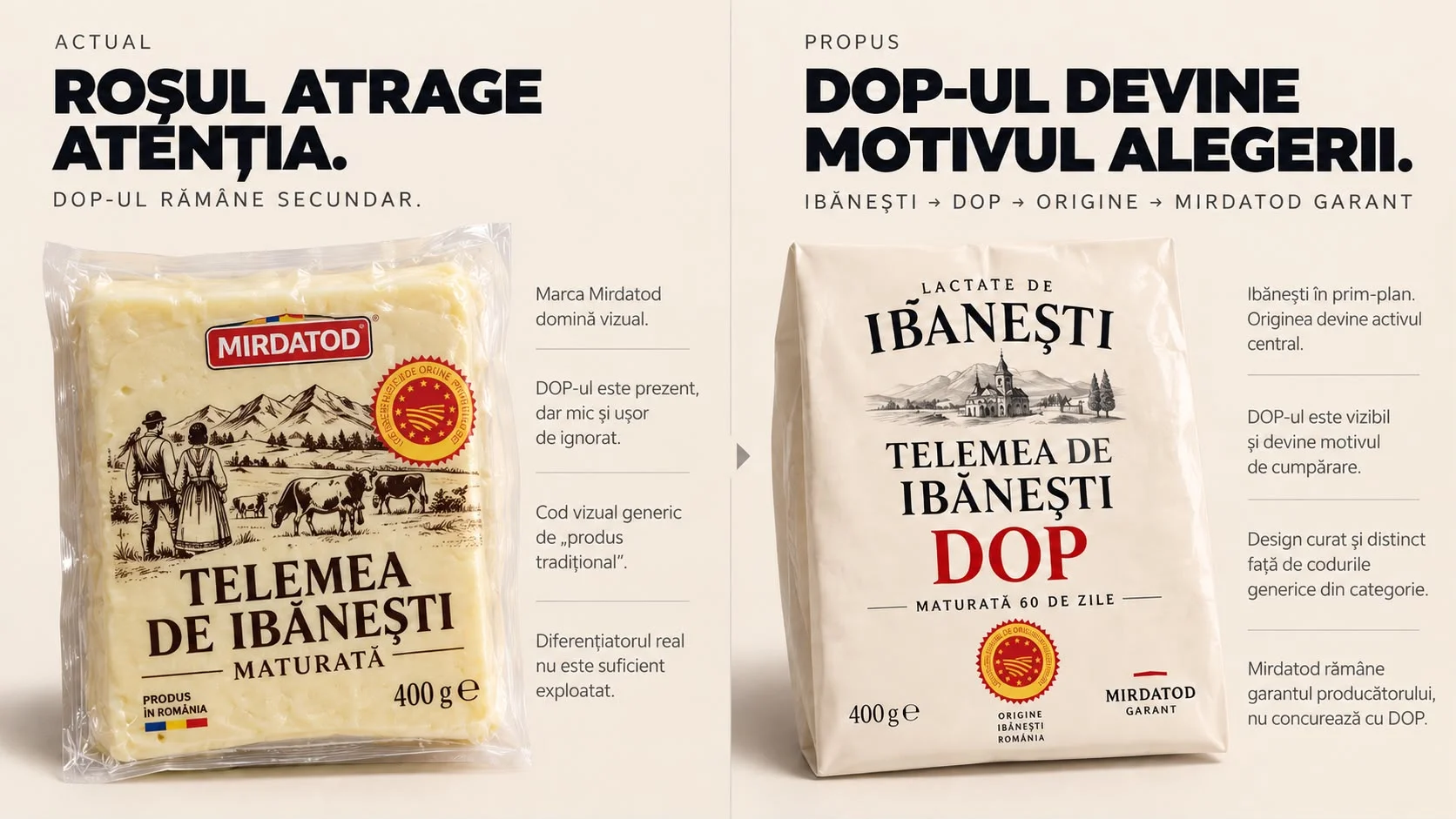
Slide 23 of the Mirdatod analysis, current pack versus proposed pack.
On the current pack, the red draws the eye, and the PDO seal stays a detail. On the proposed version, the seal becomes the reason the buyer chooses it. The example shows the difference between investing in what the product is and investing in what the market remembers it as, because the first builds substance, and the second turns it into commercial value.
## What happens when the factory gets built before the brand?
At De Colțești, a Romanian producer of matured cheese from the Apuseni Mountains, the relationship between investment and monetization shows even more clearly. The company invested about 3.5 million euros in the Colțești factory, with an emphasis on a new maturation warehouse of roughly 300 tonnes, [according to Profit.ro, in 2026](https://www.profit.ro/povesti-cu-profit/retail/foto-de-la-o-mica-afacere-de-familie-la-fabrica-de-coltesti-merge-spre-afaceri-de-30-milioane-lei-am-gresit-am-fost-dezamagiti-dar-am-invatat-mult-si-am-schimbat-lucrurile-22315784), and the product matures for up to 730 days.
Two years of maturation means capital, infrastructure and time, exactly the kind of substance an advertising promise can't imitate.
The [UNRIVALS analysis](https://unrivals.ro/deck/decoltesti) from 2026 found only a 34-out-of-100 coherence score between the maturation attribute and the existing brand system. The substance of the differentiation had been built and paid for, but the name, the tagline, the identity, the packaging and the communication weren't yet turning maturation into a clear property of the brand.
Price shows the same disconnect. At the time of the 2026 audit, the product matured for 730 days was listed at 127 Romanian lei per kilogram, while the truffle variant reached 140 lei per kilogram. **Two years of maturation were worth less on the shelf** than an ingredient any competitor can add.
De Colțești, shelf price per kilogram
Cheese matured with truffles140 lei
Extra-matured, 730 days127 lei
Source · UNRIVALS audit for De Colțești, 2026
The red bar represents two years of time, of maturation infrastructure, of locked-up capital and of proprietary know-how. It still sits below the truffle bar, meaning below an ingredient within reach of any competitor.

Slide 41 of the De Colțești analysis, with the maturation moved into the brand's signature.
In our proposal, the 730 days move from the technical data sheet into the brand's own signature. This is where it becomes clear why marketing can't be reduced to promotion.
More impressions for the matured product change nothing, because the real work is turning maturation from a technical trait into a property of its own, strong enough for the market to recognise it, prefer it, and pay for it.
**The production facility creates the economic possibility**, and the brand and the commercial system turn it into collected value.
## Why doesn't perception show up on the balance sheet, even though its cost does?
Perception doesn't show up on the balance sheet because physical assets are comfortable to value, while positioning, differentiation and brand come with no invoice. The equipment has a manufacturer, specifications, an invoice, a serial number, a capacity and a book value. It can be photographed, inspected, financed and entered into a depreciation schedule.
**Positioning has no chassis number** and doesn't arrive on a truck, and owning a category can't be shown to the bank during the factory visit. A brand architecture doesn't take up a single square meter of the plant.
**The effects of these unseen assets are very concrete.** They show up in willingness to pay, in margin, in customer acquisition cost, in the distributor's leverage, in sales cycle length, in conversion rate, and in the company's ability to grow without buying every extra unit of volume through a price cut.
**The absence of marketing carries an industrial cost**, even when marketing doesn't look like an industrial asset.
## On which layers is the monetization infrastructure built?
Monetization infrastructure has four layers, and each one answers for a piece of the road between the factory's capacity and revenue. The method we work with reads them top down, because positioning decides what everything else gets to say, while the media budget only works on the bottom layer. The full map is described in [the article on marketing architecture](/blog/marketing-architecture/).
The monetization infrastructure, by layer
L4 · Positioning and category
The attribute the market pays for
L3 · AI Brain, data
Incremental demand, estimated by segment
L2 · Revenue and commercial process
Portfolio, distribution, negotiation
L1 · Performance marketing
Demand generated across channels
**L4, positioning and category.** This is where it gets decided whether the new volume sells on an attribute the market pays for, or on price. The maturation at De Colțești and the protected origin at Mirdatod are raw material for L4, and the factory investment doesn't turn it into a reason to choose on its own.
**L3, AI Brain.** This layer estimates the incremental demand the new capacity needs and shows which segments and channels are winning or losing margin. Without it, the feasibility study calculates hourly production and guesses at monthly sales.
**L2, revenue and commercial process.** Portfolio, flagship products, distribution, sales arguments and preparation for the retail negotiation live on this layer. In FMCG, it decides how much margin stays with the manufacturer once volume passes through the IKA channel.
**L1, performance marketing.** Campaigns and media generate the demand, and they only do their job once the layers above have given them something to say.
The order matters, because **infrastructure comes before marketing** in every project we start. On a foundation for growth built correctly, every euro invested stays in the market's memory, while an ad with no foundation disappears along with its budget.
## When should the marketing for a production investment be designed?
The marketing for an investment that significantly increases capacity gets designed in the same investment cycle as the factory, before the new line starts running. Designed after the opening, it ends up patching a decision that's already been made.
Before the first day of production, there should already be a clear hypothesis about which segments will absorb the extra volume and which attributes can support differentiation and price. On the same list sit the portfolio architecture, the flagship products, the distribution channels, the sales arguments, the demand generation system and the mechanisms that turn interest into a sale.
FMCG adds one more question explicitly. **How much of the projected growth depends on volumes negotiated through IKA**, and what happens to the investment's profitability if the commercial terms get worse? A model that projects capacity without the negotiating power needed to monetize it stays incomplete.
The order of a capacity investment
1 · Feasibility study
Capacity, costs, financing
2 · Monetization thesis
Segments, attribute, price and margin
4 · First day of production
The line starts with demand ready
5 · Campaigns and media
Amplifies a system that already works
The conversation about campaigns and media only makes sense at the end of this sequence. Otherwise the company risks using advertising to amplify an unsolved problem, because more budget doesn't fix weak positioning, and more traffic doesn't save an offer the market can't tell apart from the others. **The budget amplifies the system it finds.**
## How much should be invested in marketing when capacity grows?
The level of marketing investment should track the economic objective of the new capacity, and the percentage of revenue says too little about it on its own. What matters is the company's stage, the category, the margin, the intensity of competition, the newly created capacity and, above all, the distance between today's demand and the demand the investment needs in order to hit its targets.
A fixed percentage would be tempting, since it would turn a strategic problem into a spreadsheet formula. A company building a facility for a major capacity increase has a different marketing problem than one that only wants to hold its current volume. In the first case, **marketing and commercial infrastructure are part of the investment thesis.**
We've analysed the percentages, the market benchmarks and [the relationship between revenue and marketing investment](/blog/marketing-budget/) separately. Here, a more useful question than "how much should we invest in marketing?" is how much the company is already paying because the market doesn't fully perceive the value it invested money to create.
The gap between real value and perceived value shows back up in the company's economics as discounts, ceded margin, higher media costs, longer sales cycles and distributor pressure. You also see it in **good products that need constant explaining** just to justify their price. We call this gap the [Confusion Tax](https://b2b-strategy.ro/2026/08/audit-marketing/).
Every message the buyer has to decode on their own pays part of this tax. When the company lowers the effort a person needs to understand why its product deserves its price, the cost of every new customer drops too.
Before approving the next multi-million-euro investment in a production facility, it's worth adding a new line to the feasibility study. Alongside the cost of the new capacity, that line shows how much needs to be invested for the market to absorb it at the price and margin that justify the investment.
For a manufacturer, the real investment only finishes once the company can monetize the extra capacity without transferring the value it created to discounts, to the channel, or to the buyer.
A new factory can produce more from day one, but the market has no obligation to buy more from day two. The retailer has no obligation to protect the manufacturer's margin either, just because that manufacturer's factory got bigger.
What connects the factory to the market and to the retailer isn't called promotion. It's called monetization infrastructure.
## Frequently asked questions
### What does monetization infrastructure mean?
Monetization infrastructure is everything through which a company collects the value it produces, made up of brand, positioning, portfolio, distribution, the commercial system, demand generation and sales. It turns the factory's capacity into demand, preference and price, and without it, the extra volume sells through discounts.
### How much should a manufacturer invest in marketing after an expansion?
The amount gets calculated starting from the distance between current demand and the demand the new capacity needs, at the price and margin built into the investment plan. A fixed percentage of revenue ignores exactly that distance, which is why the calculation starts from the feasibility study.
### Why does brand matter in negotiations with large retail?
A brand the consumer explicitly asks for carries a removal cost for the retailer too, so the manufacturer negotiates with its own demand standing behind it. A substitutable product, on the other hand, gets compared mainly on price, terms and margin, and spare factory capacity weakens the manufacturer's position at the table.
### When does the marketing for a production investment get designed?
Marketing gets designed in the same investment cycle as the factory, before the new line starts running. Segments, attribute, portfolio, distribution and sales arguments get set before the first day of production, and campaigns only come after that.
If you are preparing a capacity investment and want to see which monetization infrastructure it is missing, [ask for a diagnostic](/#diagnostic). We'll show you where the created value is getting lost and what needs to be built before the new line starts running.