
A business strategy is the set of choices through which a company decides where it competes, which criterion it wants buyers to choose it on, what it refuses to do, and how all of that turns into margin.
It answers the question an annual plan never asks on its own, namely why anyone would pay more for you than for the alternative next door.
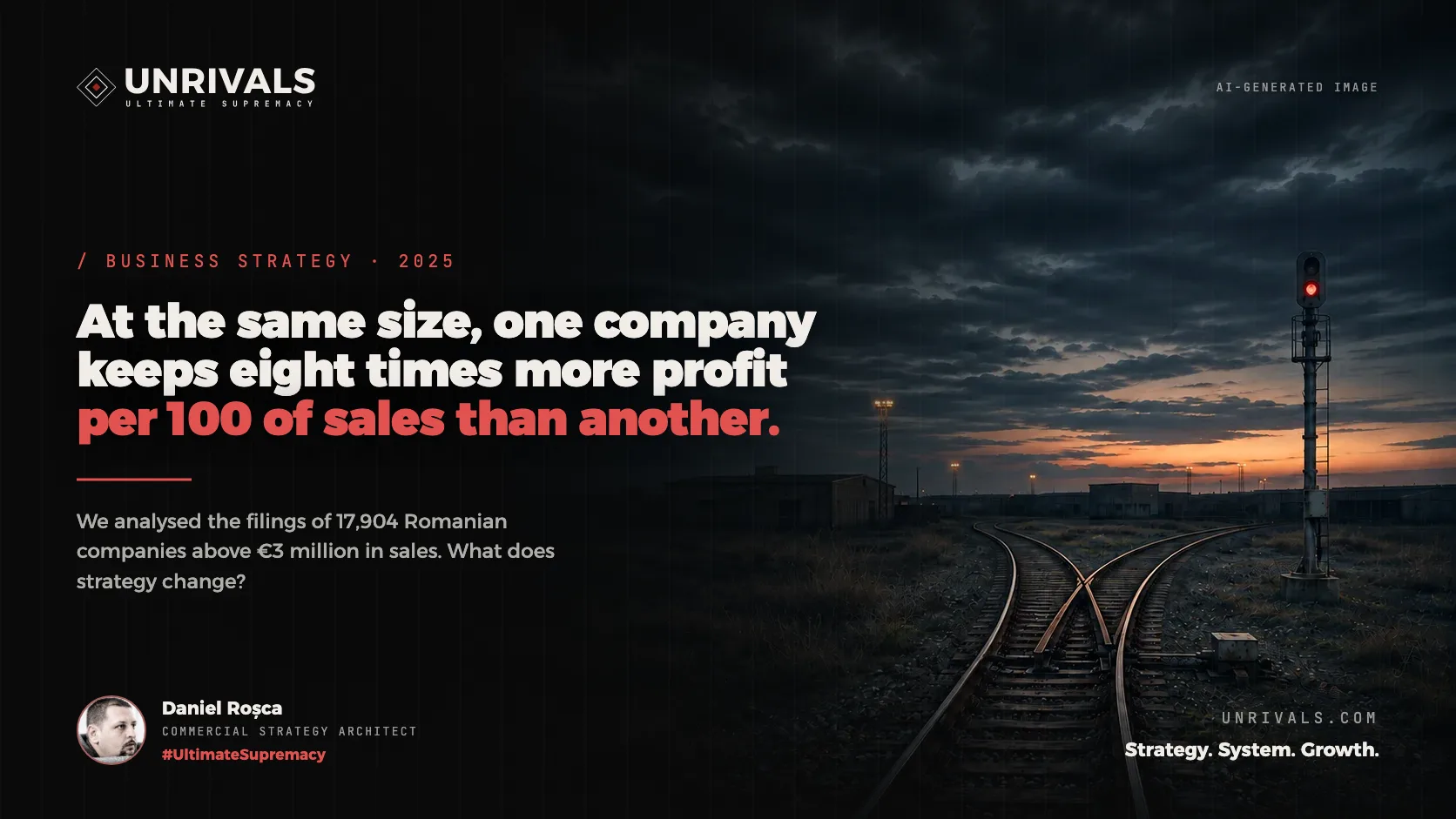
TL;DR. We analysed the financial statements of the 18,421 Romanian companies that sold more than €3 million in 2024. Of these, 17,904 also filed accounts for 2025. In 2025 these companies sold 6% more together and kept 3.8% less net profit. At the same size, some companies keep eight times more profit from every 100 of sales than others.
Business strategy decides which side of that gap your company ends up on. At this size the company already sells. It has a product, clients, a team and a history in its market. The next question is how much it keeps from every euro sold, and how hard it would be for a competitor selling the same thing to replace it.
This article explains what a business strategy is, how it differs from a business model and a business plan, what the filings say about companies above €3 million, and how we build a strategy step by step on a real case.
What is a business strategy, and how is it different from a business plan?
A business strategy says what you choose, and a business plan says how you execute. The plan holds numbers, deadlines and budgets. The strategy sits above it and decides which markets, which clients and which buying criterion deserve the money in the plan. A good plan on the wrong strategy takes the company quickly to the wrong place.
In practice, a business strategy answers five questions. The first is where you compete, meaning which markets, segments and channels. The second is the criterion on which the client picks you, whether that is price, the risk you remove, speed or specialisation. The third is what you will not do, meaning the clients and orders you turn down.
The fourth question asks for the hard-to-copy asset that supports the choice. The fifth ties everything to money and shows how the strategy appears in margin, in what is left after costs. A strategy that cannot answer the fifth question is only an intention.
A business model is the mechanism through which the company makes money, meaning who pays, for what, how often and at what cost.
The strategy picks the position, and the business model shows whether that position can pay for itself. Two companies in the same category can run very different business models, and we look at an example with numbers below.
Marketing strategy comes after both. It translates the chosen position into messages, channels and budget. We wrote about it separately, in the guide to marketing strategy for companies above €3 million. When the business strategy is missing, the marketing strategy ends up inventing one on the fly, campaign after campaign.
The classic analysis tools, from SWOT to Porter’s five forces, help with the diagnosis. They map the ground, and the choice stays with the leadership team. We gathered them on a single map in the article on business frameworks and the limits of each.
| Question | Business strategy | Business model | Business plan | Marketing strategy |
|---|---|---|---|---|
| What it answers | Where you compete and why the client picks you | How the company makes money | What you do, with what budget and by when | What you tell the market, on which channels |
| Who decides | The founder and the leadership team | The founder and the finance director | Leadership, with each department | Marketing, on the direction set above |
| Horizon, in our practice | Three to five years | As long as the position holds | One year, reviewed every quarter | One year, with quarterly campaigns |
| What it produces | A few written choices, plus what you refuse | The revenue and cost formula | Budgets, targets and owners | Messages, a calendar and a media budget |
| The sign it is missing | The company accepts any order | Sales rise while profit falls | Each department pulls in its own direction | The message changes with every campaign |
The bottom row is the most useful one for a founder. The absence of strategy shows up in the accounts first. You see it in a margin that shrinks during a good year and in orders accepted only to keep the factory busy.
Why does a company above €3 million need a different strategy?
Above €3 million, higher sales no longer bring higher profit on their own. We analysed the financial statements filed with Romania’s Ministry of Finance by the 18,421 companies that sold more than €3 million in 2024. Of these, 17,904 also filed sales for 2025, and those are the companies we follow from here on.
Those 17,904 companies sold 5.97% more in 2025 than in 2024, in local currency and before inflation. In the same year their combined net profit, after subtracting losses, fell by 3.81%. From every 100 lei of sales, the same companies kept 5.13 lei of profit in 2024 and 4.66 lei in 2025.
- 5.97% more sales on the same 17,904 companies
- −3.81% combined net profit after subtracting losses
- 4,090 companies sold more and earned less out of the 10,567 that grew
Source · financial statements filed with Romania's Ministry of Finance for 2024 and 2025, 17,904 companies with sales above €3 million in 2024, UNRIVALS calculation
The red card in the figure above shows the problem. Of the 17,904 companies, 10,567 sold more in 2025 than in 2024. For 4,090 of them, or 38.7%, net profit was still lower than a year earlier. Growth bought with margin only postpones the problem by a year.
Losses multiplied too. The number of companies in the same group that closed the year at a loss rose from 1,682 in 2024 to 2,110 in 2025. We explain the mechanism at length in the article on why net profit margin falls as revenue grows, where we follow the same companies over several years.
Short-term pressure also shows in how leaders spend their time. Across the 4,454 chief executives in 95 countries surveyed for the PwC Global CEO Survey 2026, CEOs report spending 47% of their time on issues with a horizon of less than a year. Only 16% goes to decisions that look more than five years ahead.
In the Central and Eastern Europe edition of the PwC CEO Survey 2026, the split is 57% and 11%. Strategy is exactly the work that urgent matters keep postponing. In Central and Eastern Europe, urgent matters take a larger share of the CEO’s time than the global average.
The same PwC regional study from 2026 recalls a result from the previous edition. At that point, 52% of chief executives in Central and Eastern Europe believed their business would not be economically viable in ten years if it stayed on its current path.
What do the filings from 2019 to 2025 say about the companies that grew?
The large companies of 2019 ended up in four very different places by 2025. We took all 11,824 Romanian companies that sold more than €3 million in 2019 and looked for them in the 2025 filings. We compared sales in euros, before inflation, to see how each one travelled over six years.
Of the 11,824 companies, 2,642 at least doubled their sales by 2025. Another 5,036 grew, but by less than double.
A third group of 2,933 companies sold less in 2025 than in 2019, and 1,342 of them dropped below the €3 million threshold. The remaining 1,213 companies do not appear with sales in the 2025 filings.
- At least doubled their sales 2,642
- Grew, but by less than double 5,036
- Sold less than in 2019 2,933
- No sales filed for 2025 1,213
Source · financial statements filed with Romania's Ministry of Finance for 2019 and 2025, sales in euros, not adjusted for inflation, UNRIVALS calculation
The red bar shows the companies that doubled their sales. The gap between the groups shows in margin too. From every 100 lei sold in 2025, the 2,642 companies kept 6 lei of profit together. The 5,036 that grew less kept 4.63 lei, and the 2,933 that sold less lost 1.10 lei together.
The starting point is the more interesting part. As early as 2019, the group that would go on to double its sales kept 5.13 lei out of every 100. The group that would later shrink kept only 2.12 lei. The thin margin appeared years before the decline.
A filing does not say what strategy each company had. It does say that, from the same starting size, the paths split sharply, and that margin announced the split early. For a founder, this year’s margin is a signal of where the company will be five years from now.
Even within a single year, the gap between companies of the same size is wide. Line up the 17,904 companies by their 2025 margin, and the company exactly in the middle kept 4.14 lei out of 100. The company at the edge of the bottom quarter kept 1.17 lei, and the one at the edge of the top quarter kept 9.43 lei.
The same size can keep eight times more from every unit of revenue. Size does not explain the gap, because all 17,904 companies sit above the same threshold. The gap comes from what they sell, who they sell to and the criterion they are chosen on, which are exactly the things a business strategy decides.
What is a business model, and why does it matter more than size?
The business model decides who keeps the value created in a category. The clearest example in our audits comes from the steel cable category. In the UNRIVALS audit of Cablero Steel Group, published in Romanian in September 2026, we placed side by side the public 2025 filings of companies in the same category.
Cablero, a manufacturer with its own plant, had 2025 sales of 17.17 million lei, with 40 employees and a net margin of 7.34%. Cotraco Rom, a distributor in the same category, had sales of 16.55 million lei, with 13 employees and a net margin of 7.17%. Sales and margin are almost identical for the two companies.
The difference appears in sales per employee. Cablero sold 429,296 lei per employee and Cotraco 1,272,930 lei, or 2.97 times more. Cotraco has no plant. It does own the commercial relationship with the client, and more of the value created in the category stays there. The plant keeps Cablero in the market, but needs many people and lowers sales per employee.
In the Cablero audit we wrote that the manufacturer’s only way out is to sell what leaves the plant at a price its name can support. Our own reading goes further. The problem will not be solved by lower costs or more orders, because it lies in the way the client compares offers.
At Cablero, the hard-to-copy asset already existed. The company states publicly that it produces one linear metre of cable every 1.6 seconds, and it supplies Groupe Renault through Dacia Pitești, UAMT Oradea and the DIY chain Dedeman.
On the audit date, 2 September 2026, none of this proof sat on the homepage.
Instead, the homepage advertised free delivery on orders above 1,000 lei, the promise of a shop. The company had the proof of an industrial supplier and spoke like a corner store. Business strategy starts right here, in the gap between the value a company creates and the value the client sees.
The audit proposed moving the comparison away from diameter and price per metre, towards the economic consequence of a failure. An industrial buyer really pays for an operation in which a broken cable can stop production. The line that sums up the proposed direction is “We don’t sell the cable. We sell what is not allowed to fail.”
How do we build a business strategy for a company above €3 million?
We start from what the company can defend and we finish in margin. Our method follows a fixed order in six steps. Each step closes one question before the next, and the order matters more than the tools used at each step.
- Economic advantage What the company has that is hard to copy
- Customer value Which risk or cost you remove for the client
- Attribute The criterion you want to be compared on
- Proof The figure, client or document that supports it
- Buying criterion How the attribute enters the offer and the sale
- Margin What the choice is worth, per year
The red link in the diagram, margin, ties strategy to money. A strategy without the size of the stake never reaches the board agenda. The first five steps prepare the decision, and the last one shows the founder what it is worth, so it can be compared with any other investment the company could make.
Economic advantage comes first. The question is what the company has that cannot be copied easily, and the answer must be verifiable in operations. At Cablero the answer was the plant, the production speed and the automotive approvals. The list the whole category claims, “quality, competitive prices, fast delivery”, does not belong here, because anyone can say it.
This is where we apply another pillar of our doctrine, SIGNAL DOCTRINE™, infrastructure before marketing. Its statement says that a company rarely has a marketing problem and far more often lacks infrastructure, meaning systems, channels, positioning and a brand foundation. Marketing placed on a weak base burns money. The diagnosis comes before any campaign.
Customer value is the second step. The advantage is translated into what it protects for the client, because a purchasing director buys the peace of mind of his own operation, and your plant interests him only as proof. At Cablero, the value for the client is production that does not stop.
The attribute is the third step and the hardest.
The company picks a single criterion on which it wants to be compared and remembered. The test is simple. If a competitor can say the same sentence word for word, that sentence is not your attribute. We wrote separately about the difference between a real and a claimed competitive advantage, with the six-month test.
This step is governed by the pillar we consider the essence of the method, cognitive ownership. The final goal is for a company to own the mental space of its category, so that when the need arises, the market comes to it on its own. A category without an owner is the least expensive opportunity in any market.
At Cablero, the audit found exactly such a category. Searches for the category were few, and no competitor had claimed it. On 2 September 2026, ChatGPT with web search recommended Cablero first on both general questions tested about suppliers in the category, a recommendation that rested, among other sources, on a press article from 2021, while Google ranked it tenth.
Proof only comes after the attribute, because the attribute decides what the proof has to demonstrate. An industrial buyer needs certifications, tolerances, capacities and references, and all of them must exist. Without a central idea, the company presents thirty capabilities and leaves the client to work out alone why they matter.
The buying criterion is the step in which strategy enters the sale. The attribute has to change the way the client compares offers at the very moment of the decision. Our rule is to test the position on one product and one channel for ninety days, and only then extend it to the whole range.
For a founder, the hardest part is getting these choices to exist outside his own head. A strategy that only the founder can explain cannot be applied by the team. We described the problem in our article on the founder bottleneck that stops a business from scaling.
Where does strategy get lost between paper and sales?
A strategy that never reaches sales remains a presentation. Of the 243 chief sales officers and senior sales leaders surveyed by Gartner, in a study published in May 2025, only 45% say their organisation met several of its 2024 strategic goals.
In the same 2025 Gartner survey, 49% of sales leaders say their definition of a qualified lead differs greatly from the one used by marketing. Strategy breaks exactly at this point. Leadership has chosen a target client, marketing brings in a different one, and the sales team closes whatever it can.
This is where the third pillar we apply in every business strategy comes in, efficiency through strategy. Its statement says that the marketing budget serves development, meaning the strategy and architecture of the company, while endlessly optimising the same channel keeps the company under the same ceiling. The right strategy lowers the real cost of each new client.
When margin falls, the natural reflex is to cut costs or to fine-tune existing campaigns. Both moves work under the old ceiling. Optimising the same position improves the numbers under the same ceiling. The jump only comes when the criterion on which the client chooses you changes.
Timing matters. In the PwC Global CEO Survey 2026, only 30% of chief executives said they were confident about revenue growth over the next twelve months, down from 38% in 2025 and 56% in 2022, according to the same PwC study.
In a year of lower confidence, the temptation is to postpone strategy until the market calms down. The 2025 filings show the risk of that delay. The companies that grew without defending their margin sold more and kept less, and the gap has already reached their profit.
Which layers does a business strategy sit on, from layer L1 to layer L4?
A business strategy is decided at the top and tested at the bottom, in sales. We work on four layers. In layer L1 the company attracts attention and requests for quotes, and in layer L4 it decides what it stands for in the market. Between them sit the commercial process and the AI Brain, the memory of the company.
- L4 · Positioning and category Chooses the criterion the client compares you on
- L3 · AI Brain Keeps the figures, the proof and the decisions taken
- L2 · Revenue and commercial process Carries the position into offer, price and qualification
- L1 · Performance marketing Brings in requests on the chosen position
Layer L4 is where the strategy itself lives. This is where the company chooses its attribute, the category it enters and what it refuses. Without a decision on layer L4, the other layers optimise something undefined. Every investment below then repeats the price comparison, only with more expensive tools.
Layer L3 is what we call the AI Brain, the place where the company keeps its verified figures, its proof, its decisions and the reasons behind them. A strategy written down here can be used by every person on the team and by every AI program that writes on the company’s behalf.
Layer L2 is about money. Here the position becomes an offer, a pricing logic, client qualification criteria and material for the sales team. This is also where the break from the Gartner survey closes, because marketing and sales work on the same target client.
Layer L1 is the one everyone sees, with the ads, articles and campaigns that bring in requests. On a clear position, the same budget brings clients who already know why they are choosing you. Without one, layer L1 buys attention for a company that clients still compare on price.
What is one point of margin worth to your company?
One point of margin equals 1% of annual sales, every single year. For a company selling €3 million a year, one point is worth €30,000 a year. For one selling €10 million, it is worth €100,000 a year.
Across the 17,904 companies we analysed, the gap between the company in the middle, at 4.14 out of 100, and the one at the edge of the top quarter, at 9.43, is close to 5.3 points. On sales of €3 million, those 5.3 points are worth close to €159,000 a year.
The calculation shows the size of the stake without promising any result. That is how we work in every audit. Each figure comes from public filings, and the decision stays with the leadership team. The stake then raises a simple question, namely what has to change in the way the client compares your offer.
That is why VANGUARD™ starts from the company’s position and margin, before any campaign. The programme is built for companies that already have a product, clients and traction, but are far too easy to compare with the alternatives in the market. The first three months build the strategic, brand and commercial foundation, with no additional media budget.
Commercial activation starts in month four, on a position already validated against the company’s internal data. The order is the same as in the six steps above. The foundation comes before the promotion budget, so every euro spent stays in the market’s memory.
What can you do with your company’s strategy this week?
Write your company’s strategy on a single page, in five lines. The first line says where you compete. The second says the criterion on which the client chooses you. The third says what you refuse. The fourth names the hard-to-copy asset, and the fifth says what one point of margin is worth at your level of sales.
Then open your 2025 accounts and work out how much net profit you kept from every 100 units of sales. Compare the figure with the three markers above, meaning 1.17 at the edge of the bottom quarter, 4.14 in the middle and 9.43 at the edge of the top quarter, for companies above €3 million.
The second exercise takes an hour. Look up the latest public accounts of your main competitor and divide its sales by its number of employees. Do the same for your company. A large gap says that one of you owns something the other does not.
If you cannot write the second line without words like “quality” or “reliability”, the company does not yet have a buying criterion of its own. That line is the first place where margin is lost.
Frequently asked questions
What is a business strategy, in short?
A business strategy is the set of choices through which a company decides where it competes, which criterion the client chooses it on, what it refuses to do, and how the whole choice shows in margin. The business plan comes after it and turns those choices into budgets, deadlines and owners.
What are the four key business strategies?
The most widely used classification comes from Michael Porter, who describes cost leadership, differentiation and focus on a niche. Focus splits into cost focus and differentiation focus, which gives the four types. For a company above €3 million, the practical question is whether clients recognise its criterion of differentiation.
What are the 5 P’s of strategy?
The 5 P’s of strategy are the five meanings described by Henry Mintzberg, namely strategy as a plan, as a ploy against a competitor, as a pattern of repeated decisions, as a position in the market and as a perspective on the world. For a founder, position and pattern matter most, because they show what the company actually does.
What is the difference between a business strategy and a business model?
The strategy chooses where you compete and the criterion on which the client picks you. The business model shows how you make money from that choice, meaning who pays, for what and at what cost. Two companies can share a growth strategy and run very different models, like the manufacturer and the distributor in the Cablero example.
Who can help with the business strategy of a company above €3 million?
UNRIVALS works on the business strategy of companies above €3 million through the VANGUARD™ programme. It costs €7,497 per month and starts with a six-month pilot, in which positioning, the offer, the commercial system and measurement are built. At the end, the company decides whether the programme continues, and everything built stays with it.
What choice do you make before the next budget?
Every new budget repeats the old choices unless someone changes them. Before next year’s budget, it is worth writing the five lines of the strategy and working out the stake of one point of margin. Only then does the question of how much to spend, and on what, make sense.
If you want an outside view of how the market compares your company today, ask for a diagnostic. We will show you, on public data, where value is lost between what your company creates and what the client sees.
What VANGUARD™ solves
VANGUARD™ takes the company out of price comparison and carries its position into margin. The company receives its positioning and brand architecture, its offer and pricing logic, its commercial system and monthly measurement, built by the same team on the same strategy.
The programme costs €7,497 per month, plus €3,700 once, at the start. It begins with a six-month pilot, and on the first day of month seven the company decides whether the programme continues. The brand, the website, the commercial processes and the data built along the way stay with the company.