Content marketing means a company consistently publishes information its buyers find useful, such as articles, case studies, guides, data analysis, video or a newsletter, so that it gets found, understood and chosen before it sells anything. The content answers the questions buyers ask themselves before they start looking for a supplier.
TL;DR. Content marketing builds what the market believes about your company, from a few proven ideas said the same way for a long time. We analysed the filings of 12,067 Romanian companies whose main activity was advertising in 2024, up from 7,037 in 2019. The sellers of advertising have multiplied while the buyer’s time has not, so people remember the company that fits in one sentence.
Maybe your product is good, yet it does not sell itself. Maybe you want the company to be seen in a market where competitors keep multiplying. Or maybe in your industry sales come from referrals, so marketing seems to change nothing.
All three come down to perception. This article shows what content marketing does to it, why volume does not move it, and how we build it, with data and cases you can check yourself.
What is content marketing, and how is it different from advertising?
Content marketing is the steady publishing of information buyers look for on their own. Advertising buys attention for a message, while content earns it with an answer. The difference shows over time, because a good article keeps working for years and an ad stops the day the budget does.
The formats are familiar. Blog articles, case studies, guides, data-led analysis, video, podcasts, a newsletter sent through email marketing, social media posts, trade fair decks and material for partners. Some bring traffic from Google through SEO, meaning the way a page is written so people can find it. Others reach the buyer directly, by email or through a salesperson.
Content marketing never works alone. It is one part of a marketing strategy for a company above 3 million euros, next to positioning, pricing, channels and sales. Without the strategy above it, content ends up answering questions nobody asked, in a tone nobody chose.
The definition in the AI summary Google shows for this search talks about valuable, relevant, free content that attracts an audience and turns it into customers. It is accurate. It leaves out, though, the effect that matters most for a B2B company.
Every piece you publish adds to what the market believes about you. A buyer who reads three of your articles forms an idea of who you are, how seriously you work and whether you understand their problem. That idea stays after the tab closes, and it decides whether they call you or move on to the next supplier.
So we treat content as a tool of perception, meaning the way the market sees you and remembers you. Traffic and requests for quotes come after, as effects. The order matters, because a company that only measures traffic ends up publishing whatever gets clicks, and clicks say nothing about what stayed in the buyer’s mind.
What are the elements of content marketing that actually shape perception?
Four elements do the work, and they come in a fixed order. An idea you want to own, proof that makes it credible, answers to the questions buyers ask before they buy, and a sequence that teaches the market step by step. Formats and channels carry these four elements. On their own, they carry nothing.
Formats, audiences and calendars are real elements too, and they are also the parts a competitor can copy most easily. The idea and the proof are harder to copy, because they come from inside your company, from your numbers, your customers and your operations.
That is why the rest of this article spends little time on formats. A case study and a LinkedIn post can carry the same idea, and the buyer will remember the idea long after forgetting where they read it.
Why does more content buy less attention?
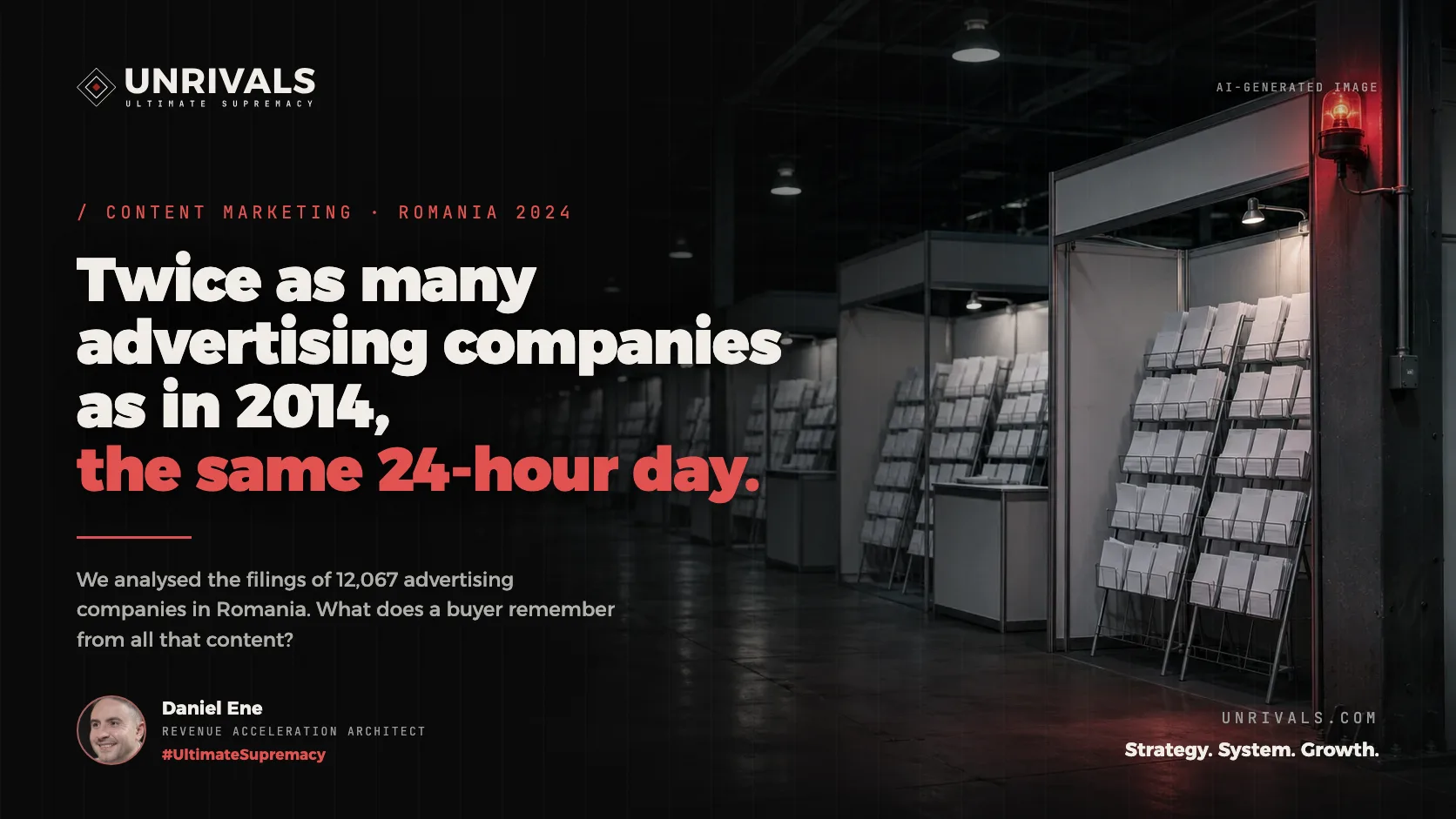
Companies selling advertising keep multiplying, while the buyer’s time stays the same. In Romania, 12,067 companies whose main activity is advertising reported revenue in 2024, according to filings submitted to the Ministry of Finance, compared with 7,037 in 2019 and 5,772 in 2014. Their number doubled in ten years, while the buyer’s day stayed at 24 hours.
- 2014 5,772
- 2019 7,037
- 2024 12,067
Source · filings submitted to the Romanian Ministry of Finance for 2014, 2019 and 2024, NACE activity code 7311, advertising, companies with revenue, UNRIVALS calculation
The red bar is 2024. Together, those 12,067 companies sold 2.9 billion euros of services, and half of them invoiced less than 37,557 euros over the whole year. It is a market of many small players, which means many voices speaking at once, to the same buyers.
Add in-house marketing teams, founders posting on LinkedIn and, for the last three years, software that writes for them. The latest Content Marketing Institute research on B2B marketing, surveyed between June and August 2026 among 861 B2B marketers, shows what generative AI brought to their work.
Among the marketers surveyed by Content Marketing Institute in 2026, 78% say AI gave them speed, 44% volume and only 17% quality. The authors frame it with the old production rule, fast, good or inexpensive, pick two. More content, written faster, means more noise in the same market.
Where people read is changing too. A Pew Research Center study on Google’s AI summaries, published in 2025 and based on the March browsing of US users, found that people clicked a traditional result in 8% of visits that showed an AI summary. Without a summary, they clicked in 15% of visits.
On the links inside the summary itself, the same Pew Research study from 2025 counted clicks in just 1% of visits.
That changes the rules. An article that repeats what others say no longer earns the click, because the summary already gives the generic answer. Attention goes to the text that says what the summary cannot. A number of your own, a case anyone can check, a judgement you stand behind.
For a founder, the conclusion is reassuring, even if it sounds backwards at first. You need things those thousands of voices cannot say, because they do not have your data, your customers or your plant. Their volume cannot catch up with you there.
What does content marketing build in the buyer’s mind?
It builds an opinion of your company, formed before the first call. In a Gartner survey of B2B buyers, published in 2025 and based on 632 buyers, 61% said they prefer a buying experience without a sales rep. They do the rest of the journey alone, on websites, in articles, in reviews and in AI answers.
The same Gartner survey from 2025 found that 69% of buyers saw inconsistencies between the supplier’s website and what the salesperson told them. Buyers compare everything. When the website says one thing and the seller another, trust drops in both, and the company loses exactly what it hoped content would win.
In SIGNAL DOCTRINE™, our working doctrine, we call the goal cognitive ownership. It means owning the mental space of your category, so that when the need appears, the market comes to you on its own.
We explain the idea in depth in our piece on cognitive ownership, and content marketing is one of the few tools that builds it without paying for every impression.
Perception exists anyway, built by you or by others. Our guide on what the market believes about you before you say anything shows how it forms from small signals, which the company does not always notice. Content is the signal you control best.
An opinion forms when the same idea comes back, proven each time. That is why we start every piece from why the company matters, following Simon Sinek’s Golden Circle. A buyer remembers why a company is useful to them more easily than its list of services.
The panel sums up how we work. We look for what the company already has and has not told anyone yet. Sometimes it is a production figure, sometimes a major client buried on the About page, sometimes a margin competitors cannot match.
What does a company with real value and invisible content look like?
It looks like a profitable plant that nobody has anything to quote about. The same pattern shows up in two audits we published in 2026, one for a dairy producer and one for a clinic chain, both in Romania. Each has something rare in its market, and each leaves it unsaid, for people and for machines.
Therezia Prodcom, a dairy producer from Pănet, runs a net margin of 11.51%, against a 5.2% category average, according to our Therezia audit. On 10 September 2026, Ahrefs, the tool that measures search visibility, counted two citations of its domain in AI answers in Romania, against 128 for a processor in the same county.
- 11.51% net margin against a 5.2% category average
- 2 citations in AI answers against 128 for a processor in the same county
- 149 visits from Google a month, roughly on eight keywords, four of them the company name
Source · UNRIVALS Therezia audit, public filings, Ahrefs and DataForSEO, Romania, 10.09.2026
The red figure tells the story. Out of everything the company built, machines cited two pages. According to the same Ahrefs reading, the website drew roughly 149 visits from Google a month, on eight keywords, four of which were the company’s own name. On the category keywords, where new buyers search, the company did not show up at all.
Therezia has a system competitors cannot easily copy, its milk collection network across the surrounding villages. The move proposed in the audit puts that system up front, in numbers, meaning how many villages, how many families, how many litres. Plus pages that answer the questions buyers ask before they buy, so machines have something to cite.
The second case comes from another industry. Doctor SKiN has 2,970 Google reviews with a 4.85 rating and seven clinics in Bucharest. On 10 September 2026, in our test, ChatGPT with web search did not name it for either of the two category questions we tested, and Gemini did not cite it at all, according to our Doctor SKiN audit.
On 8 November 2026, the site’s robots.txt, the file of rules for bots that read web pages, still blocked GPTBot, ClaudeBot and Google-Extended by name. Through those rules, OpenAI, Anthropic and Google are asked not to use the pages for their AI models. The reputation exists, and some of the systems that feed AI answers are told to stay out.
Value you do not publish does not exist for the buyer who searches. In both cases, the proof already exists and stays unspoken. That has a cost, paid by every ad. The buyer has to work out alone why they should pick the company, and that effort behaves like a tax.
In our doctrine we call it the cognitive tax, the effort each impression demands before it makes sense. An unclear brand pays it on every click, and we showed what it costs in money in our piece on why an unclear brand makes every client more expensive. Good content lowers it, because it makes understanding easier.
How AI engines read a website, and what helps them cite a company, we cover separately in our guide to generative engine optimization. For content marketing, the rule is simple. What a machine cannot read, it cannot recommend.
How do we do content marketing at UNRIVALS?
We build it as a system, with four moves repeated on every piece. We choose the idea, find the proof, write the answer nobody else has, and make sure both people and machines can read it.
Since October 2026, every new article goes through a check before the first word. We make sure the topic does not already exist on our own site, so we do not compete with our own pages in Google.
Then we require two or three facts that do not appear in Google’s top three results, and at least two numbers we calculate ourselves from company filings.
The rule comes from a question Google asks in its guide to helpful content, “Does the content provide original information, reporting, research, or analysis?” The figures on 12,067 advertising companies in this article are exactly that kind of information.
At the start, depth matters more than pace. In our doctrine, a company nobody knows yet gains more from one thoroughly documented case study than from ten articles written in a hurry. Pace comes later, once the market already links an idea to you.
We learned the part about machines on our own website.
On unrivals.ro, the llms.txt file, a summary of the site written for AI models, went unread for as long as it was not declared in robots.txt. Once it was declared, recognised AI crawlers, the bots that read pages for AI models, started requesting it the very next day.
That lesson changed how we work. A text for machines only counts if you tell them where it is. Since then, any new file for AI agents is declared the same day it goes live, and the next day we check whether the bots found it.
The same principle runs our social series. Each post starts from a single idea and rests on a real source, a study, a filing or a case, that the reader can check. The idea comes back from one piece to the next while the source changes, so the market hears the same proven thing in different ways.
What are the steps of a content marketing strategy that works in B2B?
The strategy that works proves a single idea, piece by piece, for years. In practice a content marketing strategy has six steps, in the order below. Each one closes a question before the next, and a company that skips a step ends up publishing a lot and being remembered little.
- The idea What you want the market to believe about you, in one sentence
- The proof Which number, case or document backs that sentence
- The questions What buyers look for before they ask for a quote
- The order What they learn first, what comes next, what comes last
- The channels Where your buyer reads, online and offline
- The measure What changed in what the market says about you
The red link takes the most patience. A change in perception shows only after many months. The first five steps are decisions and documentation, and the sixth tells you, a year later, whether the idea took hold.
The idea is the sentence you want buyers to repeat when they recommend you. Its test is simple. If a competitor can say the same sentence word for word, it is not yours. “Quality, competitive prices, fast delivery” fits the entire category, so it helps nobody choose you.
The proof is what makes the sentence credible. At a plant it can be production capacity, a well-known client or a rare certification. At a clinic, reviews and treated cases. Proof is found inside the company.
In four of the five problem patterns we see in our audits, the fix moves, lifts or names something the company already has, buried on a secondary page or in a folder.
The questions are the ones buyers ask before requesting a quote. How much it costs, how long it takes, what the risks are, how to choose between two suppliers. A page that clearly answers one of them becomes a page Google and AI engines can cite, and the buyer arrives with trust already earned.
The order comes from a principle we apply to every client, the market is educated gradually, in sequence. Each stage has its own goal.
The first article makes an introduction, the second explains, the third shows the proof, and the request for a quote comes at the end. A company that asks for the order in its first text burns stages and loses a buyer it has not yet won.
Channels follow where your buyer actually reads. For an industrial manufacturer, the decision may run through a trade fair, a catalogue left with a distributor, or one director forwarding a link to another. Where sales come from referrals, content arms the client who recommends you, and a well-written case study travels on its own.
The measure tells you whether the idea reached its destination. We describe it below, separately, because it needs numbers other than traffic. The difference between the two ways of doing content is clearest side by side, in the table below.
| The question | Content made for volume | Content made for perception |
|---|---|---|
| Where it starts | The posting calendar | The sentence you want to own |
| What you publish | What competitors publish | What only you know, with numbers and cases |
| How you pick a topic | Whatever is trending | The buyer’s questions before a quote |
| Who writes | Whoever has time, or an AI tool | Someone who knows the buyer and the proof |
| What you measure | Impressions, likes, clicks | Branded searches, AI citations, sales questions |
| What is left after a year | Many pages, little memory | One idea the market links to you |
Which layers of the company does content marketing work on, from layer L1 to layer L4?
Content marketing starts at the top, with positioning, and works across every layer. We work on four layers of a company, from layer L1, where attention is bought and earned, up to layer L4, where the company decides what it stands for. One of them, layer L3, is the AI Brain, the company’s memory.
- L4 · Positioning and category Decides the idea every piece repeats
- L3 · AI Brain Keeps the proof, the numbers and the approved wording
- L2 · Revenue and sales process Hands the seller case studies and answers
- L1 · Performance marketing Brings traffic and requests through articles and posts
The red layer, L4, is where the sentence gets chosen. Without a positioning decision, content repeats the category’s noise. This is where the company settles what it wants to own in the buyer’s mind, and every layer below carries that choice further, with its own tools.
Layer L3 is what we call the AI Brain, the place where the company keeps its proof, verified numbers and approved wording. This is where AI becomes useful for content. It works on what the company knows for certain, so it writes fast and has something solid to stand on.
Layer L2 is the sales layer. Here content moves from marketing to the seller, as case studies, answers to objections and analyses the seller sends after a meeting. This is also where the gap from the Gartner survey closes, because the website and the seller finally say the same thing.
Layer L1 is the one everyone sees, the articles, posts and ads that bring traffic. When content is made in a hurry, it stops here. We describe how the four layers fit together in our piece on marketing architecture.
How do you measure the effect of content marketing on perception?
You measure what the market says about you, alongside how many people show up. Four signals tell you whether the idea is taking hold, namely searches for your company name, citations in AI answers, the first questions in sales conversations, and quote requests that arrive without any ad.
Branded searches grow when people remember you and look you up directly, without going through category keywords. You can see them in Google Search Console, for free. AI citations you can track with tools like Ahrefs, or by asking ChatGPT and Gemini the same category questions yourself, once a month.
The third signal sits with your salespeople. A prospect’s first questions show what they read before. A prospect who asks about the proof you publish has read your content and believed it. A prospect who asks only about price reached you without knowing what sets you apart.
The fourth signal is the hardest to earn. Quote requests that come in without an ad and without a call from you show that the market has started to come to you on its own. It is the clearest sign of cognitive ownership, and the slowest of the four.
The Content Marketing Institute study from 2026, quoted above, also points the long-term direction. Asked what builds trust, 64% of B2B marketers chose consistently useful, practical information, and 59% demonstrated expertise. Both take time, and both are hard to copy for a competitor who publishes just to be present.
What can you do with your company’s content this week?
Write down the three sentences you want the market to repeat. The first says which problem you solve best. The second says what proof you have. The third says why it matters to the buyer. Then take the last ten pieces your company published, articles, posts or presentations.
Hold each piece against the three sentences and ask whether it supports at least one of them. Count how many pass. If fewer than half do, the company publishes a lot and builds little. If you cannot write the three sentences at all, the problem sits in positioning, and content cannot fix it alone.
The second exercise takes ten minutes. Ask ChatGPT, with web search on, “who are the best manufacturers of” followed by your category, in your country. Note whether you appear and which companies appear instead. The answer shows what the machine has already learned about your market.
Frequently asked questions
What is content marketing, in short?
Content marketing is the steady publishing of information buyers find useful, such as articles, case studies, guides, video or a newsletter, so a company gets found, understood and chosen before the sale. Over time, it builds what the market believes about your company.
What are the main types of content marketing?
The most common types are blog articles, case studies, guides, data analysis, video and podcasts, newsletters, social media posts, and material for salespeople and partners. The right type depends on the buyer’s question and on where they read.
What are the 5 C’s of content marketing?
There is no single standard list, and different authors name different five C’s. What matters more is the order behind any list, meaning one clear idea, proof that makes it credible, and consistency over time. A checklist of five words is useful only once those three are settled.
How long does content marketing take to work?
First effects in Google can appear after a few months, depending on how contested the topic is. A change in perception takes longer, and we plan it over at least a year of steady publishing on the same idea. A well-documented case study can shorten the path, because salespeople use it straight away.
Can you do content marketing with AI?
Yes, with one condition. AI writes fast, yet the Content Marketing Institute study from 2026 shows only 17% of marketers named quality among the main gains from AI. The result is good when AI works from the company’s verified proof and numbers, and a person who knows the buyer decides what gets published.
What do you want the market to believe about you a year from now?
Every piece your company publishes casts a vote for an opinion of it. Some votes you cast on purpose, others came from a posting calendar or a text written in a rush. The first job is to read what your content says today, end to end, like a buyer who does not know you.
Then you choose the idea you want to own and prove it, piece by piece. If you want an outside view on what your content signals today, ask for a diagnostic. We will show you, on public data, what the market believes about you and which proof is missing from what you publish.