
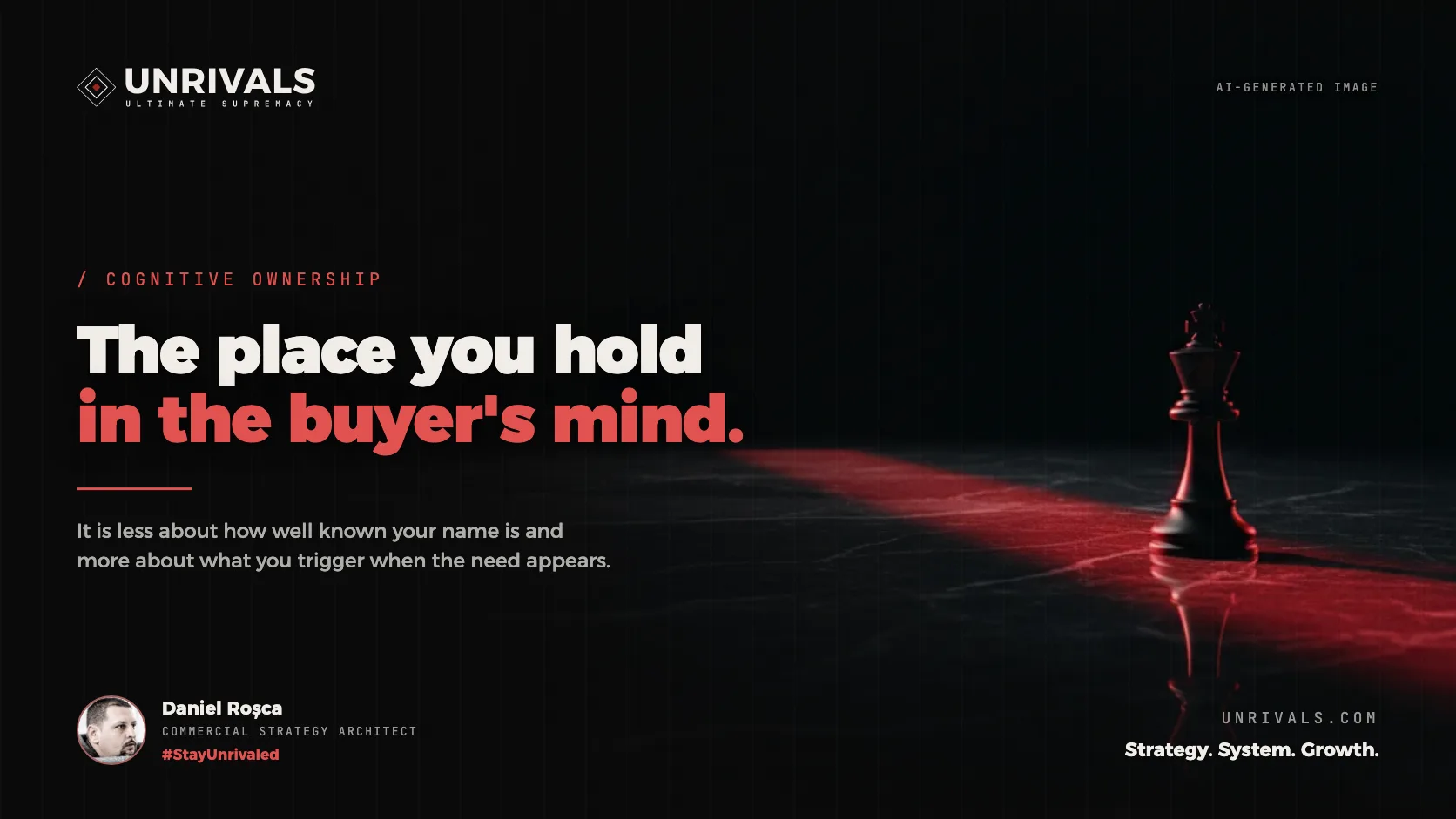
Cognitive ownership is the position a company occupies in a buyer’s mind when they think about a specific problem. It is less about how well known your name is and more about what you activate in the customer’s mind at the moment the need arises.
If, when the head of a ten-million-euro company thinks about “how do I escape competing on price”, your name is the first that comes to mind, you own the cognitive position of that category.
One clarification before we go further, because the term travels in two different worlds. In medicine, “cognitive” describes brain function and gets measured through clinical testing. Here we are talking about brand strategy, and the unit of measurement is the position you hold in the memory of a market.
TL;DR. Cognitive ownership means you are the first solution the market thinks of when the problem you solve appears. It differs from awareness, which measures whether people know you, and from positioning, which is your internal declaration of what you are. Cognitive ownership is what happens in the buyer’s mind, not in your marketing materials.
Why does cognitive ownership matter more than brand awareness?
Brand awareness tells you they know you exist, while cognitive ownership tells you that when the problem appears, you are the first they think of. The difference seems subtle and still produces entirely different outcomes in the sales cycle, because one is measured in people reached and the other in decisions taken without you in the room.
A founder who has heard of ten consulting firms does not invite all ten to the table. He calls one or two, three at most. That decision is made before any formal evaluation process, based on what is stored in his memory about who solves his specific problem.
If you are not in that short list, the performance campaigns that follow cannot add you to it, because the list was already formed without you. You can bid on the right keyword and pay for the click, and the buyer will still return to the name he already carried in his head.
The numbers confirm the mechanism. A Bain & Company study conducted with Google across more than 1,200 US B2B buyers, published in 2022, found that 80% to 90% of them already have a shortlist of roughly three vendors before formal research begins, and that 90% ultimately buy from a vendor on that initial list.
Most of the competitions you lose were lost before you knew they existed. That is the difference between being an option and being the option.
| Dimension | Brand Awareness | Positioning | Cognitive Ownership |
|---|---|---|---|
| What it measures | How many people know you | What you believe you are | What you activate in the buyer’s mind |
| Where it lives | In reach data | In internal documents | In the buyer’s memory |
| Who builds it | Media budget | Strategy team | The market, through repetition |
| What it produces | Recognition | Declared differentiation | Selection before the process starts |
| How it is measured | Brand lift, reach | Share of voice | First set called to the table |
The table shows why the three do not substitute for one another. Awareness is bought with money, a positioning statement is written in a morning, and cognitive ownership accrues only through the repetition of one idea over a long stretch of time, which is precisely why no budget can accelerate it.
This is where the first pillar of our methodology sits, and it leaves no room for interpretation. The target is the mental space of the category, and a company that owns it has no reason to compete on ads or on price, because when the need appears, the market comes to it on its own.
The practical consequence is that your budget changes destination. You stop paying to be found at the moment of search and start paying to already be there when the search begins. The first option gets more expensive every year, as more bidders crowd the same words. The second keeps lowering its own cost, because what you built last year is still working this year.
How do you build cognitive ownership in B2B?
Cognitive ownership is built through consistent repetition of a message anchored on a specific problem, not by covering multiple categories at the same time. The more precisely defined the problem you claim to own, the faster you can hold that position in the market’s mind.
Repetition matters because, at any given moment, almost nobody in your market is buying. Professor John Dawes of the Ehrenberg-Bass Institute formulated the 95:5 rule in 2021 for LinkedIn’s B2B Institute, which holds that roughly 95% of the B2B buyers in a category are out of market at any one time and 5% are in it.
Dawes illustrates the rule with the real rhythm of these decisions, noting that a company changes its principal bank or law firm about once every five years. What you build today in the minds of the 95% is the only thing working for you when their turn comes.
There are four paths through which a B2B company builds this position.
The declared specialty is the first. Not “we do marketing”, but “we build the system that extracts companies from price competition”. That specificity creates the link between the buyer’s problem and your name at the exact moment the buyer formulates it, whereas a broad description breaks the link at precisely that moment.
Category-defining content is the second. When you write the article that best explains a concept relevant to your client’s problem, you become the canonical source of that concept. Whoever owns the definition of a category ends up owning its authority as well.
AI citability is the third and one of the newest paths. Large language models are queried directly by buyers looking for solutions, and if their answers include your name in connection with the problem you solve, cognitive ownership is being built even in spaces where you are not present and cannot bid.
That path has become measurable rather than merely plausible. Research by Bain, conducted with Dynata across 1,117 respondents in December 2024, found that roughly 80% of people rely on zero-click results in at least 40% of their searches.
A growing share of the decision now forms inside a synthesised answer that the buyer reads without visiting any website at all. If your name does not appear in that answer, you have not lost a click, you have lost the entire consideration round.
The hardest to build and hardest to copy is consistency over time. A coherent message repeated over 12 months builds more cognitive ownership than four different messages in the same period, because cognitive ownership is, at its core, a phenomenon of repeated storage, and memory does not reward variety.
On a correct foundation every euro invested stays as active memory, while on ephemeral advertising nothing remains. That is the second pillar of the method, the one that explains why the order of operations is not negotiable. Brand is built as a foundation for growth, rather than as decoration added once the campaigns are already running.
Cognitive ownership does not replace your marketing architecture, it is the foundation on which that architecture is built. You can construct the best campaign system and the most coherent funnel, but if the central message does not anchor a specific problem in the buyer’s mind, the system will run on a fragile substrate.
What role does the name play in occupying a mental space?
The name is the only brand element the market repeats without being paid to do it. That makes it the least expensive repetition channel you will ever own, for as long as the company exists.
The third pillar of the methodology holds that the attribute or the benefit gets encoded into the brand name itself, and from that point the advertising works on its own. The cascade runs from central attribute to company slogan and then to product naming, the way a dripping tap wears down stone.
Volvo encoded safety into its name and held it for decades, and UNRIVALS encoded supremacy into the company name itself. A descriptive name, one that merely states the category, forces the media budget to do all the work of association, because the name itself carries nothing beyond what is written on it.
The test is mechanical and fits inside a single meeting. Say the name out loud, then ask which word follows it in the head of somebody who does not work for you. If the answer is the category, you have a descriptive name. If it is a benefit, you have an attribute.
A name does not have to be replaced at every rebrand, it can be completed. A company with history loses its recognition capital if it abandons the name, but it can add an attribute that travels alongside it, much as a product brand can carry the benefit on behalf of the umbrella company.
The attribute works because it reduces the cognitive cost of the decision. A buyer who has to remember seven things about you remembers none of them, while one who has to remember a single word carries it into the meeting where the supplier is chosen.
What layers does cognitive ownership sit on, from L1 to L4?
Our methodology works across four layers, and cognitive ownership lives at the very top. The order matters, because it explains why most companies spend in the wrong place.
L1 is performance marketing, meaning ads, funnel and traffic. That is where a poor position first becomes visible, in the form of a cost per click that rises without explanation.
L2 is the revenue layer, meaning pipeline, offer design and selling. Attention turns into real conversations here, and an unclear message at L4 shows up as a long sales cycle full of education rounds.
L3 is AI orchestration, the decision engine that holds the company’s memory and the context of every client. It does not replace strategy, it makes strategy repeatable at scale.
L4 is positioning and category design, the layer where what the market believes about you gets decided. Cognitive ownership is won here and felt downward, at L2 and L1.
Construction runs from the bottom up, because a company matures through traffic, then revenue, then positioning. The message, however, is derived from the top down, from positioning to offer and only then to advertising.
That inversion explains almost every frustration inside a marketing budget. Most of the market operates only at L1 and L2, asks for leads now, and blames the channel when the numbers come out badly. The channel is not at fault, because it faithfully amplifies a position that was never built.
There is also a sequencing rule that comes down to patience. A market does not get educated by a single campaign, it gets educated gradually, and a message that skips stages asks the buyer to accept a category he has never heard of in one jump.
This is why work at L4 gets tested first on a single product and a single channel, over ninety days, and only then generalised. What works on a narrow segment can be widened, while what fails there does not get repaired by budget.
What does cognitive ownership look like on real companies?
The theory above only holds if it changes something in the operation. Here are three situations from our own work, each with the move that followed, so the point of intervention is visible.
At Cardio Clinic, a Romanian cardiology practice, the conversation did not start with campaigns, it started with the missing attribute. We encoded control into the product name, and the cardiac prevention programme became InfarctControl. The name says by itself what the patient receives, so the advertising no longer has to explain the concept from scratch.
At Infosan, an ophthalmology group, the assets existed and were not being claimed, which is a pattern we meet constantly. The umbrella received a single promise, “clarity for your family’s eyes”, and the product brands settled underneath it, KlariKid for children and ClariVision for adults. Each one owns a problem, and the umbrella transfers authority to both.
At Cablero, a cable manufacturer, the problem was the classic one for industrial suppliers. The communication rested on quality, good prices and fast delivery, which is the minimum definition of the category and can be claimed by any competitor.
The move was to shift the unit of value from the product to the economic risk being protected, and the proposed position became “we do not sell cable, we sell what is not allowed to fail”. The exit from a price war runs through language, not through discounts.
That pattern has a name in our own inventory of analyses, and it is called the assets exist but the language does not. We have seen it at Zeelandia, at Ivatherm and at Lactate Brădet, companies with a factory, a laboratory or a certification, all of them real and none of them claimed in the communication.
The distance between holding a proof and communicating it shows up directly in cost. A company that owns a laboratory and never talks about it pays to persuade the market of something it could simply demonstrate, while the competitor without the laboratory, who does talk about quality, ends up compared with it on equal terms.
One pattern repeats across these cases and across most of the 28 brand analyses we have delivered so far. In four of the five problem patterns, the solution adds nothing new to the company, it moves, elevates or names something that already exists inside it.
The conclusion is uncomfortable for anybody selling creativity by the metre. Branding does not create value, it makes value visible, and the hard work lies in finding the proof already sitting in the operation and raising it to the rank of primary message.
There is a proof we applied to ourselves as well. We declared the llms.txt file inside robots.txt on our Romanian domain and, in 2026, reads by AI crawlers rose from zero to roughly 32 per day. The file had existed all along, nobody had announced it, which is the same pattern transposed into infrastructure.
How do you know whether you own the cognitive position of your category?
The honest answer is that few founders know. They know they have satisfied clients and they receive referrals, but they do not know whether, at the level of the unserved market, their name activates anything at the right moment.
There are three signs that indicate the absence of cognitive ownership.
The first is that a prospect who contacts you cannot say exactly why they chose you and not someone else. They searched online, saw several options, and chose almost randomly. That means you have awareness, not cognitive ownership.
The second sign is that you are constantly compared on price. When cognitive ownership is missing, the buyer has no internal differentiation criterion and falls back on the simplest one available. An unclear brand produces exactly this situation, because the buyer cannot distinguish and so compares on the only parameter that is easy to compare.
This is also the mechanism by which a good company ends up trapped in a price war without ever deciding to enter one. It did not walk in, it was pushed there by the absence of an alternative criterion.
The third sign is that the sales cycle is long and includes multiple rounds of education. The buyer does not know why you are different and must be convinced during the process, not before it.
The window in which you can still intervene is narrow inside the process as well. Gartner measured in 2024 that a B2B buyer spends only 17% of total buying time in meetings with potential suppliers, with the rest going to independent research and internal discussion.
If that buyer is comparing three vendors, your team gets roughly five percent of the decision time. The rest plays out in your absence, and what works for you there is exactly what you built beforehand.
There is also a check you can run yourself inside an hour. Ask a language model who solves the problem you claim, in your market, and see whether your company name appears in the answer. If it does not, you now have a measurement rather than an impression.
What is the difference between cognitive ownership and brand positioning?
Positioning is your internal declaration about which space you intend to occupy in the market’s mind. Cognitive ownership is the outcome you reach when you repeat that declaration coherently and specifically enough that the market adopts it.
You can have a perfect positioning statement on paper and zero cognitive ownership in the market. The reverse is rarer, but some companies have built cognitive ownership without a declared strategy, through the accidental consistency of their message.
The distinction has practical consequences when you decide what to buy. A well-formulated brand positioning is the starting point rather than the final deliverable, and if the project stops at the positioning document, you have paid for the map without ever walking the ground.
A branding agency builds your identity elements and formulates your positioning. The criterion for choosing the right agency is exactly this, namely who understands that the ultimate objective is not the visual identity, but the cognitive ownership that identity is meant to support.
The relationship between the two is one of means and ends, and the comparison that describes it best remains the one between a map and a territory. Positioning draws the map, while cognitive ownership means you have actually arrived on the ground and the market finds you there.
There is one more link worth making explicit, because it connects message to memory. A message that starts from the reason the company exists is retained better than one describing the service, and the way the Golden Circle places WHY ahead of the product is the mechanism by which a position becomes memorable.
Frequently asked questions
Is cognitive ownership the same as brand awareness?
No. Brand awareness measures how many people recognise you. Cognitive ownership measures whether you are the first solution they think of when the problem you solve appears. You can have high awareness and zero cognitive ownership if the market does not associate your name with a specific problem.
How long does it take to build cognitive ownership?
It depends on how specific the message is and how consistently it is repeated. On a well-defined category with a coherent message, the first signs appear within six to twelve months. Broad categories or generic messages do not produce cognitive ownership, regardless of time and budget.
Can a small company own cognitive ownership?
Yes, and often more easily than a large one. A small company can claim a specific category that a larger company considers too narrow. Specificity is the most accessible way to build cognitive ownership without a large media budget.
What happens if you do not build the cognitive ownership of your category?
Someone else does. Markets do not leave a mental space unoccupied indefinitely. If you are not the canonical source for the problem you solve, the competitor who speaks more consistently on that topic will occupy the position, and you will compete on price for the attention of buyers who did not find you first.
How is cognitive ownership measured?
Most directly, through the first set called to the table. How many of your new prospects found you because they searched for a specific problem, rather than because they received a referral or saw an ad? Other signals include organic mentions, citations in AI answers, organic traffic on category-defining content and, indirectly, share of voice.
Can cognitive ownership be built without a media budget?
Yes, though not without consistency. Category-defining content and citability inside AI engines are the two paths that cost time instead of money. Budget accelerates rather than replaces, and a company publishing the same idea for a year travels further than one buying attention for three months.
If you want to see what the market says about your company when you are not in the room, ask for an audit.