
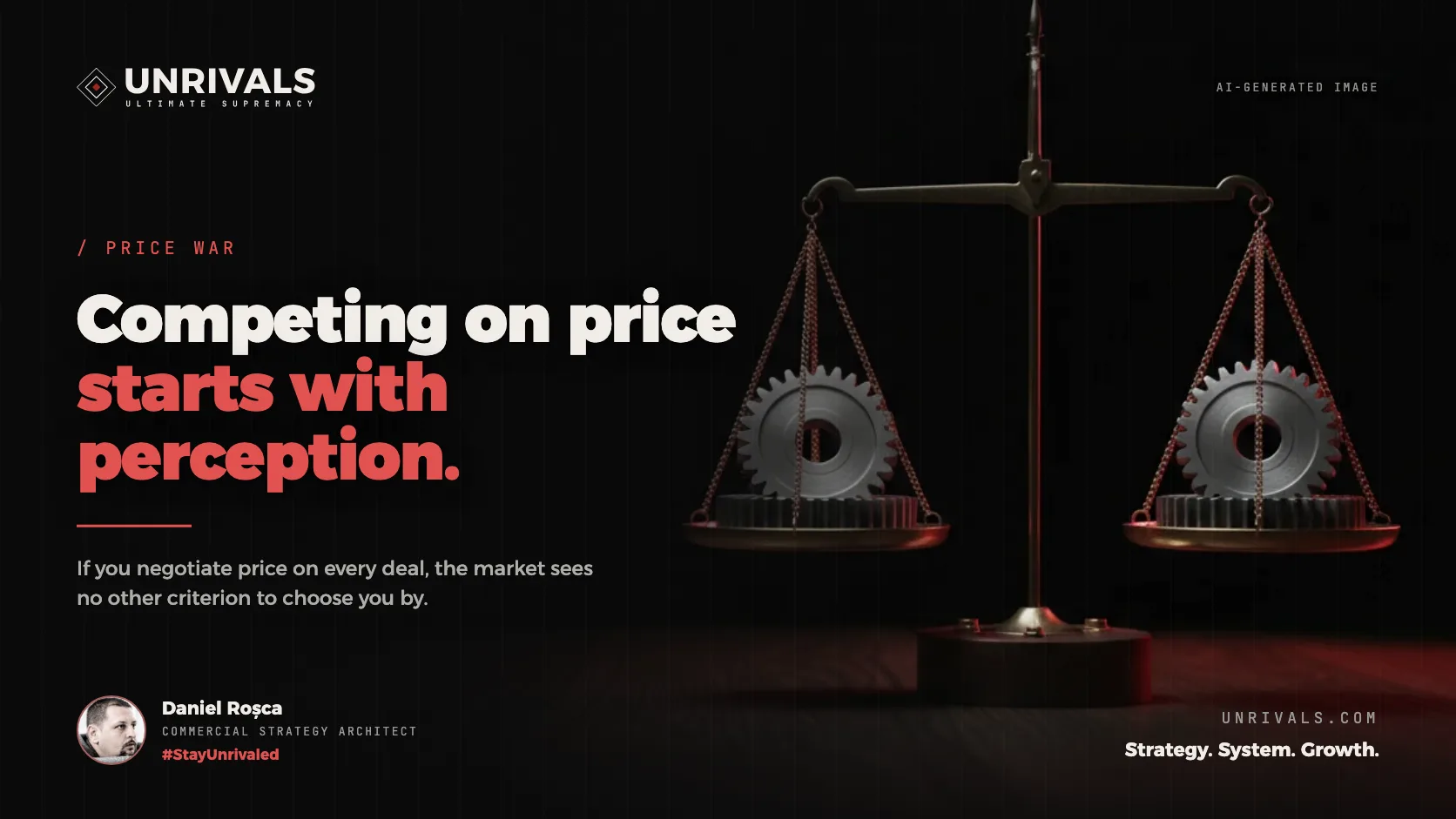
A price war is a situation in which companies in a category compete mainly through price cuts, and every reduction made by one player is matched by the others, until the margin of the entire category wears thin. Buyers gain in the short run, suppliers lose together, and after a while nobody remembers who started it.
TL;DR. A price war rarely starts with price. It starts at the moment the market can no longer tell you apart from the next supplier on the list, so price becomes the only criterion it can compare without effort. Discounting treats the symptom and feeds the cause. The way out is a positioning decision that gives the buyer a second dimension of comparison, namely what your company stands for.
Why do we start from the reason someone picks you, and only then from price?
We start from the reason because price is the answer the market gives when it has no other question to ask. A buyer looking at five identical suppliers does exactly what you would do in their place. They look for the simplest anchor to compare, and a number is easier to compare than anything else.
Our method starts from Simon Sinek’s golden circle, from WHY, then WHAT, then HOW, in that order. The principle we call golden circle in the UNRIVALS methodology Codex holds that communication which starts from meaning stays in memory, while a description of the service gets lost among the descriptions of every competitor.
Applied to pricing, the principle has a direct consequence. If everything you communicate is WHAT you sell, meaning the product, the specification and the delivery time, you hand the buyer a list of attributes any competitor can copy within a week. On a list of identical attributes, price is the only column where the values differ.
The reason a company deserves to be chosen is the one thing a competitor cannot copy overnight. That is why, before we talk about discounts, margins or campaigns, we look at what the market believes about a company before it ever asks for a quote.
What exactly is a price war?
A price war is a spiral, and that is what separates it from an ordinary promotion. A promotion has a start date, an end date and a goal. The spiral has none of them, because every price cut sets the precedent for the next one, with the customer as much as with the competitor.
The phenomenon is more common than it looks from inside a single company. According to the Simon-Kucher Global Pricing Study 2016, which surveyed 2,186 participants from 25 industries and more than 40 countries, 49 percent of companies say they are actively engaged in a price war.
That same Simon-Kucher study from 2016 reports that eight out of ten companies are worried about rising price pressure. In other words, half of them are already in the spiral, and nearly all of them feel it pulling downward.
The interesting part is what companies choose as a remedy. In the 2016 Simon-Kucher release, 66 percent rely on new products to escape price pressure, while 50 percent see better value communication as the most suitable option.
Both reactions make sense, and both can fail for the same reason. A new product launched without a clear position lands in the same comparison column as the old one. Better value communication changes nothing when the value belongs to the whole category, because then the competitor can communicate it just as well.
Who benefits from a price war?
In the short run the buyer benefits, and over the long run the advantage usually goes to the lowest-cost player, the one that can afford to bleed the longest. Mid-sized companies with their own plant, their own engineers and real fixed costs tend to pay the highest price for the spiral.
The arithmetic of discounting rarely gets written down, so here it is, on illustrative numbers. You have a €10,000 contract at a 40 percent gross margin, which means €4,000 of gross profit. The buyer pushes and you give up 10 percent. The deal closes at €9,000 and gross profit drops to €3,000.
You conceded 10 percent of the price and lost 25 percent of the profit in a fifteen-minute negotiation. At a 15 percent discount, gross profit falls to €2,500, a 37.5 percent loss. To make up the profit lost to a 10 percent discount, you need to sell a third more volume with the same team and the same cost to serve.
The spiral feeds itself through three channels. The first discount sets a precedent with the same customer, who comes back to the next order expecting the price to move. Other customers hear through the market that prices are flexible and start from a lower offer. The competitor sees it is losing ground and cuts too, and the cycle begins again.
Warren Buffett described the mechanism more plainly than any pricing textbook, in an interview he gave on May 26, 2010, to the Financial Crisis Inquiry Commission, now archived by the St. Louis Fed.
“The single-most important decision in evaluating a business is pricing power. If you’ve got the power to raise prices without losing business to a competitor, you’ve got a very good business. And if you have to have a prayer session before raising the price by a tenth of a cent, then you’ve got a terrible business.” Warren Buffett, 2010
Pricing power comes from the market having a reason to choose you even when you cost more, and that reason is built long before the negotiation starts.

What is a price negotiation actually telling you?
A price negotiation tells you that perception has already formed, before the sale began, and that it has formed against you. When the person across the table says “you’re too expensive”, the sentence in their head is “I don’t see why you and not someone else”, which is a statement about positioning spoken in the language of money.
Buyers form that opinion largely on their own. Gartner states on its B2B buying journey research page, which we consulted in September 2026, that 75 percent of B2B buyers prefer a rep-free sales experience.
The consequence for pricing is immediate. If three quarters of buyers would rather decide without a salesperson, the argument that was meant to justify your price never gets made. The buyer arrives with a conclusion already formed, and when that conclusion says “they’re all the same”, the negotiation happens in the only column left.
The same Gartner page, consulted in 2026, notes that 99 percent of B2B purchases are driven by organizational change. People buy steel cable, software or advisory work to solve an internal problem, and the company that names that problem better than the others leaves the price column without touching its price.
That is why the customer who negotiates hard is not a bad customer. They are a customer who entered your sales process without a solid reason to choose anything but the number. The process that should have built that reason failed earlier, in what they believed about you before they ever picked up the phone.
Cognitive ownership, as our Codex calls the principle, says exactly this. Its ultimate goal is not to compete on ads or on price, but to own the mental space of the category, so that when the need appears, the market comes to you on its own. A supplier who owns that space discusses terms, while everyone else haggles over the discount.
On which layer of the company does price actually break?
Price almost always breaks on the positioning layer, even though the symptoms show up on the layers below it. In the UNRIVALS methodology, a company has four working layers, and each one shows the price war differently. A correct diagnosis starts by seeing which layer holds the cause and which ones only carry the effects.
L1, performance marketing. This is where CAC, CPL, ROAS and conversion rate live. When the market cannot see a difference, every ad explains from scratch who you are, and the cost per lead climbs. On this layer the price war shows up as ads with a price badge, which attract exactly the buyer who compares costs and nothing else.
L2, revenue and commercial process. This is where the pipeline, the length of the sales cycle and the discount granted in negotiation live. The reflex discount sits on this layer. The salesperson gives in because price is the only argument available, and margin erodes deal after deal without any report showing the cause.
L3, orchestration and memory, meaning the AI Brain. This is where price objections from every conversation, the phrases on your website and what competitors say about themselves are collected. On this layer we run the competitor test on every sentence, mechanically, and keep a memory of what works, so the positioning decision does not depend on anyone’s impression.
L4, positioning and category architecture. This is where it gets decided which dimension you are compared on. When this layer is missing, the rest of the chain works against you, however well the ads are optimized. Most companies caught in a price war try to fix it on L1 or L2, while the break sits on L4.
The principle our Codex calls reducing cognitive cost connects the layers. It states that an unclear brand imposes a cognitive tax on every impression, and that reducing friction lowers CPC and CPL and raises ROAS. This principle is the bridge between branding and performance, and in our methodology the gap it closes is called the Confusion Tax.
In practice the Confusion Tax gets paid twice. Once in media, because the ad has to persuade someone who does not know why they would choose you. A second time in negotiation, because the person who reached you anyway arrives with price as the only criterion. The discount is the visible form of the tax, and the cost per lead is its hidden form.
What does leaving a price war look like when we run it on real companies?
Leaving a price war looks like moving the unit of value, from the product to the economic outcome the product protects for the customer. In our solutions library, price comparison is the problem pattern we find most often at diagnosis, and the move that follows is the same every time, applied differently.
The diagnosis is done from public sources, before any conversation with the company. We take the sentences on the website verbatim and run them through the competitor test. If a competitor could say them word for word, they are noise. Then we look for the proof the company already has and does not use, because the solution rests on what already exists inside the company.
The four cases below come from the Romanian market, where we work first. The mechanism travels well, though, because a mid-sized manufacturer in Romania, Poland or Ohio loses margin in the same order and for the same reason.
At Tamos, a furniture maker with its own plant in Zimnicea, net margin fell from 11.45 percent in 2024 to 4.20 percent in 2025, which we calculated from the public ANAF financial statements in August 2026. The site’s meta description opened with the Romanian word for inexpensive, and the market retained a single principle out of the five the company declared, namely price.
The move proposed in the positioning analysis we published for Tamos was to remove that word from the company’s own code and to create a reason to buy that is not price. Its in-house plant could mean control, durability, made-to-measure sizes and a guaranteed lead time, meanings nobody in the category was claiming.
At Cablero Steel Group, a steel cable manufacturer in Iași, the top bar of the website promised free shipping, free advice and fast delivery, the same promises made by the retailers who resell its goods. The figure no competitor could say, one linear metre of cable produced every 1.6 seconds, sat further down, published by the company and read by us in September 2026.
The territory proposed in the analysis we published for Cablero changes what is being sold. “We don’t sell cable. We sell what is not allowed to give way.” The industrial buyer is really paying for an operation that does not stop, and against that risk the price per metre becomes secondary.
At Pescado Grup, a fish products manufacturer, the company’s opening line spoke of tradition and quality, a promise of parity. The real proof, zero product recalls in 23 years, sat on the About page. For the category term for fish roe salad in Romanian, we measured 1,300 monthly searches in Ahrefs in August 2026, with no manufacturer on the first page of Google.
The proposed move was to raise safety to the level of a position, in a category where people fear exactly a recall, and to take the searched category that nobody owned. Comparison on weight and price stays possible, it simply stops being the only one.
The table below brings the four cases together. Three of them are positioning analyses we published, built solely on public data, and the fourth is one of our clients, with the result measured.
| Company | What the market saw | The move we proposed | Verifiable proof |
|---|---|---|---|
| Tamos | “Inexpensive”, in meta description and titles | A reason to buy that is not price | Net margin from 11.45% to 4.20%, ANAF 2025 statements |
| Cablero | Free shipping, fast delivery | From product to the protected operation | 1 metre of cable every 1.6 seconds, cablero.ro |
| Pescado | Tradition and quality | Safety raised to the level of a position | Zero recalls in 23 years, pescado.ro |
| Cardio Clinic | Ads with a price badge | From the cost of a test to the patient’s fear | +39.4% revenue, Jan-Apr 2026 vs 2025 |
At Cardio Clinic, our client, the 2022 ads described the cost of the service, with the price in a badge, and spoke to the patient who searches for the price of a Doppler scan and compares fees. Research revealed a second, larger audience, people who have a symptom and do not know what it means, and the message moved to the fear the clinic can remove.
The result, published in the Cardio Clinic method presentation, is a 39.4 percent rise in revenue in January to April 2026 against the same period of 2025, according to the client’s CEO dashboard. Impressions from searches for the clinic’s name grew 41.2 percent in May to July 2026 against the same period of 2025, measured by us in Google Search Console.
How to deal with price competition?
You deal with price competition by changing the criterion of comparison before you touch the price. The order matters, because a discount granted before a position exists simply moves the spiral one step lower. We work in five steps, in the order below, at every company.
The competitor test, on real sentences. Take the homepage, the sales deck and the email signature, and run every sentence through a single question. Could a direct competitor say this sentence word for word without lying? High quality, a dedicated team, competitive prices and fast delivery all fail at the first pass.
Digging up the proof. The proof that takes you out of the price column almost always exists inside the company already, buried on a secondary page, in an old article or in the heads of the engineers. Reference customers, production figures, certifications and an incident-free track record get raised to the level of the main message.
Moving the unit of value. Ask what your product protects inside the customer’s operation. A cable protects the continuity of a production line, a medical test protects a person’s peace of mind, and made-to-measure furniture protects a space nothing else can fill exactly.
One product, one channel, ninety days. A position is not launched across the whole range at once, because then nothing can be measured. You track rotation, average realized price and demand for the name, and you extend only after the numbers move.
The discount rule. A discount granted with nothing in return trains the customer to negotiate. One granted in exchange for volume, payment terms or a longer commitment remains a trade. The sales team gets the rule in writing, so nobody has to improvise under pressure.
These steps call for a leadership decision, because they touch what the company promises and what it refuses to promise, while the campaign budget stays where it is. That is why the conversation about leaving a price war belongs with the founder or the managing director.

Why won’t a better campaign get you out of a price war?
A better campaign amplifies the position you already have, and if that position says “we are like everyone else, only less expensive”, the campaign simply makes it louder. More posts, better ads and a more elaborate website can help, yet none of them changes the criterion the market uses to compare you.
The principle we call efficiency through strategy, beyond optimization, says that a marketing budget exists for development, meaning strategy and architecture, and not for endlessly optimizing the same channel. The right strategy lowers the real cost, CAC and CPC, further than any ad tweak can.
Applied to a price war, the principle explains why optimization hits a ceiling. You can shave a few percent off cost per click, test ten headlines and segment the audience more finely. All of that still works inside the same comparison column, and in the end the column decides whether the buyer chooses on price.
Differentiation through adjectives runs into the same limit. Premium, trustworthy, customer-centric and fifteen years of experience sound solid in a pitch deck, except that everyone says them. No company presents itself as mediocre and indifferent, so adjectives separate nobody from anybody.
Real differentiation is a position a competitor cannot claim without lying. It has a territory, a central attribute and proof the buyer can check without your help. When the position exists, the sales conversation shifts from “how much does it cost” to “why you and not the others”, and in that conversation price becomes a detail to settle.
There is one more test, harder than it looks. Call a satisfied customer and ask why they work with you rather than someone else. If the answer is vague, the position does not yet exist in the market. If it is specific and repeats across different customers, you have already found your differentiation, and what remains is to say it more clearly than they do.
We wrote separately about the link between unclear positioning and the real cost of acquisition, in our piece on how an unclear brand raises the cost of every customer. The mechanism by which a brand becomes commercial infrastructure is laid out in our guide to B2B branding.
If you want to see how a position turns into revenue without a bigger ad budget, we documented the mechanism in our case for growth without ads. The principle that ties all three together is explained at length in our article on cognitive ownership.
Frequently asked questions
How do I get out of competing on price without losing customers?
You get out gradually, by rebuilding perception over a few months. Start with your ideal customer, defined precisely enough that you can say who you are right for and who you are not. Adjust the message on the website and in sales, bring the proof into view and test the position on one product. Some old customers who came only for price will leave, and new ones will arrive with less negotiation.
How do I justify a higher price than my competitors?
A higher price is justified by the context built before the quote. If you have to defend your price during the pitch, the buyer did not learn before the meeting why you and not someone else. When the customer arrives asking “why you?”, the price difference becomes secondary on its own.
Can you give me an example of a price war?
A widely reported example is the electric vehicle market in China, where The Wall Street Journal wrote in June 2023 that NIO was stumbling as the EV price war took its toll. In B2B the pattern is quieter, visible in promises such as free shipping and competitive prices that every supplier in a category makes. Our published analyses for Tamos, Cablero and Pescado show what it looks like inside real companies.
Should I keep my price low so I don’t lose market share?
It depends on what you want to build. If your strategy is volume with low operating costs, a low price can be a deliberate choice. If you want margin, customers who stay and a predictable business, a low price without differentiation becomes a trap, because share won on price leaves for the first competitor who charges less.
How do I differentiate when the products look the same?
Products can look identical, and that is exactly when position makes the difference. Differentiation can come from context, meaning who you serve, from method, meaning how you deliver, from proof, meaning whom you have served and with what result, or from how you understand the customer’s problem. Two cable manufacturers deliver the same steel, yet only one can say it sells the continuity of an operation.
A price war is decided by what the market believes about you before it asks how much you cost. If you want to see which criterion the market uses to compare you today, ask for an audit.