
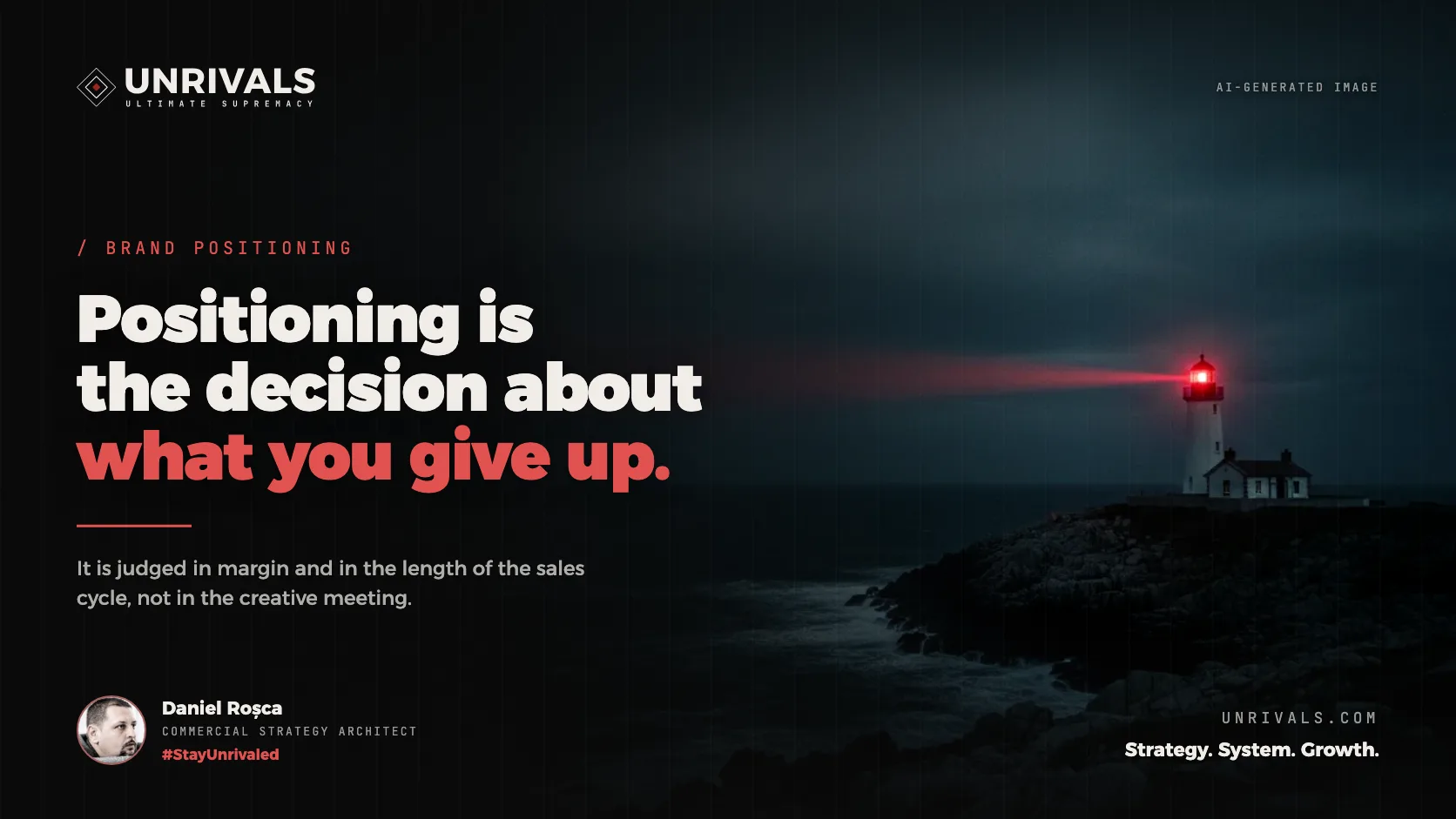
Brand positioning is the decision about the place your company occupies in a buyer’s mind relative to their alternatives. Formulated properly, it states who you address, on which problem, and, more importantly, who you leave out. Positioning is not the tagline, not the visual identity and not the list of values. It is a business decision with a direct effect on margin.
TL;DR. A positioning works to the extent that it excludes. If your statement does not make clear which clients you turn down and which services you do not offer, you do not have a positioning, you have a description. It is measured in three numbers, namely the margin you can hold, the length of the sales cycle, and the share of deals in which you were contacted first.
What is brand positioning, actually?
The term comes from the work of Al Ries and Jack Trout, who in 1981 published Positioning, the book that moved the conversation from product to perception. Their central idea holds, because the battle is not fought in the factory but in the buyer’s memory, and memory has room for very few names per category.
For a CEO, the useful definition is blunter. Positioning answers the question „why would anyone pay more for us than for the next option on the list". If the answer needs five minutes of explaining, positioning has not yet been taken as a decision.
Three things get confused with it routinely. Visual identity is the consequence, never the cause. The commercial message is how positioning shows up in one specific channel. Company vision looks inward, while positioning looks outward, at the buyer and at the competition.
The practical difference shows in how each decision gets approved. A visual identity clears a one-hour meeting, because nobody loses anything if it changes. A positioning clears only when somebody accepts that the company will stop selling something it sells today, and that shows up in next quarter’s revenue.
Why does positioning start from WHY rather than from the service list?
Because the service list describes what you do, and buyers do not buy descriptions. The golden circle model holds that passive memory retains meaning rather than enumeration, so meaning gets formulated before anyone talks about deliverables. A company that opens with „what" stays inside a category where everyone says the same thing.
Here is how that looks in the field. An industrial cable manufacturer we worked with sold inside a category defined by quality, fair pricing and fast delivery, which is the minimum anyone can promise. The territory that changed the conversation was „we do not sell cable, we sell what is not allowed to fail", because it moves the unit of value from the product to the economic risk being protected.
The thesis holding the whole argument together is short. Branding does not create value, branding makes value visible, and visibility converts into commercial margin. The company already owns the thing that differentiates it, it simply never says it, and what goes unsaid goes unpaid.
The gap between value created and value perceived has a name and a price. We call it the confusion tax, because it gets paid on every impression, in discounts, in extra rounds of explaining and in cost per click. It never appears as a separate line in any report, so it accumulates quietly, for years.
Why is positioning a business decision rather than a creative one?
Because every good statement costs something. Choosing one segment means giving up another, and giving up shows in revenue before it shows in margin. No creative review can take that decision, because nobody in a creative review answers for the quarter.
This is where the process breaks in most companies with more than 3 million euros in revenue. The statement goes through the marketing team, which has no authority to refuse clients, lands in a handsome document, and produces no operational consequence whatsoever.
A positioning that does not change the service list, the qualification criteria and the pricing policy is a vocabulary exercise. The test is mechanical. If no operational document changed after approval, the decision was never taken, it was merely phrased.
| Question | Description (does not position) | Positioning (decides) |
|---|---|---|
| Who you sell to | „Companies that want to grow" | „€5M+ manufacturers selling through distributors" |
| Which problem | „We help with marketing" | „We remove the company’s dependence on a single channel" |
| What you refuse | Unspecified | „No engagements under six months, no execution without strategy" |
| Why you | „Experience and quality" | „The only ones who enter before the tender document exists" |
| Internal consequence | None | Qualification criteria and pricing rewritten |
The test that settles it is the one I apply to any message. If a direct competitor can post the same sentence on their website without lying, the sentence positions nothing. The middle column passes that test at every company in the category, the right-hand column passes at none.
How do you measure a positioning, if it really is a business decision?
Through three indicators already sitting in your system. None of them requires new market research, because all three can be read from the last twelve months of contracts. When all three move the wrong way at once, the problem lives in the statement, not in the execution.
Margin held without negotiation. A positioning that works takes the conversation out of price. If the last ten contracts closed on a discount, the positioning never reached the buyer, whatever the website says.
Sales-cycle length. The more rounds of education a buyer needs, the less they understood about you in advance. Long cycles are usually the cost of ambiguity, paid in the sales team’s hours.
Share of deals where you were contacted first. This sits closest to the definition of positioning itself. Research by Bain & Company with Google, published in 2022 across more than 1,200 B2B buyers, found that between 80% and 90% of them hold a shortlist of roughly three suppliers before formal evaluation even begins.
The second half of the same study explains why that matters so much. Bain measured in 2022 that 90% of buyers ultimately choose from the list they had already formed. Positioning decides whether you are on the list before the list exists, and the rest of the budget funds a contest you were never invited to.
The context in which those lists form has changed, which raises the stakes. A Bain–Dynata survey from December 2024, across 1,117 respondents, found that roughly 80% of people rely on zero-click results in at least 40% of their searches.
The effect on traffic has already been measured. The same Bain research from 2024 records a 15% to 25% decline in organic traffic. Buyers form an impression from summaries and citations without ever visiting your site, so anything not clearly stated does not appear at all.
In B2B the squeeze is tighter still. Bain measured in September 2025 that click-through rates dropped by as much as 30% in some categories. Visibility budgets buy less attention every quarter, and the difference has to come from positioning rather than from bidding.
The figure that closes the argument comes from the same source. Bain’s 2025 study shows that 85% of B2B buyers choose from the list they already held in mind before searching. Search confirms a decision taken earlier, it does not produce one.
A statement that survives contact with the market has four components, in this order. Who it is for, against which alternative, what the buyer concretely gains, and on what proof. Each component answers separately to „how do we know", and the component without an answer is the one that collapses first in front of a sceptical buyer.
The sentence „for €5M+ manufacturers selling through distributors, unlike providers who deliver campaigns, we build the system that removes dependence on a single channel, proven across three companies in the category" is not elegant, but it is operable.
You make it elegant after verifying that each of the four components holds. The reverse order, beautiful first and true afterwards, produces taglines that do not survive their first meeting with a buyer who has a comparison sheet open on screen.
Which layer of the company does positioning get decided on?
We work companies across four layers, and positioning sits on the last of them. The order is not a methodological preference, it is a causal constraint, because each layer above determines how expensive the layer below becomes.
L1 is performance marketing, meaning paid and organic traffic, measured in cost per click, cost per lead and return on ad spend. This is where symptoms show, never causes. A company shifting budget between channels stays at L1 and pays to maintain the same ceiling.
L2 is the commercial layer, meaning pipeline, win rate, cycle length and how marketing hands over to sales. Most of the market operates exclusively on L1 and L2, which is where the feeling that „marketing does not work like it did three years ago" comes from.
L3 is the AI Brain, the orchestration layer where company memory, client profiles and methodology become machine-readable. It does not decide positioning, but it makes the L4 decision apply identically in every message, on every channel, without depending on what one person remembers on a busy day.
L4 is positioning and category design. It is the densest layer in the methodology and the only one from which the cost structure at L1 can genuinely change. Nine of the fifteen pillars of our doctrine live here, which says enough about where outcomes get decided.
The commercial consequence follows directly. An unclear brand levies a cognitive tax on every impression, and reducing it lowers cost per click while lifting return on spend. The bridge between branding and performance runs through L4, not through endlessly optimising the same campaign.
That is why the working order stays the same at every company. Infrastructure diagnosis, then attribute, then positioning, then marketing architecture, then proof, identity and commercial system. Skipping a step gets paid for at the next step, with interest.
What changes when the central attribute enters the brand name?
The work of communicating changes hands. When a central attribute sits inside the name, the advertising works on its own, because the name carries the benefit before anyone reads the message. Volvo encoded safety, and we encoded supremacy, by exactly the same mechanism.
The cascade has four steps, always the same. A central attribute, then the company tagline, then the product name, then every commercial material. The Chinese water drop, meaning one meaning repeated from different directions until the market retains it without effort.
The coherence test runs backwards, from materials toward the name. Take the last five commercial materials and check whether one word travels through all of them. If you cannot find it, the company has no central attribute, it has five messages cancelling each other out and a budget paying for all of them.
A company without one spreads sideways. We have seen it in a portfolio company whose offer covered categories with nothing in common, none of them claimed through a clear property. Width looks like ambition and behaves like dilution, because every new category splits the same finite attention.
At a cardiology clinic in our portfolio, 90% of patients were over 65 and the company had no tagline at all. The attribute chosen was control, the tagline became „your heart under control", and the flagship service was named InfarctControl.
The simulation run on their campaign structure indicates that a properly built product brand lowers cost per click by roughly four times. That number is an estimate on their campaign data rather than a result measured after implementation, so we treat it as an order of magnitude, never as a promise.
The second application comes from an ophthalmology clinic carrying very different segments under one narrow name. We separated the roles, with a mother brand transferring authority and two product brands, KlariKid for paediatrics and ClariVision for cataract surgery.
The stated target there was not awareness but cognitive ownership of the paediatric segment. We want the name to surface on its own when a parent in that city thinks about their child’s eyes, with no advertising in between. That is the finished form of a positioning that has landed.
The same mechanism appears outside healthcare. At a preserves manufacturer, the territory „three producers, three properties, only one is free and it is yours" moved the discussion from product to the mental space still unclaimed inside the category.
At a dairy producer running seven different formulations, the sentence that settled it was „seven formulations do not cover the margin, one standard does". Positioning forced a portfolio decision rather than a campaign, exactly as the table above describes.
The rule keeping this honest is provenance. We name companies only where the thesis is ours, and we publish numbers only when they come from a public, re-verifiable source. Whatever was said on a call stays on the call.
What are the signs that a positioning is not working?
Four of them, in the order they appear. None requires an external audit, because all four are visible from the weekly sales meeting. They always arrive in this sequence, and by the fourth one the bill is already large.
The first sign is prospects asking for comparative quotes. When a buyer puts you in a table alongside three other suppliers, they have told you they cannot see the difference. An unclear brand produces exactly this situation, and the table becomes the ground on which margin is lost.
The second is a sales team explaining a great deal at the start of every conversation. Long explanation is the cost of ambiguity, relocated from marketing into sales. It gets paid in hours, in stretched cycles and in good people tiring of the same introduction.
The third is offering services with no relationship to one another, because each arrived from one client’s request. A portfolio grown from requests rather than from decisions signals an absent positioning and, usually, a margin sliding for no obvious reason.
The fourth is the conversation reaching price within the first two meetings, which pushes you into a price war, where the winner is whoever holds the lowest cost structure rather than the best product. You do not exit that position through discounts, you exit it through language.
Positioning is the statement, and its result in the market is cognitive ownership, the moment your name surfaces on its own against the right problem. Between the two sit execution and consistency, repeated long enough for the market to retain them.
If you decide to work with a partner on this step, the criterion for choosing a branding partner is who understands that the final deliverable is the decision, not the brand manual. The manual takes three weeks, the decision is taken once and holds for years.
How do you build a positioning that holds?
You build it on proof the company already owns rather than on new promises. In four of the five problem patterns we meet at diagnosis, the solution adds nothing new. It moves, elevates or names something the company already had and never communicated.
The most frequent pattern looks like this. The company describes its offer through quality, fair pricing and fast delivery, which is the minimum definition of the category and available to every competitor. The move that follows shifts the unit of value from the product to the protected economic outcome. How this pattern looks phrase by phrase, across 18 audits of Romanian companies, is shown in the article on differentiation strategy and the unique selling proposition.
The second pattern is newer and growing fast. The company holds real assets, meaning a factory, a laboratory, an accreditation, certifications, and claims none of them in language. At a bakery ingredients manufacturer the diagnosis was phrased briefly, „you have the assets of a dominant position and the language of an interchangeable supplier".
The third pattern shows up inside answer engines. The company has no citations at all, sometimes because it blocks the crawlers itself in its own site rules. What follows is a set of pages answering pre-purchase questions, so the machines have something worth quoting.
The stake can be calculated, which changes the internal conversation entirely. At the Doctor SKiN clinic, the 2025 statement filed with the Romanian tax authority shows 400,376 lei of profit on 14.7 million in revenue, a margin of 2.72%. The calculation that follows is ours, on those figures.
The distance to an 8% threshold, which is our working assumption and not a promise, is worth around 776 thousand lei a year at the same revenue. We do not promise the outcome, we show the order of magnitude of the stake.
The final step is the easiest to skip. Positioning establishes what the proof has to demonstrate, so proof gets selected afterwards, never before. A company with large clients buried in an „about us" page holds the proof but not yet the positioning that would make it matter. The test that separates proof that lasts from proof a competitor can match within months is described in the article on sustainable competitive advantage.
The verification order stays the same at every company. First what it can demonstrate, then what it claims, and only at the end how it looks and where it communicates. Companies that invert those steps end up with an immaculate brand manual laid over a promise nobody internally can defend in front of a client.
Infrastructure comes before campaigns, in that order and not the other way round. Clients rarely have a marketing problem, they have an infrastructure gap, and marketing built on a poor foundation burns money with remarkable efficiency. That is why budget belongs in development rather than in endlessly optimising the same channel.
Frequently asked questions
Who decides positioning inside a company?
The CEO or the founder, because it involves refusals nobody else has the authority to make. The marketing team formulates and distributes it, but cannot decide it, and when it tries, the result carries no operational consequence.
How often does positioning change?
Rarely, and that is the point. A positioning needs years of repetition before it accumulates in market memory. It changes when the business model changes or when the category redefines itself, never when the team grows bored of the message.
Can we position on several segments at once?
Practically, no, not under the same brand. What works is an umbrella with product brands beneath it, each holding its own positioning. Trying to position one brand across three segments generally produces the absence of positioning across all three.
What does a wrong positioning cost?
It shows in margin and in cycle length, and the cost accumulates quietly. Companies usually attribute it to the market or to competitors, because it never appears as a separate line in any report and nobody is tasked with calculating it.
Is positioning the same as differentiation?
Differentiation answers „how are you different". Positioning answers „what place do you occupy in someone’s mind". You can be different in ways the market neither notices nor values, in which case you have differentiation without positioning.
Where does a company start if it has never run the exercise?
From an inventory of the proof it already holds, meaning clients, accreditations, capabilities, verifiable numbers. Only once you can see what you are able to demonstrate does it make sense to choose what you will claim, because a claim without proof collapses at the first serious meeting.
If you want to see how your company’s positioning reads from the outside, alongside your three closest competitors, request an audit.