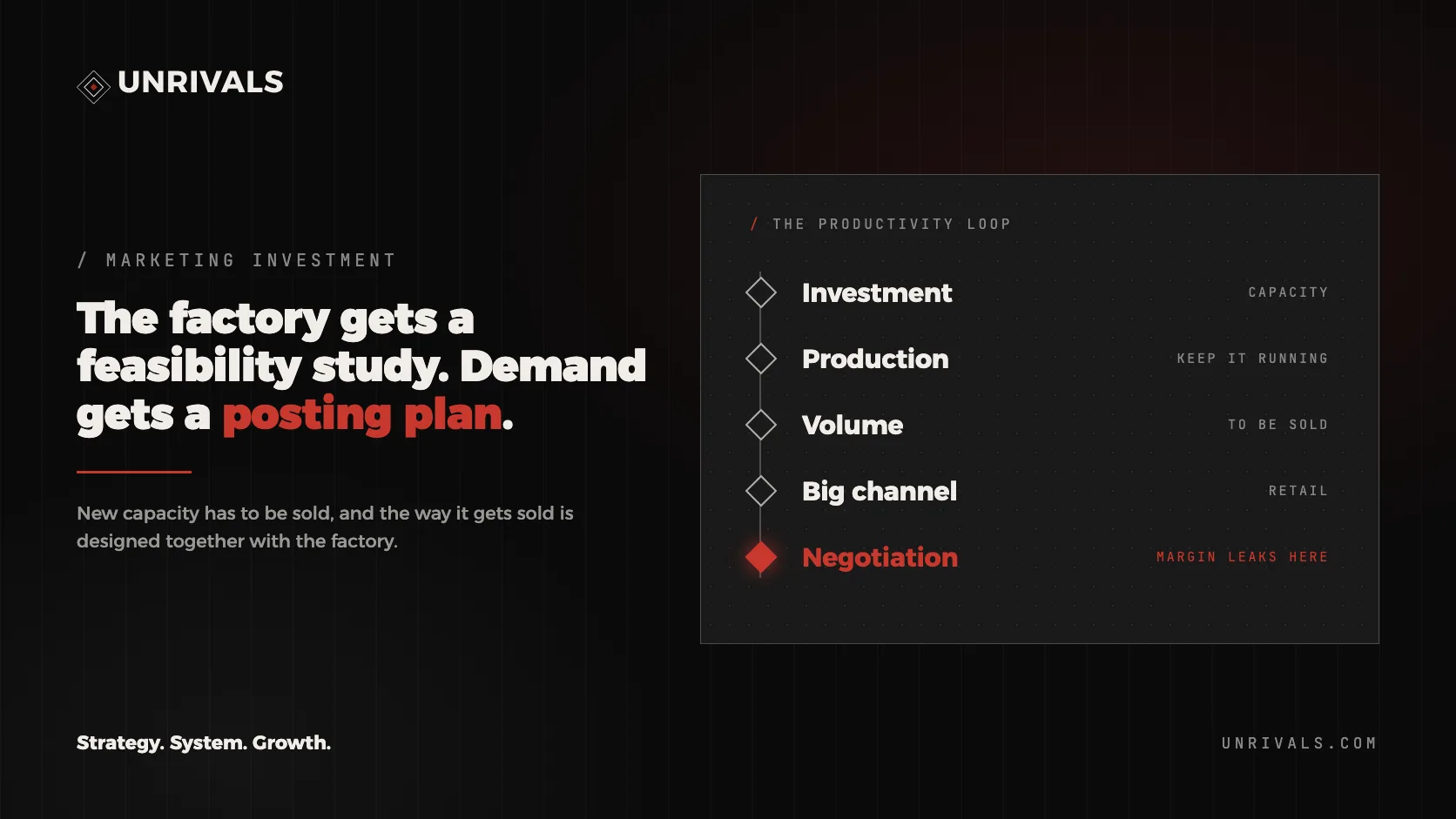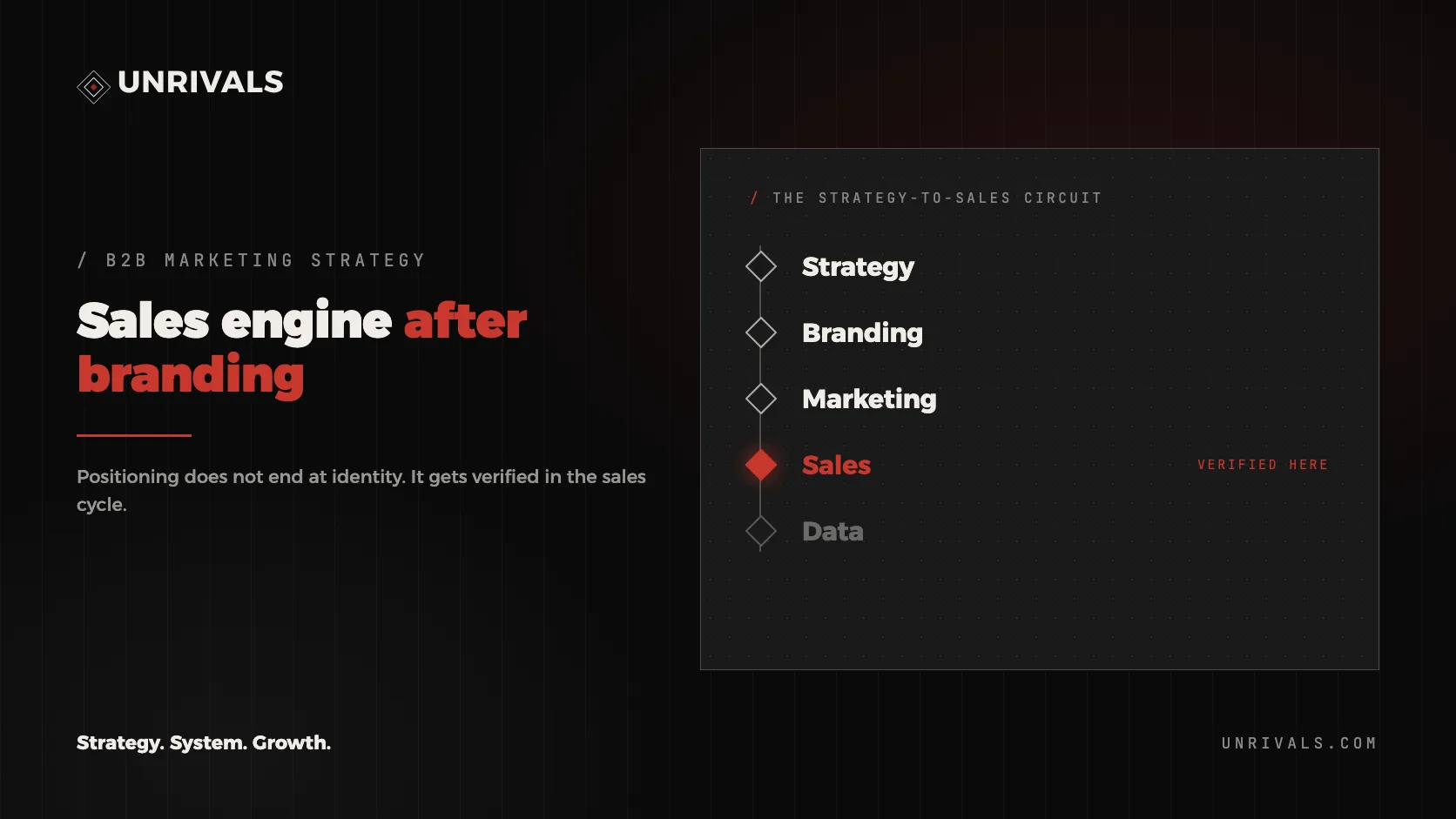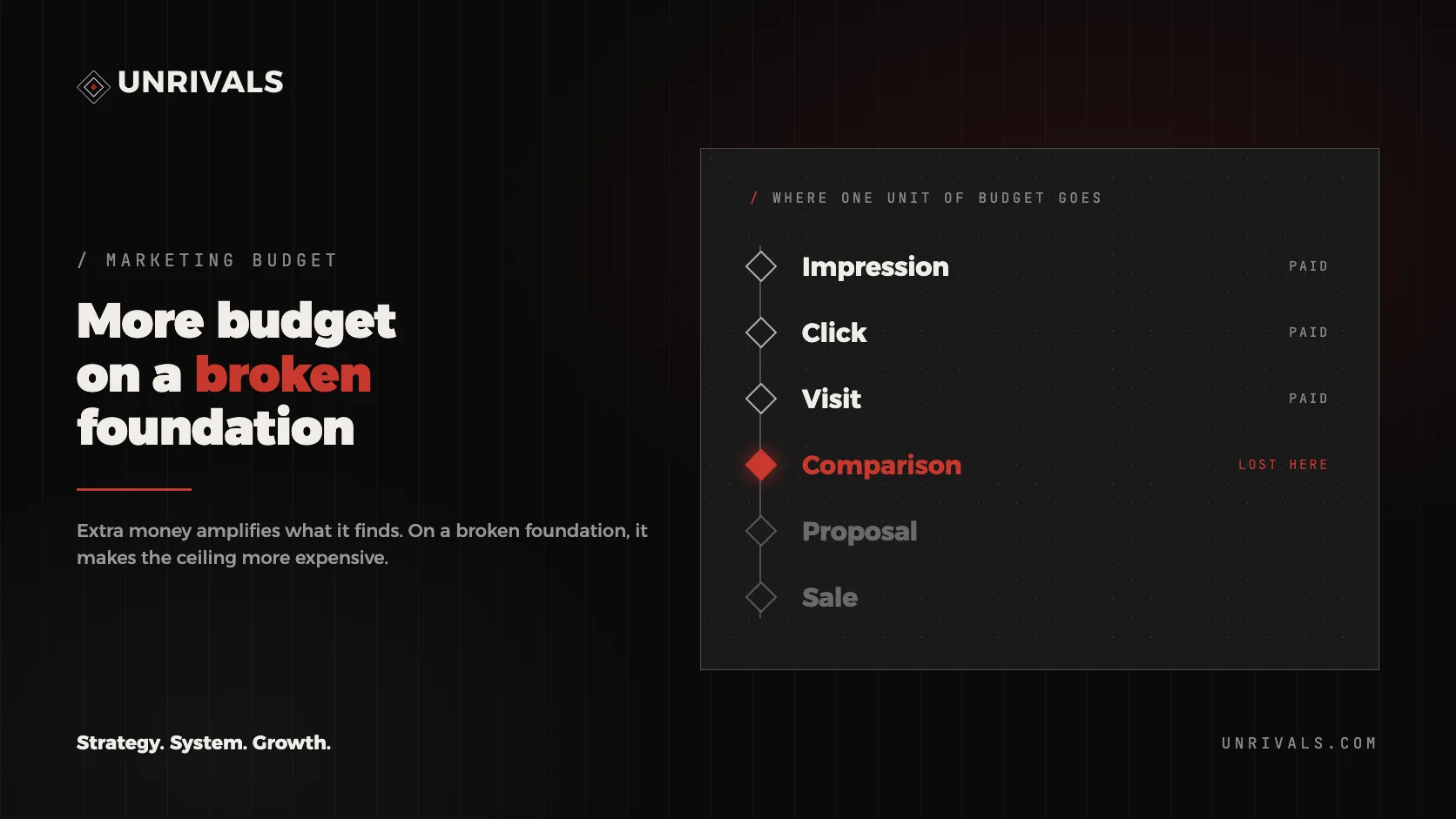


TL;DR. Marketing architecture is the coherent system in which positioning, demand generation, selling, and performance measurement operate as connected layers. Each layer feeds the next, so growth becomes predictable instead of depending on how much you pour into ads every week.
The difference from running campaigns is plain. Campaigns generate episodic attention, while an architecture turns attention into a decision, the decision into revenue, and revenue into data that improves the system, so every cycle costs less than the one before it.
The layers are numbered from the ground up, L1 for performance, L2 for revenue, L3 for orchestration, and L4 for positioning. Most companies operate on the first two alone, which is exactly why marketing stops working the way it did three years ago.
If you switch off the ads and growth stops, what you own is a faucet rather than a system.
Why do isolated campaigns plateau?
The typical campaign starts from zero. You pick a channel, build a message, set a budget, run it for a few weeks, draw conclusions, and start over. Every restart costs the same effort as the first one, because nothing learned stays inside the system.
The problem is not that these campaigns are wrong, it is that they do not compound, since each one stays a discrete event rather than an investment that stacks on top of the last.
The buyer who saw last month’s ad and did not purchase has not disappeared, yet they landed nowhere either. No mechanism keeps them close, builds trust gradually, and brings them back at the moment they are ready to decide.
Worse, isolated campaigns demand an impossible condition, that they turn a profit from the very first interaction, in markets where the buying cycle runs 30, 60, sometimes 180 days.
The result is predictable. The company grows only as much as it pumps, the founder stays stuck in the role of chief marketer, and every month becomes a fresh fight instead of a consequence of last month’s work. Any pause in the budget produces a pause in growth.
This is not an execution problem, it is an infrastructure problem. The client rarely has a marketing problem, what the client lacks is infrastructure, meaning systems, channels, positioning, and a brand foundation. Marketing built on a weak base burns money with remarkable efficiency.
Companies that grow predictably do not have better campaigns, they have a system in which campaigns are one layer rather than the whole picture.
What does a predictable marketing system mean?
A predictable marketing system is one where you can say, within a reasonable margin, what next month looks like if you hold the current parameters steady. It is not magic and it is not a guarantee, it is visibility into a mechanism you actually understand.
That visibility comes from a system that measures everything, ties each channel to a stage of the buying process, and reallocates budget on real performance rather than on a plan written in January.
Concretely, you know how many people enter the pipeline each week, how long they take on average to become buyers, where most of them fall out, and what improvement follows a change at any one of those points.
Without that data, marketing gets managed on instinct. With it, marketing gets managed like an engine with several adjustable parameters. Predictability comes from coherence between layers, never from budget size.
| Dimension | Isolated campaign | Marketing architecture |
|---|---|---|
| Unit of work | The campaign, with a start and an end | The layer, which remains after the campaign |
| What accumulates | Nothing, every month restarts | Data, brand memory, pipeline |
| Who integrates | The founder, by hand | The orchestration layer |
| Profit condition | Profitable from the first interaction | Profitable across the full buying cycle |
| What happens when budget stops | Growth stops | Existing demand keeps converting |
| How budget is decided | One annual figure, split up front | Monthly reallocation on real performance |
The table doubles as a diagnostic grid, because a company that recognises itself in the middle column on four rows out of six does not need another campaign, it needs the missing layers.
- L4 · PositioningDecides what you say and what you give up. Without it, the other three amplify a message nobody chose.
- L3 · AI orchestrationConnects the layers, reports on its own and moves budget on data. Works only on top of positioning already decided.
- L2 · RevenueTurns demand into revenue, through pipeline, CRM, win rate and sales cycle length.
- L1 · PerformanceTurns attention into a visit, through ads, SEO, email and paid or organic channels.
Most companies operate on L1 and L2 only
What are the four layers of a marketing architecture?
Four, numbered from the ground up by how visible they are. L1 is performance, L2 is revenue, L3 is orchestration, and L4 is positioning. Most companies operate on the first two alone, and that is where the feeling comes from that marketing has stopped working.
L1 · Performance
The first layer is the one everybody sees, meaning ads, search, email, paid channels, and organic ones, and its job is to turn attention into a visit.
The base indicators stay impressions, clicks, cost per acquisition, and return on ad spend. If performance is not measured on those dimensions, what you have is not a performance layer, it is a marketing expense.
What rarely gets understood is that L1 on its own produces traffic rather than durable growth, and what happens to that traffic depends entirely on the layers above it.
L2 · Revenue
The second layer turns demand into revenue, meaning the sales process, the pipeline, the customer relationship system, opportunity tracking, conversion rate, and cycle speed.
The indicators are marketing qualified leads, sales qualified leads, win rate, and cycle length. Without that data you cannot say whether a growth problem comes from traffic or from selling, and the confusion costs money every single day.
This is where the double funnel operates, the overlap between the marketing funnel, which differentiates, and the sales funnel, which negotiates and closes. The point is not owning both, it is matching every marketing asset to the exact commercial stage the buyer sits in.
L2 is the layer that performance vendors ignore almost systematically. They deliver leads, and whatever happens to those leads afterwards stays the client’s problem, which is how a structural divorce between marketing and sales opens up and lasts for years.
L3 · AI orchestration
The third layer ties everything together, because its job is to connect L1, L2, content, and research into a coherent system that makes decisions and recalibrates itself.
In practice that means automated reporting, near real time performance analysis, content at scale, systematic testing, and budget redistribution based on data. Without this layer, every decision consumes time from the founder’s calendar.
AI is not a brain, it is a cognitive processor, meaning a cognitive extension of human decision making. The quality of the output depends on how precisely you tell it where to think, so this layer only works on top of positioning that has already been decided, never in place of it.
L3 is where perception and performance meet. Data from L1 and L2 travels up into strategic decisions, and those decisions travel back down into execution. The practical detail sits in a separate piece on how AI fits into a marketing strategy.
L4 · Positioning
The fourth layer gives meaning to all the others, because positioning shapes what the market believes about you before a prospect ever reaches your first ad or your first page.
Its indicators are harder to measure and no less real, meaning aided awareness, branded search, share of voice in the category, price resistance, and pipeline quality.
Without clear positioning, L1 spends money generating attention for a company nobody has heard of, nobody understands as different, and nobody has a cognitive reason to prefer over lower priced alternatives. The result is an acquisition cost that climbs without end.
Michael E. Porter wrote in “What Is Strategy?”, Harvard Business Review, 1996 that “the essence of strategy is choosing what not to do”. This layer is exactly where that choice gets made, and when it is missing, the other three work hard at amplifying a message nobody chose.
Positioning is not a slide in a deck. It is the cognitive infrastructure of the business, the understanding of market, segment, and real differentiation, carried through every touchpoint. An unclear brand raises acquisition cost directly.
Why does the order between strategy, infrastructure, and performance matter?
The most frequent mistake at companies with serious budgets is inverting the order. Money goes into performance before the infrastructure is in place, and ads run before the positioning is clear.
The result shows up in return, and the ads perform far below their potential, not because the media buying team is weak, but because traffic lands on a foundation that does not convert.
The correct order runs against the reflex. Strategy first, infrastructure second, performance last. Strategy settles who you are, for whom, with what real differentiation, and in which category.
Infrastructure builds the system that translates strategy into experiences, meaning site, funnel, sales process, and content pipeline. Performance amplifies what already works, because amplification never repairs, it only enlarges whatever it finds.
Performance in a vacuum is optimisation with a low ceiling. You can tune an ad indefinitely, yet you cannot compensate for generic positioning or a broken sales process. A marketing budget exists for development, not for maintaining the same channel forever.
The difference lands in the final number, because correct strategy lowers real cost per click and per acquisition, while tuning an ad moves the same number by a few percent and gives it back the following month.
What does the economic sequence look like in numbers?
There is direct economic logic behind the architecture. Clear positioning reduces the cognitive effort a buyer spends while evaluating, they grasp quickly why you rather than somebody else, and higher trust produces better conversion.
The context in which the decision gets made has shifted, which raises the stakes on the top layer. Research by Bain & Company with Google in 2022, across more than 1,200 B2B buyers, found that between 80% and 90% of them hold a shortlist of roughly three suppliers before formal evaluation begins.
The same Bain research from 2022 found that 90% of buyers ultimately choose from the list they had already formed. A performance budget that starts after the list is set buys visibility inside a contest that is already decided.
Search behaviour has moved as well. A Bain and Dynata survey from December 2024, across 1,117 respondents, found that roughly 80% of people rely on zero click results in at least 40% of their searches.
The effect on traffic is already measured. The same Bain research from 2024 records a decline of 15% to 25% in organic traffic, which means the L1 layer delivers less for the same effort.
In B2B the pressure runs higher. Bain measured in September 2025 that click through rates fell by as much as 30% in some categories, and that 85% of buyers choose from a list they already carried in their heads before searching.
The operational conclusion is direct. The earlier the decision gets made, and the further from your own site, the more of the outcome is settled at L4 and the less of it can be recovered through bidding at L1.
We have our own proof as well. At one clinic, repositioning grew revenue by 39%, with no increase in ad budget. The full mechanism, including what changed and in which order, sits in the piece on growth achieved without additional ads.
Companies that climbed out of a price war followed the same sequence, clarifying first what they are, for whom, and why, before buying more traffic. The concrete route sits in the piece on leaving a price war behind.

Why does a single point of coordination beat five vendors?
When a company hires an ads vendor, an SEO vendor, a social media vendor, a designer, and a strategy consultant separately, each one works on a private island. Nobody holds a view of the complete chain.
The performance vendor does not know what the strategy consultant says, the designer does not know which message gets tested in the ads, and the consultant never sees the commercial data. Each one is optimised on their own deliverable rather than on company growth, and each one is right inside their monthly report.
Execution comes out fragmented. Five vendors with five slightly different directions, five sets of priorities, and five reports that never speak to each other. The founder becomes the integrator, which consumes more time than any saving on rates.
A marketing architecture has a single point of coordination, meaning a coherent system in which every executor works from the same positioning, the same message, and the same data. That does not mean everything moves in house.
It means an orchestration layer keeps the system aligned no matter how many vendors execute at the tactical level. A single discipline vendor can optimise one layer, yet no such vendor can own the whole chain from positioning through to execution.
The difference is clearest when a move at the top changes what everybody else executes. At Cablero, a cable manufacturer, the proposed territory shifted the unit of value from the product to the economic risk being protected, meaning they do not sell cable, they sell what is not allowed to fail.
A move of that kind rewrites the message in the ads, the qualification criteria in sales, and the structure of the pages on the site, all in the same week. Five separate vendors cannot make that call, because none of them holds a mandate over the layer where it gets decided.
What are the seven stages of the system?
A marketing architecture does not get built in random order. There is a sequence in which each stage informs the next, and skipping one gets paid for at the following stage, with interest.
1. Strategic diagnosis. Before any tactical decision you understand the real situation, through SWOT, PEST, 5C, competitive analysis, and the full mix. Not as an academic exercise, but as the basis for decisions that cost money.
2. Market space. Where you can win, which segments are underserved, where competition is weak. This stage identifies the optimal place to position, meaning the territory that still has an owner slot free.
3. Winning strategy. You define the ideal customer profile, the priority segments, and the real differentiation. Without this stage the message stays generic and speaks to everyone, which means to nobody.
4. Marketing mix. With strategy settled you build the mix, meaning product, price, distribution, and communication, according to what you learned in the earlier stages rather than what the industry does by habit.
5. Sales engine. The commercial process, the objections mapped and answered, the closing method. Without a defined process, selling depends on one person’s individual talent rather than on a system.
6. Performance economics. Acquisition cost, customer lifetime value, return on spend, and pipeline health. That dashboard tells you whether the system works and where the holes are.
7. Budget cascade. The last stage answers not how much budget in total, but how much on each stage of the buying process, from awareness through to retention, plus a mechanism for monthly reallocation on real performance.
The budget cascade is the exact opposite of how planning usually goes. You set a figure at the start of the year and split it across channels, even though what works in January may stop working by August. A predictable system reallocates dynamically.
How do you recognise that you have no system?
A few clear signs, which you can check without any external audit. Results depend directly on how much you pump into ads in the current month, and if you stop the budget, traffic and leads stop with it.
Every month starts over. There is no compounding effect, and nothing from last month makes this month easier. The team reinvents each time rather than accumulating systemic knowledge.
You cannot say even approximately what happens if you double the ad budget or cut it in half. The absence of an answer is itself the diagnosis, because a system you understand answers within minutes, with its own numbers on the table.
A collection of campaigns answers the same question with a hunch. Ask it at the next management meeting, in exactly that form, and the honest silence that follows will tell you which layer is missing.
Nearly every marketing decision passes through the founder, because no system runs without them. You have leads that do not convert, or convert slowly, and you cannot say precisely where they get lost.
If you recognise more than two of these signs, what you have is not a campaign problem. You have an architecture problem, and it does not get repaired with another channel, it gets repaired with the layers placed in their proper order.
Frequently asked questions
What does a predictable marketing system mean?
A system in which you know, within a reasonable margin, what each euro invested produces. Not in the sense of guaranteed results, but of visibility, meaning you know how many people enter the pipeline, how long they take to become buyers, and where they get lost. The opposite is marketing run on instinct, where every month brings a surprise.
How do I make marketing predictable instead of running isolated campaigns?
You stop treating campaigns as the unit of work and start treating layers as the unit of work. Positioning gets decided first, the infrastructure that carries it follows, and only then does paid performance amplify something that already converts. Measurement runs across the full buying cycle rather than across the first interaction.
What is the difference between an outside vendor and a marketing system?
A vendor owns one discipline and optimises inside it, which is useful and insufficient. A system owns the chain from positioning through to execution, so a decision at the top layer changes the message, the qualification criteria, and the pages at the same time. The vendor reports on their deliverable, the system reports on growth.
How do I integrate AI into a marketing architecture?
AI has a specific job in a marketing architecture, which is orchestration. It connects performance channel data with the sales process, generates content at scale from defined positioning, automates reporting, and flags anomalies before the founder notices them in a spreadsheet. AI accelerates strategy rather than replacing it, and the practical detail sits in the piece on how AI fits into a marketing strategy.
Why do my campaigns fail to support one another?
Because nothing connects them. Each campaign carries its own message, its own audience, and its own landing page, so the learning from one never reaches the next. Coherence between campaigns is not a creative matter, it comes from a positioning decided once and carried everywhere, which is why cognitive ownership of a category does the work that a clever campaign cannot.
Where does a company with budget but no system start?
With the diagnosis, never with the channel. You establish which layer is missing, and in the majority of cases the missing layer is L4, meaning the market cannot articulate what you are. A budget poured into L1 above an empty L4 buys attention for a company nobody has a reason to prefer.
Growth stops being a monthly fight the moment the layers sit in order and the system starts keeping what it learns. If you want the honest version of which layer is missing in your case, request an audit.