
TL;DR. A sales engine is the system through which the positioning built during branding reaches, consistently, qualification, the sales script, the offer and follow-up. It is not a new CRM, and it is not a marketing subscription tacked onto identity work. It is the proof that the new brand attribute has changed something beyond the website, measured in the sales cycle, win rate and the reasons deals are lost.
A branding process can produce clearer positioning, a stronger identity and a coherent message. All of that matters, but for a company that still has to sell, it is the beginning, not the final result.
The real test starts after branding. The new attribute has to reach the sales conversations, the qualification of opportunities, the offer and the way the team handles objections.
If, after 90 to 180 days, the company communicates differently but sells exactly the same way, there is a break between the brand and the commercial system. The result is not visible in the pitch deck. It shows up in the numbers behind it.
Branding produced a clearer signal. It did not yet build the engine that turns that signal into sales.
Why doesn’t rebranding increase sales right away?
Because most of the commercial mechanism stays untouched. In most markets, branding projects wrap up neatly with a defined set of deliverables: audit, positioning, verbal architecture, visual identity and, sometimes, a new website.
The problem is not the quality of that work. It shows up when the company treats the handover of those deliverables as the end of the process.
After launch, the sales team goes back into the same CRM. Opportunities get qualified by the same criteria, the price objection gets the same answer, and follow-up runs exactly as before. The identity is new, but the commercial mechanism stayed the same.
A brand attribute does not create value just by appearing on a website or in a deck. It starts producing value once it changes the reason a customer picks the company, and that is exactly where branding has to connect to a B2B sales strategy.
This break is not visible right away, because a new website and new materials look good regardless of what happens behind them. It becomes visible only once someone looks at this quarter’s sales cycle and compares it with the period before the rebrand, and finds no difference at all.
A sales engine is not a new CRM
A sales engine is not an app, and it is not a CRM implementation project. It is the system through which the promise built through branding reaches, consistently, all the way into the sales process.
If the brand diagnosis identified a clear ICP, that same ICP has to exist in sales qualification. If positioning identified a differentiating attribute, that attribute has to show up in the first minutes of the sales conversation. The connection has to be traceable end to end, from diagnosis and positioning through qualification, the offer, follow-up and the result.
We call the principle behind this continuity brand as a foundation for growth, the same principle described in the brand platform. It states that on the right foundation, every dollar invested stays as active memory in the market’s mind, while short-lived advertising, cut off from stable positioning, leaves nothing behind.
A company that rewrites its brand but leaves the old brand platform unused by the sales team ends up paying twice. Once for positioning, and again for the mechanism that was supposed to carry it further.
That is the difference between branding treated as a project and branding treated as commercial infrastructure.
Where does VANGUARD fit into the system?
This is where the VANGUARD system enters the UNRIVALS methodology. It is not the stage that follows branding, and it is not a marketing subscription added once identity work wraps up.
VANGUARD takes the positioning, the central attribute and the message set during branding and carries them into the mechanisms that produce commercial effect: prioritising segments and ICPs, sales messaging, campaigns, offers, opportunity qualification and follow-up processes.
The important difference is continuity. The team that builds the strategy does not disappear after handing over a brand manual, and it does not leave the company to translate positioning on its own into dozens of disconnected executions.
We call the principle behind this kind of engagement a defensible business model. It requires the proposed system to hold up beyond the presence of a single person and to stay verifiable over time, not just useful in the month it gets delivered. A sales engine built correctly still runs in the months when nobody on our team is watching it directly, because its logic was transferred, not just explained.
In our standard engagement, this transfer has a name and a precise place in the sequence. After diagnosis, positioning and offer architecture comes Commercial Activation. That is the phase where the central attribute actually enters qualification, the script and how the price objection gets handled, not just the published materials. Without it, a company is left with a new brand and an old sales process, exactly the break this article describes.
Rhythm matters as much as structure. Important opportunities need periodic review, loss reasons need to be centralised, and recurring objections need to be read as a pattern, not an isolated incident. A weekly pipeline review and a monthly win/loss analysis turn commercial information from anecdote into data that positioning can actually use.
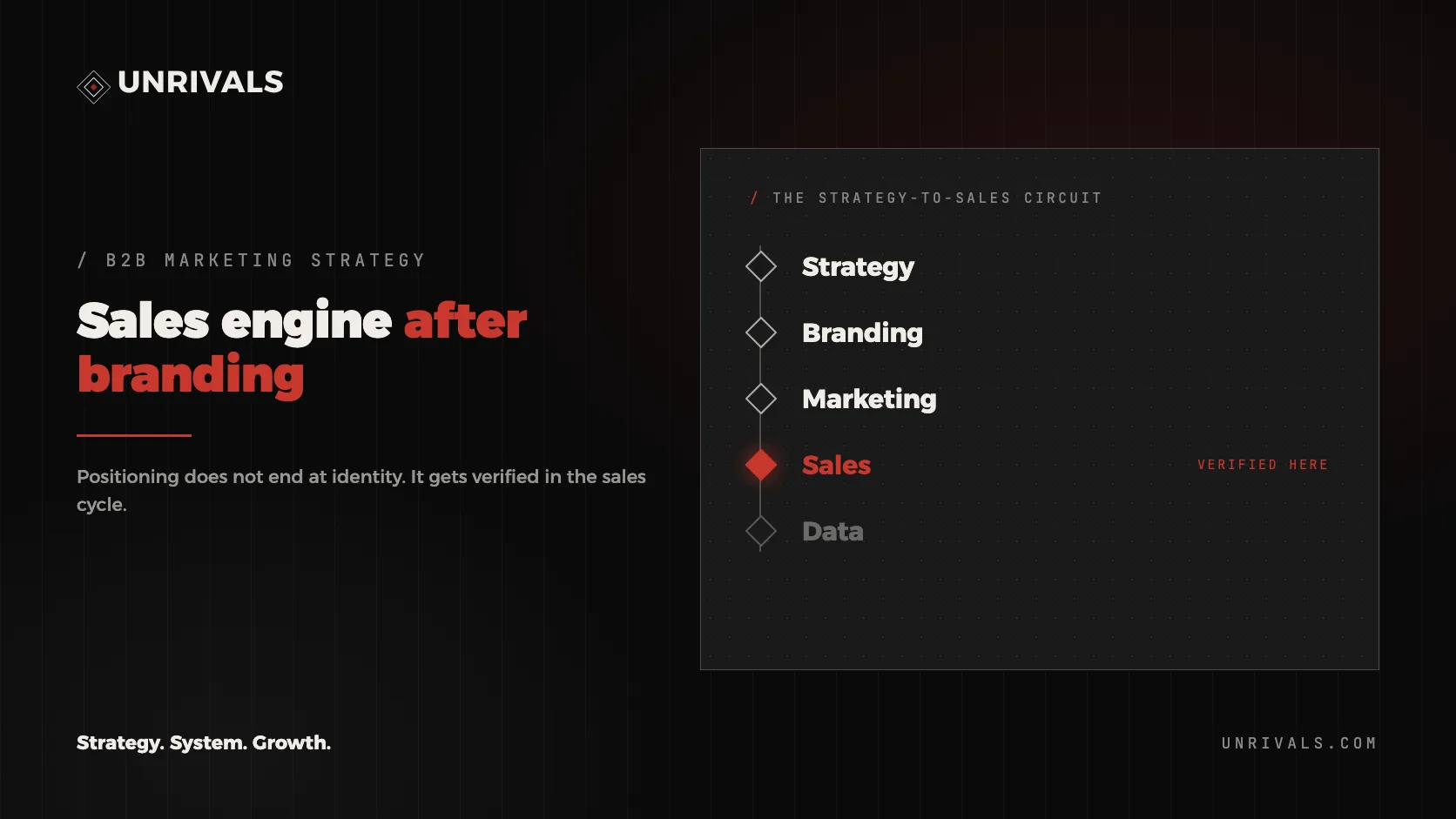
The relationship is not linear, with branding at the start and sales at the end. It is a continuous loop:
- StrategyDiagnosis and positioning
- BrandingAttribute and message
- MarketingCampaigns and content
- SalesQualification, offer, follow-up
- DataCycle, win rate, loss reasons
If the central attribute does not show up in the sales conversation, we transfer it into the script. If opportunities keep getting lost mostly for reasons other than price, we check whether the differentiator is expressed clearly enough in the message and in the sales argument.
How do you turn positioning into qualification and a sales script?
A good diagnosis does not just define who might buy. It defines the customer for whom the company’s differentiator carries the most value, and that distinction has to reach the sales process, not just sit in a strategy document.
The principle connecting marketing and sales in our methodology is the double funnel: marketing works the differentiation funnel, from suspect to prospect, while sales works the synergy funnel, through the SPANCO stages, from negotiation to account development. Marketing materials have to match the actual sales stage an opportunity is in, not be delivered generically.
The criteria that come out of the diagnosis, industry, company size, problem, maturity level, type of decision maker, need to be carried into the sales process. A lead that does not match the profile should not consume the same time as an opportunity sitting right at the centre of the market the positioning was built for.
The second test shows up in the sales conversation itself. Many companies invest in new positioning but keep introducing themselves by listing products, certifications or years in business. All of that can be valid proof, but it is not automatically a reason to choose.
This is where the principle we call reducing the cognitive tax comes in. Unclear branding puts a cognitive tax on every impression, and cutting that friction, meaning a buyer who understands faster why the company is relevant, shortens the time a decision takes. The same applies to the price objection. If positioning justifies a price difference, that justification needs to exist inside the sales system too.
CRM stages need to describe real progress, not just activity. “Contacted” or “proposal sent” do not necessarily prove proximity to a decision. A correctly qualified opportunity has verifiable criteria: the problem is relevant, the right stakeholder is involved, and there is a clear decision process.
A concrete example shows the difference. An industrial equipment manufacturer going through a rebrand might define the “qualified” stage through four criteria, not through the simple existence of a conversation: budget for the investment is approved for the current year, the technical decision maker has confirmed the problem directly, the prospect fits the revenue band set by the ICP, and the incumbent competitor has a known weakness the new attribute addresses directly.
Without those four criteria written down, two different salespeople qualify the same conversation differently, and the pipeline report shows a health the reality does not confirm. With them, qualification becomes a decision tool, not a form filled in after the fact.
The same principle applies to the opening script. Instead of starting with company history or a list of certifications, a script aligned to positioning opens with the problem the central attribute solves, stated in the customer’s own words, not in the company’s internal terminology. The rest of the conversation confirms and deepens it, rather than introducing it.
Why do B2B sales cycles take so long?
Because B2B buying, across the market, has become slower and more complicated than it was a few years ago. Unclear positioning adds time on top of an already large problem, because every new stakeholder who joins the decision process has to relearn the explanation from scratch.
The average B2B sales cycle reached 10.1 months in 2025, down slightly from 11.3 months in 2024, according to 6sense’s 2025 report on the B2B buying journey, based on more than 4,000 responses.
The cycle stretches even further once external consultants enter the decision: 13.6 months, against 6.5 months when the company decides without them, according to the 2024 edition of the same 6sense report. Every extra stakeholder in the decision process is one more chance to lose the clarity of the message, unless the sales team carries the central attribute explicitly into the conversation.
- 10.1 monthsaverage B2B sales cycle in 20256sense, 2025
- 13.6 monthsthe cycle, with an external consultant in the decision6sense, 2024
- 6.5 monthsthe cycle, without an external consultant6sense, 2024
Sources · 6sense, 2025 · 6sense, 2024
Clear positioning does not remove the real complexity of a B2B purchase, but it can cut the time a buyer spends trying to understand why the company is different. That is exactly the time a sales engine is built to track.
How do you lose pipeline if not on price?
Most often through indecision, not through a direct comparison with a competitor, and that changes what actually needs fixing in the sales system.
86% of B2B purchases stall at some point in the process, and 81% of buyers end up dissatisfied with the vendor they eventually chose, according to Forrester’s 2024 research on B2B buying behaviour. The study covers more than 16,000 buyers worldwide.
Between 40% and 60% of pipeline is lost to the status quo or to indecision, not to a better competitor, according to the study by Matthew Dixon and Ted McKenna published in Harvard Business Review in 2022.
Their analysis covers more than 2.5 million recorded sales conversations. 56% of those losses come from indecision driven by fear of risk, not from a preference for the current solution.
74% of buyers say they faced too many competing options in their most recent purchase, according to the Sales Benchmark Index report on commercial differentiation, published in 2024.
- QualificationLead enters the process
- OfferToo many comparable options
- Decision delayedStatus quo or indecision, not price
- ContractWhat reaches signature
If the sales team treats every loss as a pricing problem, it is fixing the wrong instrument. The differentiator built through branding needs to reduce exactly this kind of indecision, by showing clearly why the risk of choosing the company is smaller than the risk of not deciding at all.
In practice, that means the sales argument has to answer the question the buyer never asks out loud: what happens if I delay this decision another quarter? A salesperson who can answer it, with concrete evidence about the cost of delay, keeps an opportunity moving far better than one who only defends the price.
How do you measure sales engine ROI after a rebrand?
To say whether the change is working, the baseline has to be set before implementation. Otherwise, the effect of branding cannot be separated from seasonality, pricing changes or turnover on the sales team.
A handful of numbers matter most: the average sales cycle, the win rate on new opportunities, the share of opportunities lost for reasons other than direct competition, average contract value, and the share of pipeline coming from the ICP.
Each of these numbers answers a different question. The sales cycle shows whether the message shortens the time needed to understand the difference. Win rate shows whether that difference, once understood, actually weighs in the final decision. The share of pipeline from the ICP shows whether the engagement is bringing in the customers the company was actually repositioned for, not just anyone who joins a conversation.
Not every effect shows up right away. In the first 90 days, the focus is whether the new strategy has been adopted, whether salespeople are actually using the attribute, and whether loss reasons are being logged correctly. Adoption gets checked by listening to sales calls, not by reading the monthly report.
| Indicator | At 90 days | At 6 months | At 12 months |
|---|---|---|---|
| Sales cycle | Baseline set, adoption checked | Roughly 10% shorter | 15-25% shorter |
| Win rate on new opportunities | Old pipeline separated from new | About 3 percentage points higher | 5-8 percentage points higher |
| Losses to reasons other than price | Loss reasons start being logged | Share starts to fall | 10-15 percentage points lower |
These are operational targets, not guaranteed outcomes. An industrial manufacturer with a nine-month sales cycle cannot mechanically copy the results of a company where the decision takes a few days. What it can copy is the discipline of measuring.
Which layer of the methodology does the sales engine sit on?
We work across four layers, from L1 to L4. L1 is performance marketing, meaning ads and traffic. L2 is revenue and the sales process, meaning exactly the pipeline, the sales cycle and the win rate discussed in this article. L3 is orchestration and the company’s memory, where the AI Brain lives. L4 is positioning and category architecture.
We build from the bottom up, meaning traffic, then revenue, then positioning, but we derive the message from the top down, from positioning to the offer and only then to the ad.
The sales engine lives at the border between L4 and L2. Positioning, set at L4, produces no commercial effect until it reaches L2, in qualification, in the script and in the pipeline. Without that transfer, L4 stays a document, and L2 stays unchanged, exactly the break described at the start of this article.
L3 is the layer that makes the transfer repeatable. Qualification criteria, logged loss reasons and the arguments that work on each segment need to end up in a system anyone joining the company later can consult, not just the person who wrote the original positioning. Without the memory kept at L3, every new person on the sales team relearns the same lessons from zero.
For a fractional CMO, who joins for a few days a month, this transfer is usually the first thing sacrificed, because their time goes to the urgent work at L1 and L2, not to building the connection between them.
What does success look like in practice?
Success does not just mean the website looks better or the pitch deck reads more coherently. It means the founder can state the company’s central attribute in a few seconds, and the salesperson can do the same thing without opening a slide.
It means every new opportunity has a source, an ICP profile and a sales stage defined through verifiable criteria, and that after six and twelve months, the sales cycle, win rate and loss reasons can be compared against the original baseline.
One example of integration between positioning, product and the conversion system can be seen in the Cardio Clinic project, where the brand differentiator was carried all the way into the process through which patients actually choose the clinic, not just into the communication materials. The attribute did not stay on the website. It reached the conversation at the front desk and the argument used at the first appointment, exactly the commercial point this article is about.
The practical test for a founder is simple. If you asked three people on the sales team today why a customer picks the company over a competitor, would they give the same answer, or three different ones? Three different answers mean positioning has not reached sales yet, no matter how good the brand looks on paper.
A clearer brand should reduce the effort needed to explain why the company is different. Correct positioning should help the company choose more carefully which opportunities are worth pursuing.
Branding builds the signal. Marketing carries it into the market. The sales system turns it into a sequence of measurable decisions, and the sales cycle is one of the most concrete pieces of proof that the market understood what the company was trying to build.
No branding agency can guarantee this last step just by delivering a manual or a website, because it plays out in conversations the agency never hears directly. What it can build is the mechanism through which those conversations, systematically, end up carrying the same idea, measured afterward in real sales numbers, not just in how good the new brand looks.
If you want to know where the link between your company’s brand and its sales cycle breaks today, ask for a diagnostic. You get, in writing, where positioning stands and where pipeline is being lost, and the document stays yours whatever you decide afterward.
Frequently asked questions
How do you measure the ROI of a brand repositioning?
Through a cohort comparison, not the total revenue figure. Separate the opportunities that entered after the new positioning was implemented from the ones already in the pipeline, then track the sales cycle, win rate and loss reasons of the new cohort against the baseline set before the change. Old contracts, negotiated under the previous positioning, distort the result if they stay mixed into the same figure.
What do you do after a rebrand to see results in sales?
Transfer the central attribute into qualification, the sales script and the price argument, then set a review rhythm, with a weekly review of important opportunities and a monthly win/loss analysis. Without that rhythm, the new message stays known to the team but unused in the actual conversations.
How much of a lost sale is due to indecision, not price?
Between 40% and 60% of lost pipeline, according to the Dixon and McKenna research cited above, is lost to the status quo or to indecision driven by fear of risk, not to a better competitor or a lower price.
How long does it take to see commercial results after branding?
The first 90 days check whether the new positioning has been adopted into the sales process. At 6 months, the first cohorts of opportunities can be compared. At 12 months, for companies whose sales cycle allows this kind of analysis, the targets on cycle, win rate and losses become more ambitious. A nine-month sales cycle requires more patience than a three-week one, so the comparison horizon has to adjust accordingly.
Does VANGUARD replace the existing sales team?
No. VANGUARD transfers positioning and the central attribute into the mechanisms the existing sales team already uses, qualification, script, offer and follow-up, without replacing the people who sell. It corrects the tools they work with. The people stay the same, but the argument they carry into the market changes, and so do the criteria they use to decide which opportunities are worth pursuing.