
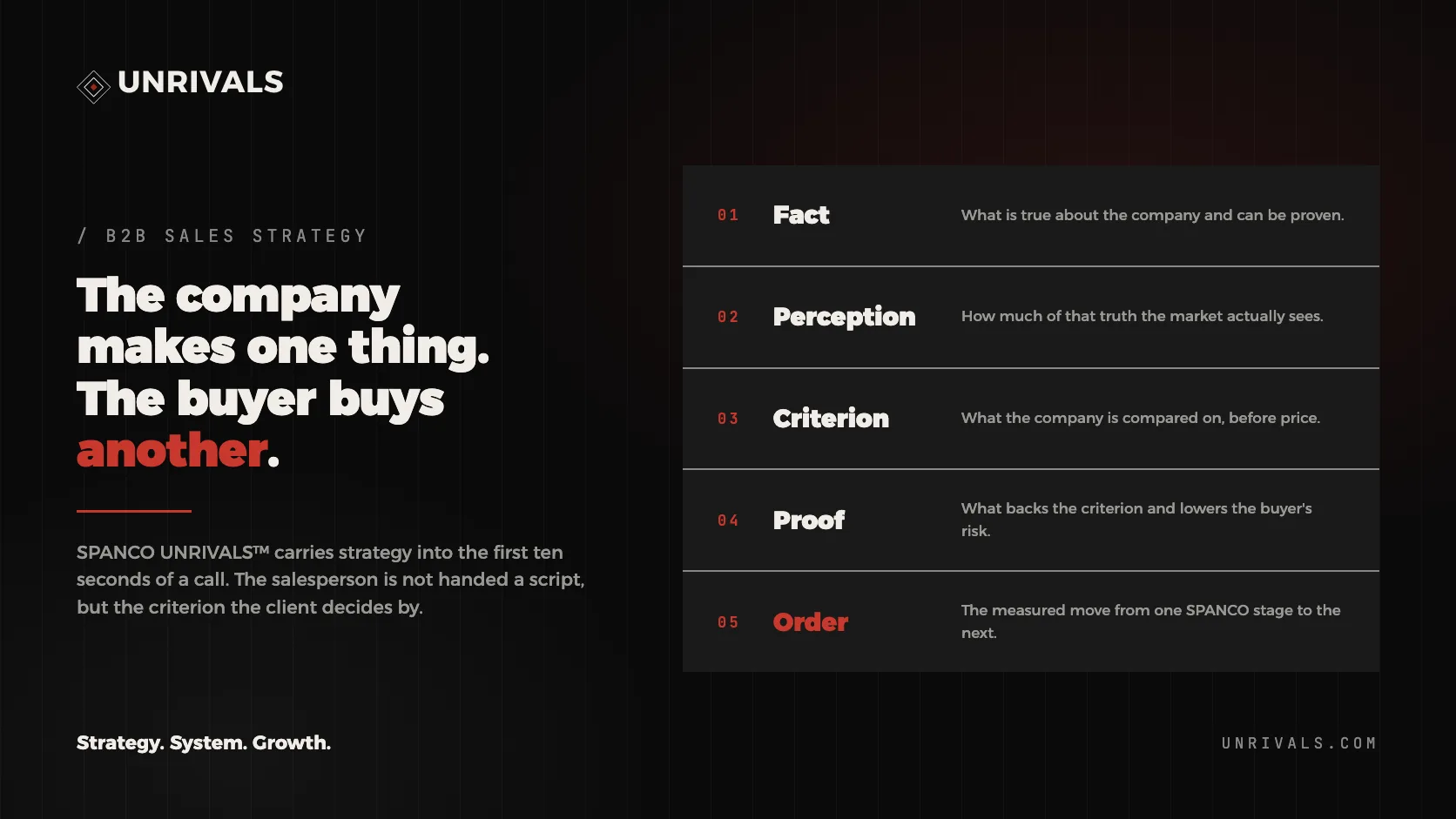
In a B2B sales strategy, the product is only the starting point. The company produces one thing, but the buyer buys another: an outcome, a reduced risk, a mission fulfilled or an economic value. That is why any commercial methodology has to start with a simple question: what are we actually selling this buyer?
TL;DR. SPANCO UNRIVALS™ is the proprietary adaptation of the SPANCO commercial methodology (Suspect → Prospect → Analysis → Negotiation → Contract → Order), extended through strategic marketing, positioning, brand architecture and integrated revenue operations. The difference from classic sales training is that the salesperson does not receive a script, but the decision criterion by which their company can be compared favourably, plus the proof that supports that criterion. The seven case studies below show how positioning reaches the first ten seconds of a call.
The SPANCO commercial discipline comes from the experience Daniel Roșca accumulated within Orange Business Services, later developed through more than 16 years of consulting in strategic marketing, positioning and sales.
What does each company actually sell?
BIG Aluminium does not sell aluminium or façades. It sells the value of the building. For the developer, the façade contributes to the asset’s value over time. For the general contractor, it means predictability of execution. For the architect, it means keeping the architectural intention intact, from drawing to finished building. The same physical product generates three different values, depending on the buyer.
Fereastra ADF does not sell windows. It sells architecture that lasts. Aesthetics and durability become two sides of the same promise: the architect’s freedom to design the shape they want, backed by the technical performance needed for it to hold. Its origin in Piatra Neamț and the Cucuteni territory build the cultural and artistic side; its own factory, certified glass and fire-resistant joinery rated up to EI120 build the technical proof.
This is the starting point of the UNRIVALS methodology applied to sales.
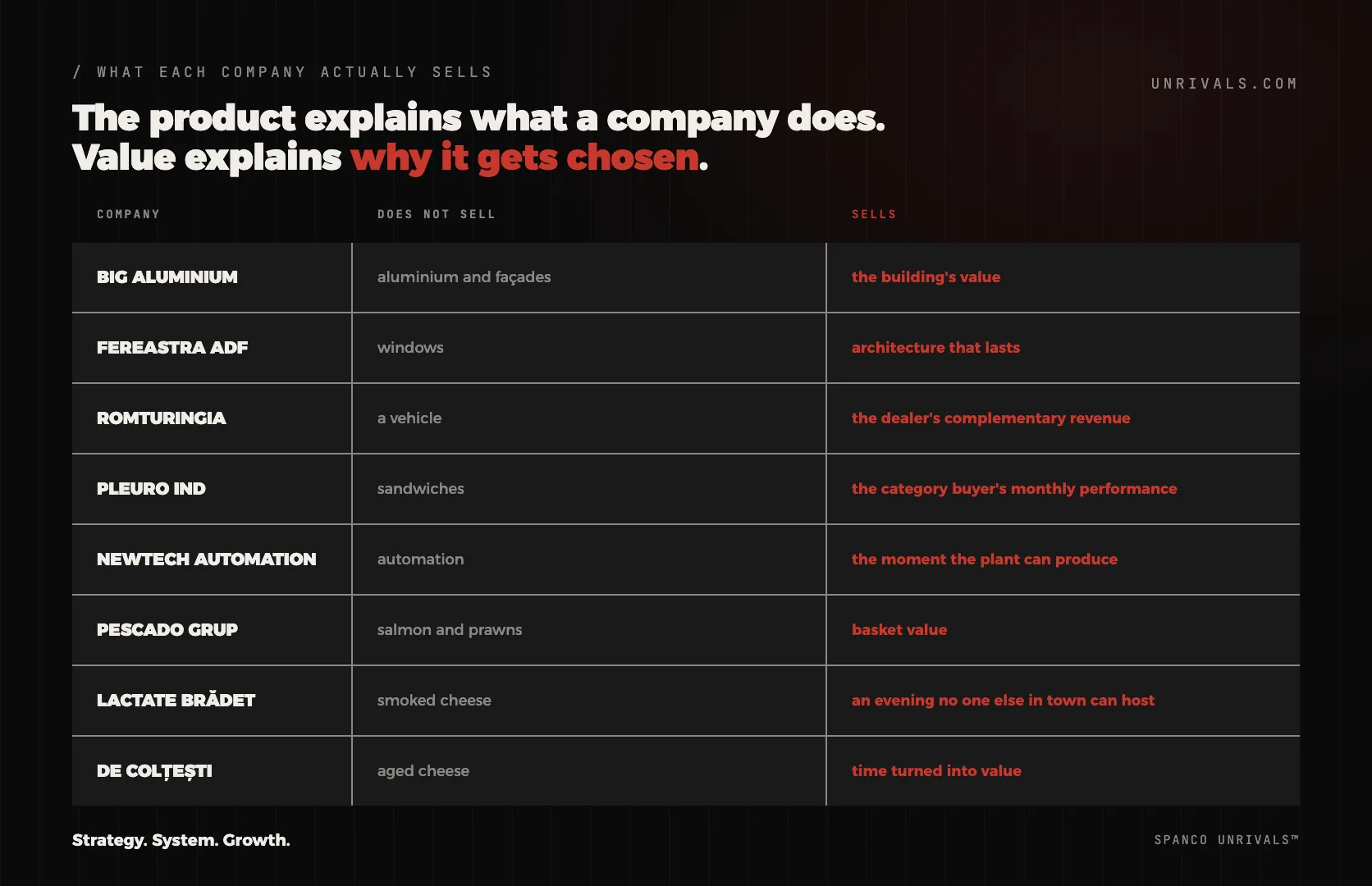
The product explains what the company does. The buyer’s value explains why they should buy from it. This is where strategically prepared selling begins.
How does marketing translate strategy into a sales conversation?
In the UNRIVALS implementation process, SPANCO is not a separate process run by the sales department. It becomes the commercial structure of a system in which marketing, sales and revenue are coordinated through the same strategy.
Marketing identifies the competitive reality and builds the decision criterion. Sales turns it into a commercial conversation. Integrated revenue operations track the move from first contact through to contract, order and revenue. The full logic is described in the article on the B2B sales system and the double funnel; here you see it executed, on the phone.
From the company’s truth to market perception
The starting point is not the salesperson’s pitch, but the company’s reality: FACT → PERCEPTION GAP. What is true about the company? What does the company believe about itself? How much of that truth does the market see and understand, and how much of it is valuable to the market?
The gap between reality and perception explains why a company can have good products, industrial capacity, certifications, experience and results, and still be compared almost exclusively on price. The role of the strategic marketing process is to identify the relevant truth the company can demonstrate, the market can understand, and the competition cannot legitimately claim.
From product to decision criterion
Every advantage has to be turned into a commercial argument capable of influencing the customer’s decision: PRODUCT → BENEFIT → RISK → DECISION CRITERION.
The product is translated into a benefit. The benefit is measured against the buyer’s risk. The risk is turned into a decision criterion by which the company can be compared favourably. The customer does not buy the product in the form the manufacturer describes it. They buy a reduced risk, a solved problem, a fulfilled mission, an achieved outcome or access to an opportunity. That is why the strategically prepared salesperson does not recite product features. They identify the buyer’s risk and offer a better criterion for making the decision.
From claim to proof
No commercial promise should be left unsupported: CLAIM → PROOF.
Innovation, quality, flexibility, experience, professionalism and customer focus are generic phrases. Almost any competitor can use them, and that is exactly why they do not build differentiation.
UNRIVALS removes the claims anyone can make and keeps the claim the company can prove. The proof can be a rare certification, a proprietary process, an industrial capacity, a financial result, a certified product, infrastructure that is hard to replicate, an incident-free track record, an official partnership, or a combination of resources the competition cannot reproduce. The claim gets attention. The proof changes the comparison criterion.
What are the eight steps of the UNRIVALS extension applied to SPANCO?
The UNRIVALS strategic extension adds eight steps ahead of and around the six classic SPANCO stages. They turn the company’s reality into the criterion by which it is chosen.
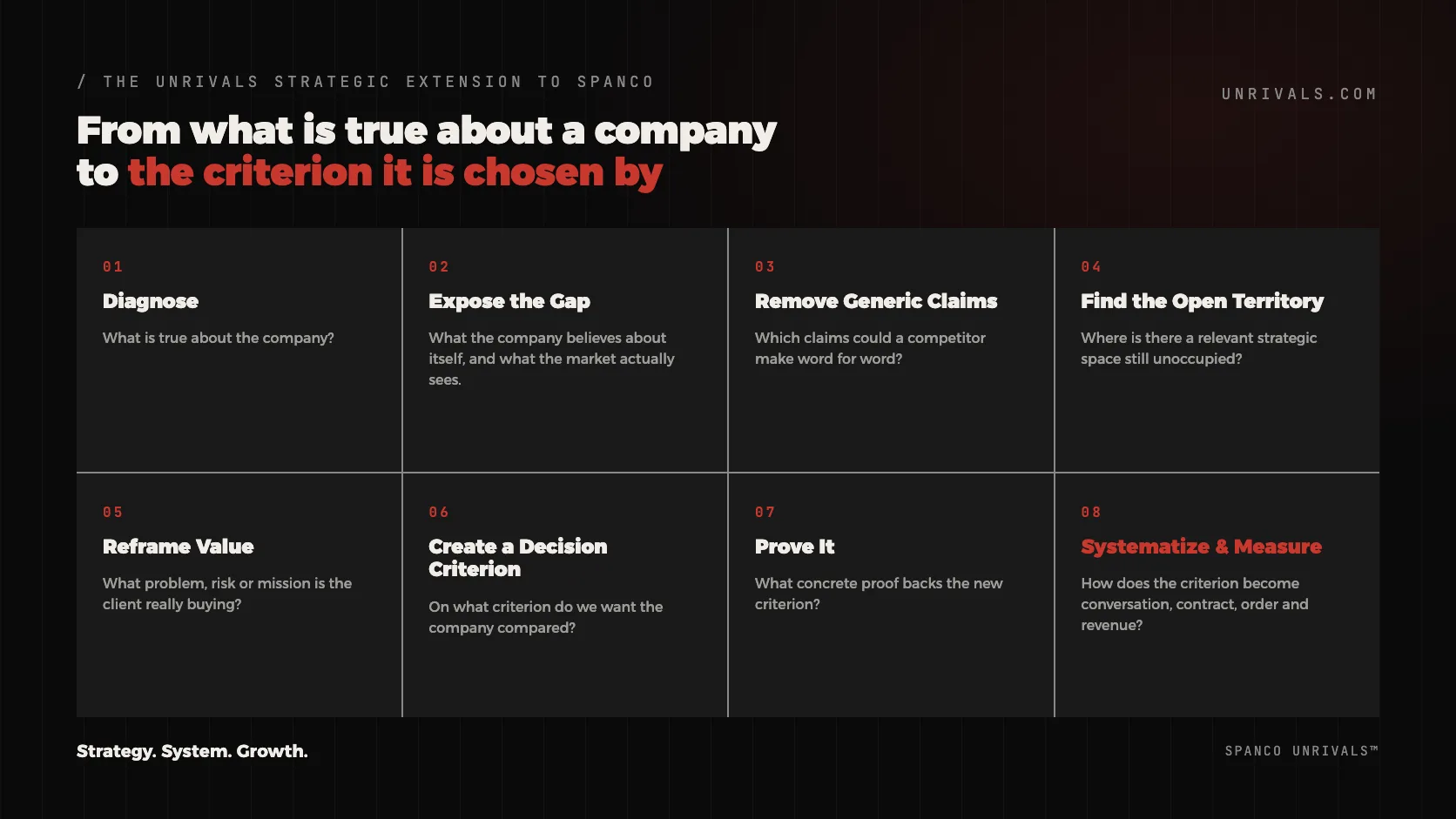
- Diagnose. What is true about the company? We analyse the company, its products, customers, competitors, financial data, operational capacity, intellectual property, commercial channels and existing proof.
- Expose the Gap. What does the company believe about itself, and what does the market actually see? We identify the gap between the value that exists inside the company and the value the market can recognise in its current communication.
- Remove Generic Claims. Which claims could any competitor make word for word? We remove the phrasing that does not differentiate and inevitably pushes the comparison towards price.
- Find the Open Territory. Where is there a relevant strategic space that is still unoccupied? We look for the territory the company can legitimately occupy, based on a reality of its own that can be demonstrated.
- Reframe Value. What problem, risk or mission is the customer actually buying? We move the conversation from what the company produces to what the customer gains, protects or avoids.
- Create a Decision Criterion. By what criterion do we want the company to be compared? We build the criterion that takes the company out of the generic comparison and changes the buyer’s question.
- Prove It. What concrete proof supports the new criterion? We tie every strategic claim to verifiable proof that is relevant to the decision.
- Systematize & Measure. How do we turn the criterion into a commercial conversation, a contract, an order and revenue? The new criterion is built into positioning, brand architecture, campaigns, commercial materials, call scripts, objection responses, offers, negotiation and result tracking. We do not just measure visibility. We measure the customer’s move from one SPANCO stage to the next: from unqualified contact to qualified prospect, from analysis to negotiation, from negotiation to contract, and from contract to order.
Why do we not sell documents, but commercial capability?
UNRIVALS does not sell repositioning or rebranding processes, sales prep sheets, presentations or strategic documents that end up in a drawer, as separate items.
Positioning, brand architecture, commercial arguments, SPANCO scripts, objection responses, sales team preparation and measurement tools are integrated, at no separate cost, into the VANGUARD system.
These are not standalone deliverables, but products the same system needs to function. Their value comes not from the number of pages, but from their ability to change a sales conversation and move the customer towards the next decision.
Strategy does not end when the tagline is approved, or when the presentation is delivered. It has to reach the first ten seconds of a call, the response to an objection, the reduction of the buyer’s perceived risk, the structure of the offer and the concrete step asked of the customer.
What does a strategically prepared salesperson understand?
The cases below are not sales training material, and not theoretical exercises. They are the practical application of the same methodology to different companies, products, buyers and commercial situations. In every case, the strategic information is turned into an argument adapted to the buyer, their risk, the SPANCO stage and the decision being pursued.
The salesperson does not just receive a line or a script. They understand:
- what is true about the company;
- what the market does not see yet;
- which generic claim needs to be removed;
- which commercial territory can be occupied;
- what the customer is actually buying;
- which decision criterion needs to be introduced;
- what proof supports it;
- what concrete step needs to be secured at the current stage of the SPANCO process.
This practical exercise is proof of a methodology built for impact on revenue: sales coordinated through strategic marketing, not marketing handed over separately to a sales team that has to interpret it on its own.
This is the UNRIVALS difference: we do not deliver the marketing for sales and then ask the sales team to translate it. We build positioning, arguments, proof and commercial conversations as parts of the same system, measured all the way to contract, order and revenue.
The seven cases cover different SPANCO stages and different buyers:
| Company | Buyer | Stage | Step required |
|---|---|---|---|
| BIG Aluminium | Architect, UK | Suspect | information opt-in |
| Fereastra ADF | Architecture practice | Suspect | information opt-in |
| Romturingia | Premium second-hand dealer | Prospect | detailed follow-up meeting |
| Pleuro Ind | Ready-to-eat buyer | Prospect → Analysis | pilot validation |
| NewTech Automation | OEM project director | Prospect → Analysis | 30-minute discussion |
| Pescado Grup | Seafood buyer | Prospect → Analysis | pilot store |
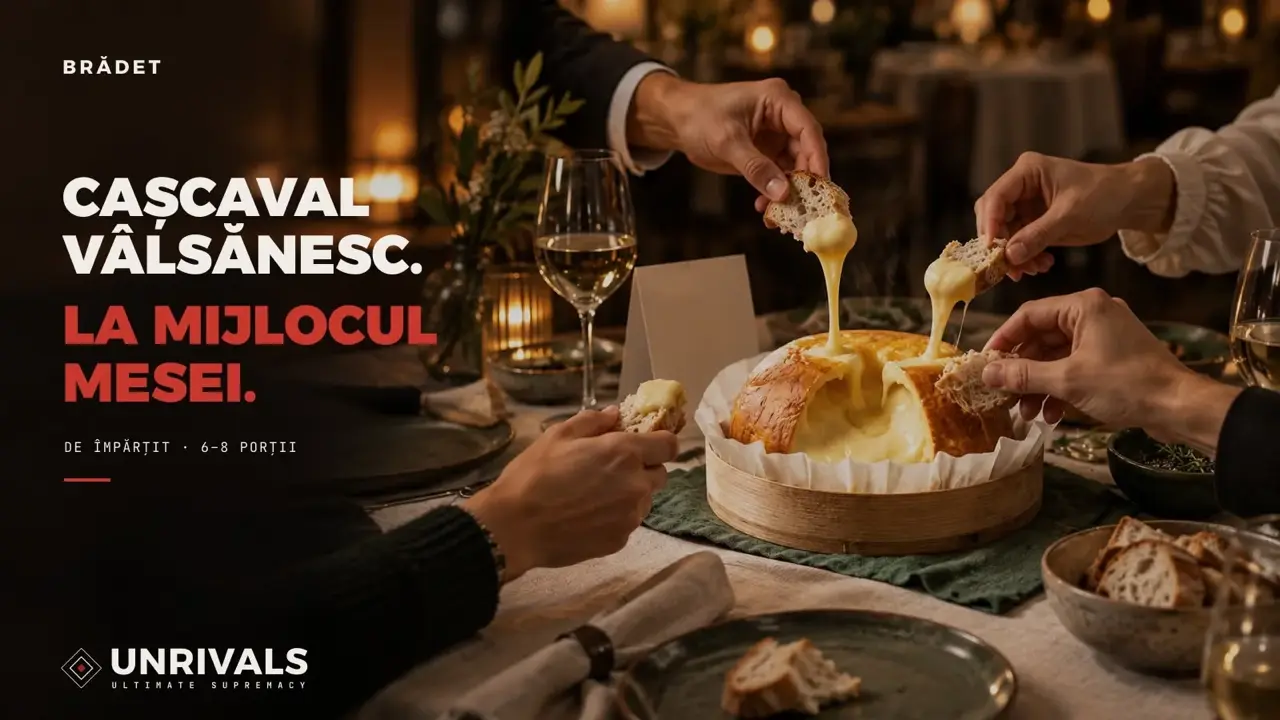
| Lactate Brădet | HoReCa chef or owner | Prospect → Analysis | pilot evening |
Case study 1 · BIG Aluminium
About the company. BIG Aluminium is a Romanian manufacturer of aluminium joinery, curtain walls and ventilated façades, founded in 1994 in Târgu Mureș. It has 30 years of experience, more than 1,200 national projects and more than 100 international projects in 8 countries. Production capacity of more than 30,000 sqm a year. It works with Schüco, Aluprof, Reynaers and Cortizo systems. It has had its own subsidiary in Germany since 2013 and holds international certifications: ISO, BREEAM, LEED, DGNB, nZEB, Passive House.
The central attribute built by marketing: BIG carries the architectural intention from concept to installation, under a single responsibility. Five stages, one single party responsible: architectural concept, structural calculation, engineering measurements, precise production, professional installation. The company addresses three categories of client: the architect, the general contractor and the developer. Each buys something different. The architect buys the fact that their intention arrives intact in the building. The contractor buys predictability on site. The developer buys the asset’s value over time.
Role: BIG Aluminium Export Sales Director. Context: regional conference in London, on 12 November, organised by BIG Aluminium for architecture practices in the UK. The conference is called “When Façade Becomes the Value of the Building”. Its central theme is the move from the architectural drawing to the real façade, under a single responsibility. Target: architecture practices in the UK. SPANCO stage: Suspect. Operational stage: cold call, single objective: sign-up to the event’s information database. Objective: not a sale, not a listing, not a meeting. Only the agreement to receive information about the event.
Role-play
BIG Aluminium Export Sales Director: Hello, this is [name] from BIG Aluminium, calling from Târgu Mureș, Romania. I will take ten seconds of your time. We are hosting a conference in London on the 12th of November for architecture practices working on curtain wall and façade projects. The conference is called When Façade Becomes the Value of the Building.
But before I say anything else, let me tell you what that title means to us. Value here is not the market value of a building. It is the value of your work — the moment when what you drew on paper becomes a real façade and stays exactly as you intended it. For us, that is the only value that matters, because it is the value of the architect’s work, not the developer’s asset.
That is what the conference is about.
We have been producing aluminium curtain walls and ventilated façades for thirty years. We take the architectural concept, run the static calculations, do the engineering measurements, manufacture in our own factory and install on site — under one single responsibility. Your intention does not get diluted between the static engineer, the fabricator and the installer. It arrives in the building exactly as you drew it.
We are not selling anything today. We are only asking one thing: may we add you to the information database for the event? You will receive the agenda, the speaker list, and the official invitation when they are ready. If it interests you, you come. If not, you unsubscribe with one click. May we add you?
Architect, UK: Yes, sure. That sounds interesting.
BIG Aluminium Export Sales Director: Perfect. Thank you. You will receive a confirmation email within 24 hours, with a clear unsubscribe link. If you would like to propose a topic for the conference yourself, reply to that email and I will take it into account.
Addendum: what we did and how
What is sold, and to which category of client. Here, no aluminium is sold, no façade is sold, no production is sold. What is sold is the single responsibility: the fact that the architectural intention does not get diluted between the engineer, the manufacturer and the installer, but stays with a single party responsible, from concept to installation. The client category is the architect, and the architect buys something different from the developer. The developer buys the asset’s value over time, through certifications and energy performance. The architect buys the fact that their drawing arrives in the building exactly as they conceived it.
The conference theme and its double meaning. For the developer, value is asset value, measurable in money and time. For the architect, value is something else: it is the emotional value of their work, the moment when what they drew on paper becomes real and stays exactly as it was conceived. In the cold call, we used the theme as an opening for the architect, explaining exactly this difference: the value is not the building’s, it is your work’s. This way, the theme built in the deck for the developer becomes, for the architect, an emotional gateway into the conversation.
The first 10 seconds: entering through value, not through product. We did not say “we are an aluminium manufacturer”. We said “I am calling from Târgu Mureș, Romania, and I will take 10 seconds of your time”. Then we went straight into the conference theme, explaining immediately that the value is not the building’s market value, but the value of the architect’s work. It is an opening that speaks to them emotionally, because it names exactly what they defend on every project: the fact that their drawing stays intact. We did not ask them for anything, we simply put them in front of the value of their own work.
The central advantage: single responsibility. BIG carries the architectural intention through five stages, under a single responsibility. The architect no longer hands over a drawing and hopes it comes back right. They hand over an intention, and BIG translates it into a constructive system, checks it structurally and carries it through to installation. We used this as the answer to the tension we opened with: your intention arrives in the building exactly as you drew it, because a single party is accountable from the first calculation to the last screw fitted.
The advantages from the deck: shown against the client profile, not listed. More than 100 international projects and the German subsidiary since 2013 are proof that it is not theory; the British architect hears that someone already delivering in Europe knows what their standards mean. The ISO, BREEAM, LEED, DGNB, nZEB, Passive House certifications are mentioned briefly, as fact, as proof of alignment with European project requirements. The 30 years of experience and the more than 1,200 national projects are introduced subtly, as proof of scale and continuity, not as boasting.
SPANCO stage: Suspect. We did not ask for a sale, a listing or a meeting. We only asked for agreement to receive information. It is the lowest possible level of commitment. Once the architect agrees to be in the database, moving to Prospect and then to Analysis is natural, because the relationship already exists.
The subliminal benefit conveyed. The architect is not signing up for a conference. They are talking to someone who understood that the value of their work is not the building’s value, but the fact that their drawing stays intact. What they hear subliminally: no one is selling anything, I am talking to a manufacturer who knows exactly what I defend on every project, who takes responsibility from my drawing all the way to installation, and who already delivers across Europe.
The “why are you asking me this” objection: eliminated. The question about the value of the architect’s work is not a barrier, it is an invitation to reflect. The architect has nothing to answer “why” to, because nothing was asked of them, they were only told something that concerns them directly.
Objective reached. We obtained the sign-up to the database, without talking about products, without talking about price, without asking for a meeting. This is cold call 1, with a single objective: entry into the information database. The next step, cold call 2, comes after the architect receives the agenda, and that is when the conversation enters Analysis, on concrete projects from BIG’s portfolio. The conference theme stays in their mind as the reason BIG Aluminium is not just another supplier, but the partner who carries the architectural intention through to the building, under a single responsibility.
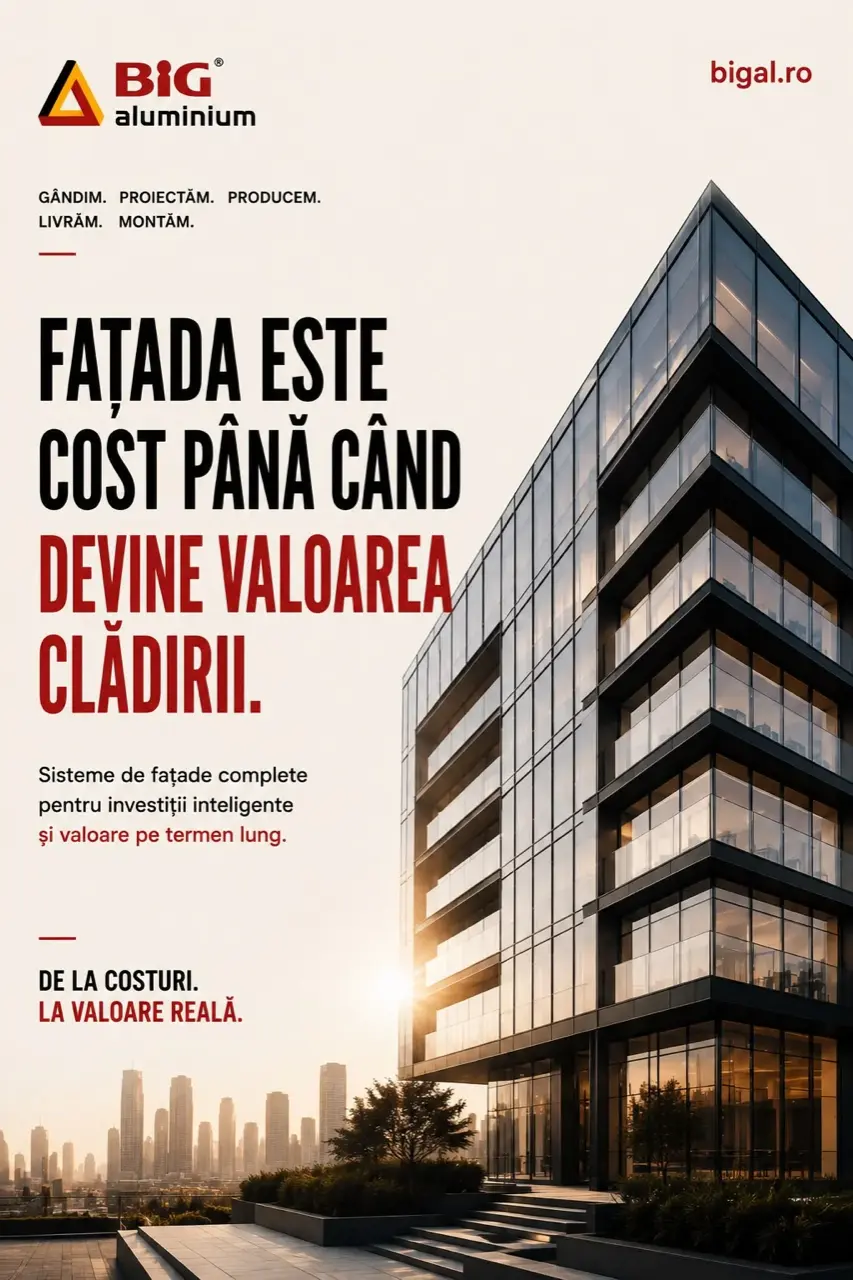
Discover the BIG Aluminium case study
Case study 2 · Fereastra ADF
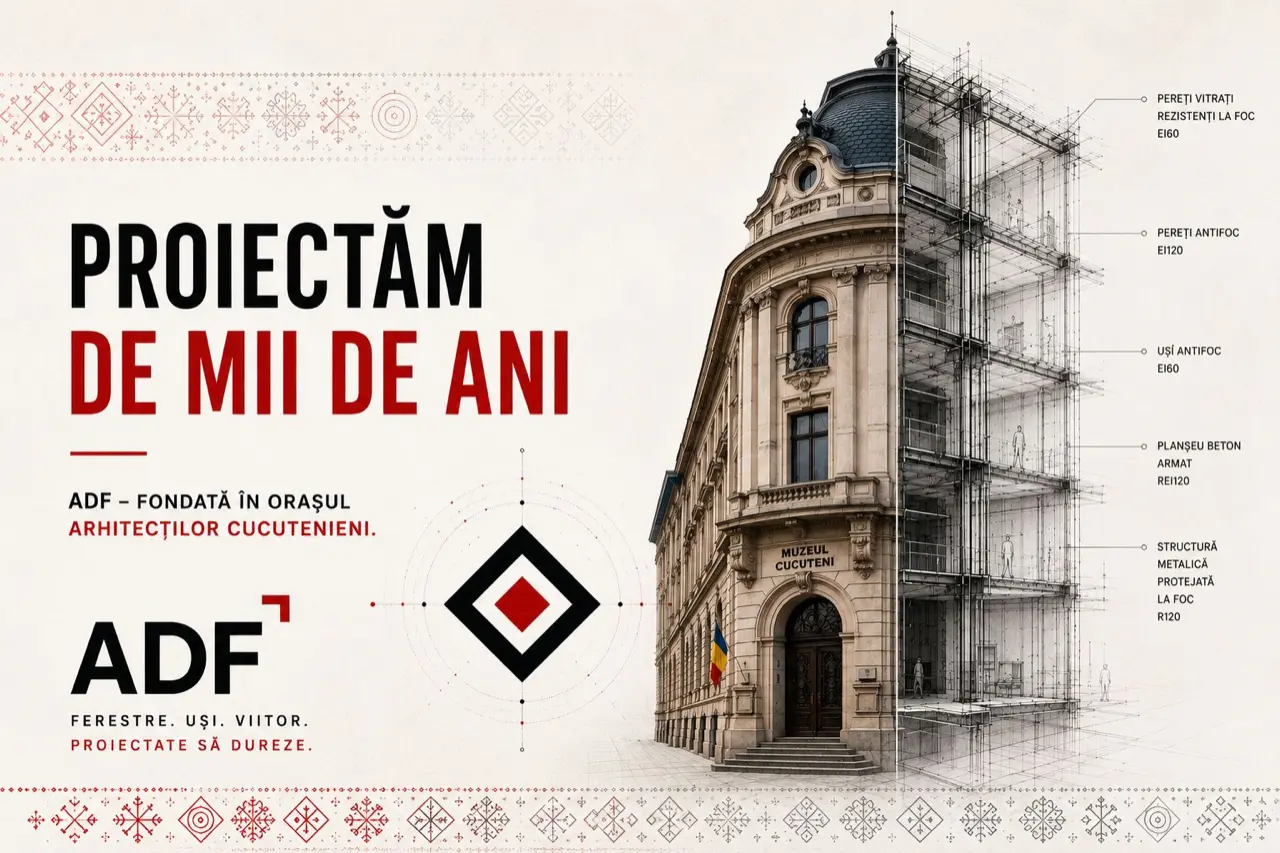
About the company. Fereastra ADF is a Romanian joinery manufacturer, founded in 1994, with its own factory. It produces windows and doors in PVC and aluminium, for residential as well as commercial and public buildings. It has around 323 employees and a turnover of roughly 188 million lei, which places it among the largest joinery manufacturers in Romania. Half of its production goes to export, to Italy, France, Germany, Belgium and Austria. It has its own glass, certified at a reference German institute, and a capability very few Romanian manufacturers have: fire-resistant joinery, certified up to EI120, exactly what is required for public buildings, hospitals, schools and commercial complexes. The company was founded in Piatra Neamț, the city of the Cucuteni architects.
Role: Fereastra ADF Regional Sales Director. Context: the regional conference “News and Technologies applied in architecture”, organised by ADF. Target: architecture practices. SPANCO stage: Suspect. Operational stage: cold call, single objective: sign-up to the event’s information database. Objective: not a sale, not a listing, not a meeting. Only the agreement to receive information about the event.
Role-play
Fereastra ADF Regional Sales Director: Good afternoon. From the city of the millennia-old architects, from Piatra Neamț, the city of the Cucuteni architects, I am calling from Fereastra ADF. I will take 10 seconds of your time, after you tell me one thing. When you design, what weighs more in your decision: the aesthetic side of the building or its durability? Because that tension is exactly what our conference on 15 October is about, titled News and Technologies applied in architecture.
We have been manufacturing joinery for 30 years, in our own factory, with certified glass. But that is not why I am calling. I am calling because we are organising an event for architecture practices working on commercial and public projects, and the central topic is exactly what interests you: how do you specify, in the technical brief, joinery that resists fire, what does EI120 certification mean in practice, and what changes does the new regulation bring for ongoing projects. We hold this certification, and very few Romanian manufacturers do.
I am not selling you anything and I am not asking you to attend. I am only asking for your agreement to sign you up to the event’s information database, so you receive the agenda and the speaker list when they are ready. You get the email, and if it does not interest you, you leave with one click. Shall I sign you up?
Architect: Yes, sure, sounds interesting.
Fereastra ADF Regional Sales Director: Perfect. Thank you. You will receive confirmation within 24 hours, with a clear unsubscribe link. If you would like to propose a topic for the conference yourself, reply to that email and I will take it into account.
Addendum: what we did and how
The first 10 seconds: entering through Cucuteni, not through qualification. We opened with the origin, not with a question. From the first second we said: from the city of the millennia-old architects, from Piatra Neamț, the city of the Cucuteni architects.
We removed the cold call barrier by bringing the architect into the manufacturer’s world. The architect is the hardest category in a manufacturer’s value chain, because they see themselves at the top of the pyramid. If you enter with the product, they treat you as a supplier. If you enter with their own language, they treat you as an equal. Cucuteni is their language.
Qualification: detailed, not binary. We did not ask “residential or commercial”, because that is a segmentation question, not a qualification one. We asked something else: in your projects, when you choose a solution, does the aesthetic side weigh more, or the durability side? This is a question that does two things at once. First: it qualifies the architect on the client profile who might be interested in the conference. Second: it puts them in front of the tension the whole conference is built on, aesthetics versus durability. The architect does not answer “yes” or “no”. They answer with a thought, and the conversation continues naturally from that thought.
The central advantage: Cucuteni, on two levels. The Cucuteni people were the founders of the first cities in Europe. They built megastructures of over 1,000 square metres, huge temples, settlements spread across 25 hectares, fortified with palisades, at a time when the Sumerians still lived in earth dwellings. They appeared 500 years earlier than Mesopotamian civilisation. This, in fact, would have been the cradle of European urban civilisation. ADF makes windows in the place where the architecture of this land began, and no other joinery manufacturer in Romania can claim this. We used the origin as a bridge, not as a slogan: we do not boast about it, we use it as the reason we have something to say at an architecture conference.
The emotional level: Cucuteni art is close to the art of architecture. The Cucuteni people did not leave only walls. They left an aesthetic. Their painted ceramics are unique in the world, with geometric and zoomorphic motifs that look contemporary, displayed in art museums, not just history museums. The Cucuteni Art Museum in Piatra Neamț holds the most important collection of prehistoric art in Eastern Europe. Art and architecture were, at Cucuteni, the same gesture: the person who raised a 1,000-square-metre temple was the same person who painted a vessel with a precision that is still striking today. This connection speaks directly to the emotional side of an architect’s thinking. An architect is not just a technician who calculates loads. They are someone who feels the beauty of a form and knows that a building is, before anything else, an aesthetic gesture. When you tell an architect you come from the city where art and architecture were the same gesture, you speak the language they carry inside but do not use in conversations with suppliers.
The rational level: the durability of the ochre and of the vessels themselves. The Cucuteni people painted with red, black and white ochre on ceramics. Those vessels have survived seven thousand years. Not just the painting survived, but the vessel itself, its structure, its shape. What survived is not only the art, it is also the material’s capacity to hold. This durability speaks directly to the rational side of an architect’s thinking. Every architect knows that a beautiful building that does not hold is a failed building. What lasts is what was conceived both aesthetically and structurally. When you tell an architect you make windows in the city where ceramics have survived seven thousand years, you activate their thinking on durability, on resistance over time, on what it means to build something that lasts. And this thought is exactly the ground on which EI120 certification lands, fire resistance as the supreme form of durability.
The two levels work together. The architect hears one single thing: ADF comes from the place where art and durability were designed together. Emotionally, they are drawn to the beauty of the origin. Rationally, they are convinced that whoever comes from that place knows what it means to build something that holds. Between these two levels, EI120 certification is no longer a technical argument. It becomes the natural continuation of a tradition of builders who made things that last.
The strategic advantages from the deck: shown against the client profile, not listed.
- Cucuteni, Piatra Neamț: the origin, the territory that belongs only to this company, used as the gateway into the conversation.
- Fire-resistant joinery up to EI120: the certified capability the deck calls the best argument, the most buried one. Introduced as an agenda topic, not as a sale.
- Export into markets with strict standards: export-grade quality, manufactured in Romania, mentioned briefly as proof of credibility.
- The new regulation for projects: introduced as a benefit for the architect, not as a sales argument.
- Its own factory and certified glass: introduced subtly, as the reason ADF has something to say at a conference about applied technologies.
SPANCO stage: Suspect. We did not ask for a sale, a listing or a meeting. We only asked for agreement to receive information. It is the lowest possible level of commitment, which makes the sign-up almost inevitable.
The subliminal benefit conveyed. The architect is not signing up for a conference. They are talking to someone who comes from the place where art and architecture were the same gesture, who manufactures in its own factory for 30 years, and who holds a fire-resistance certification almost no one else has. What they hear subliminally, on two levels: emotionally, I am talking to an equal from my own world, who feels the beauty of a form; rationally, I am talking to someone who comes from the place where things last seven thousand years, so they know what durability means.
The “why are you asking?” objection: eliminated. There is no longer a binary qualifying question that invites an objection. The question about aesthetics versus durability is not a barrier, it is an invitation to reflect.
Objective reached. We obtained the sign-up to the database, without talking about products, without talking about price, without asking for a meeting. The next step, cold call 2, comes after the architect receives the agenda, and that is when the conversation enters Analysis, on concrete technical topics from their projects. The Cucuteni advantage stays in their mind as the reason ADF is not just another supplier, but a manufacturer who comes from the place where art and durability were designed together.
Case study 3 · Romturingia
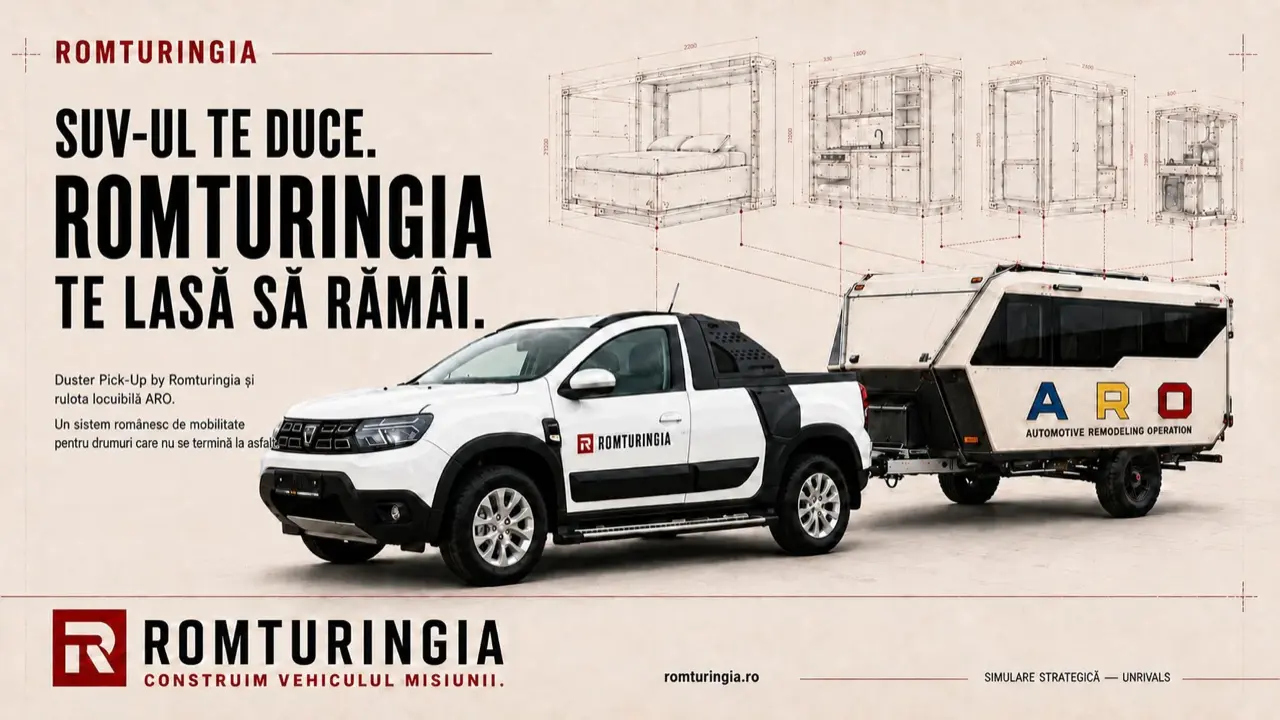
About the company. Romturingia is a Romanian manufacturer of bodywork and special vehicles from Câmpulung Muscel. It produces and fits out refrigerated vehicles, ambulances, fire-fighting special vehicles, armoured vehicles and derivatives built on automotive platforms (Dacia Duster Pick-Up, Renault Express, under an official OEM partnership).
Role: Romturingia Sales Director. Context: a new range for tourism and van life. Buyer: premium second-hand car dealer. SPANCO stage: Prospect. Operational stage: cold call.
Role-play
Romturingia Sales Director: Good afternoon. Calling from Romturingia, I will take 10 seconds of your time. We have a national concept in our factory that does not exist anywhere else in the market right now: reviving the ARO tradition, but on a growing and exclusive niche, van life. It would let you balance your revenue with minimal upfront effort, backed by us through campaigns for the end customer.
When can we go through the concept in detail, tomorrow or Thursday?
This is about the Romturingia VanLife range, aimed at a customer profile complementary to the ones buying premium second-hand cars. The showroom space needed would be small, tied to how we split the demo car investment between us and you, but above all to a dealer-focused campaign designed to move this product quickly from stock.
Premium second-hand dealer: Interesting, but I sell premium second-hand cars. My customers want Porsche, BMW, Mercedes. Why would I need an ARO? And who buys it?
Romturingia Sales Director: That is exactly the point. Your customer is not replacing their BMW with an ARO. But they already have a BMW in the garage and are looking for something complementary, a second car for weekends, holidays, light off-road. Van life is a growing niche, and the person paying 60,000 for a premium second-hand car is exactly the person who would pay 40,000 for an adventure vehicle that looks like a revived ARO.
We manufacture in Câmpulung Muscel. We already have the Dacia Duster Pick-Up under an official partnership with Dacia. Our industrial capacity is proven: 145 reviews, a 4.7 rating, the largest volume in our category. And on van life the territory is open, no one else in Romania makes this.
I propose a pilot: we bring a demo car into your showroom, split the investment, and we run the campaign to the end customer in your area. You decide if and when. If it does not sell, we withdraw it. If it sells, you have a new revenue stream from the same showroom. When can I show you the concept, tomorrow or Thursday?
Addendum: what we did and how
1. The first 10 seconds: WHY, not WHAT. We did not say “we sell van life vehicles”. We said “we have a national concept in our factory that does not exist anywhere else”. The WHY is the ARO heritage plus van life freedom. The customer is not buying a vehicle, they are buying a story they can resell.
2. The strategic advantages from the deck, made tactical.
- Reviving the ARO tradition: inherited positioning, symbolic capital.
- A growing and exclusive niche: the open territory, van life.
- You balance your revenue: the dealer’s economic benefit.
- Minimal upfront effort: reduced risk, shared demo car.
- Backed by us through campaigns for the end customer: guaranteed sell-out, marketing handed over.
- The demo car investment split: zero barrier to entry.
- A dealer-focused campaign to move it quickly from stock: rotation, not dead stock.
3. SPANCO stage: Prospect → Analysis. We did not ask for a sale. We asked for the decision to go through the concept in detail, tomorrow or Thursday, a choice between two yeses, not between yes and no.
4. The subliminal benefit conveyed. The dealer is not buying a vehicle. They are buying balanced revenue, minimal risk, exclusivity, sell-out backed by someone else. What they hear subliminally: this is not an expense, it is complementary income at close to zero risk, that someone else is backing for me.
5. The response to the “who buys it?” objection. We did not contradict. We requalified the customer: they are not replacing the BMW, they are completing it. We moved the conversation from “why ARO?” to “what does your customer do with their second car?”
Case study 4 · Pleuro Ind
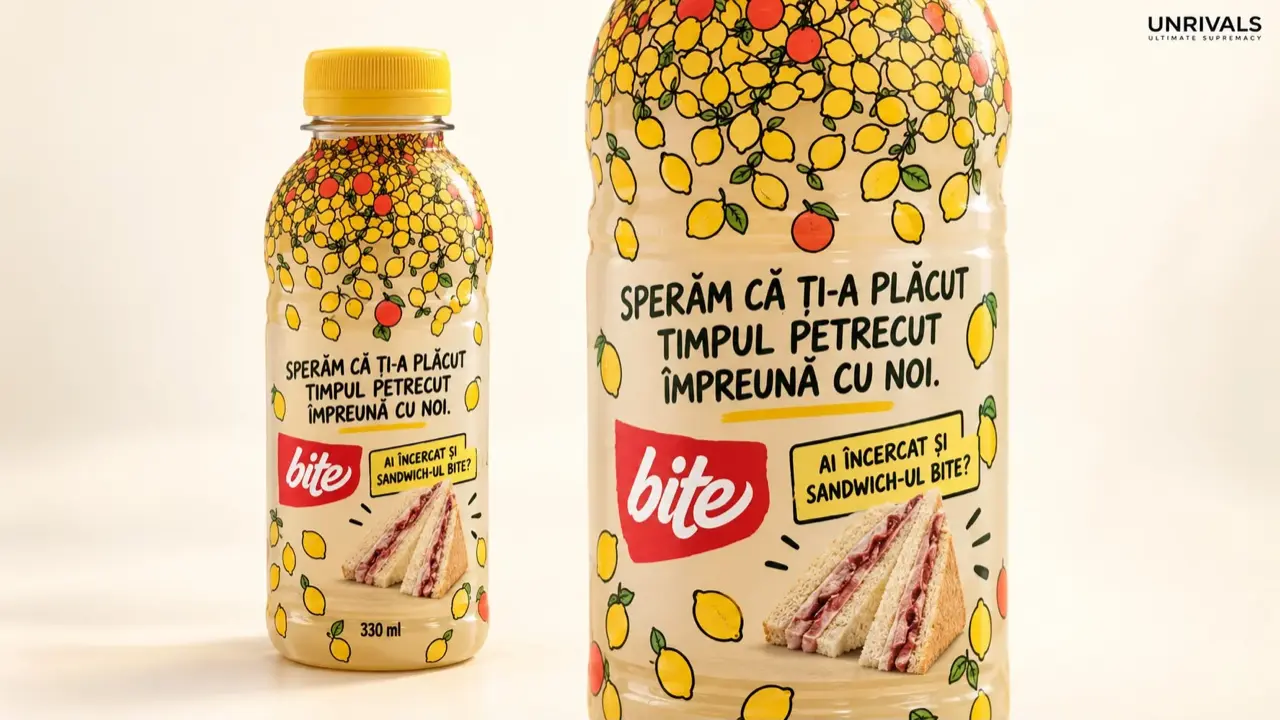
About the company. Pleuro Ind is a Romanian manufacturer of packaged sandwiches and ready-to-eat products, from Târgu Mureș, operating since 1997. It owns the BITE brand for the end consumer and produces private label for retailers. It had 38.26 million lei in turnover in 2025, up 18.3% on 2024, and 5.31 million lei in net profit cumulated over four years, without a single loss-making year, the only company among those analysed that is both growing and staying profitable.
Role: Pleuro Ind Sales Director. Context: listing 12 new SKUs (lemonade and healthy sandwich) at Mega Image. Buyer: ready-to-eat and convenience category buyer. SPANCO stage: Prospect → Analysis. Operational stage: cold call → pilot validation → listing negotiation.
Role-play
Pleuro Ind Sales Director: Hi there. I will take 10 seconds of your time, after you tell me whether you still have any shelf space free for around 12 new SKUs on lemonade and healthy sandwich.
Buyer: No chance.
Pleuro Ind Sales Director: I promised 10 seconds. Our marketing team built an incredible sell-in and sell-out simulation, and I would love to validate it with you on Wednesday or Thursday: 10 instant sell-outs, backed by a media campaign that costs you nothing, but where you decide the store and the proximity for the pilot project.
Addendum: what we did and how
1. The first 10 seconds: WHY, not WHAT. We did not say “we want to list 12 products”. We said “tell me whether you still have shelf space free”, turning the request into an availability question, not a favour request. The WHY is sell-out, not listing.
2. The strategic advantages from the deck, made tactical.
- 12 new SKUs on lemonade and healthy sandwich: a concrete figure, not a promise.
- The sell-in and sell-out simulation built by marketing: marketing has already done the work, the salesperson is not asking, they are validating.
- 10 instant sell-outs: the buyer’s direct economic benefit, rotation, not dead stock.
- A media campaign that costs them nothing: zero risk for the buyer.
- The buyer decides the store and proximity for the pilot project: they keep control, autonomy as a subliminal benefit.
3. SPANCO stage: Prospect → Analysis. We did not ask for a listing. We asked for validation of a pilot, Wednesday or Thursday, a choice between two yeses, not between yes and no.
4. The subliminal benefit conveyed. The buyer is not buying 12 SKUs. They are buying an already-simulated sell-out, zero risk, control over the pilot. What they hear subliminally: this is not a listing, it is a validation that they are running for me, with their own money and their own campaign.
5. The response to the “no chance” objection. We did not contradict the objection. We went around it with proof already built, the simulation, and moved the conversation from “I have no room” to “let’s validate this together”.
Discover the Pleuro Ind case study
Case study 5 · NewTech Automation
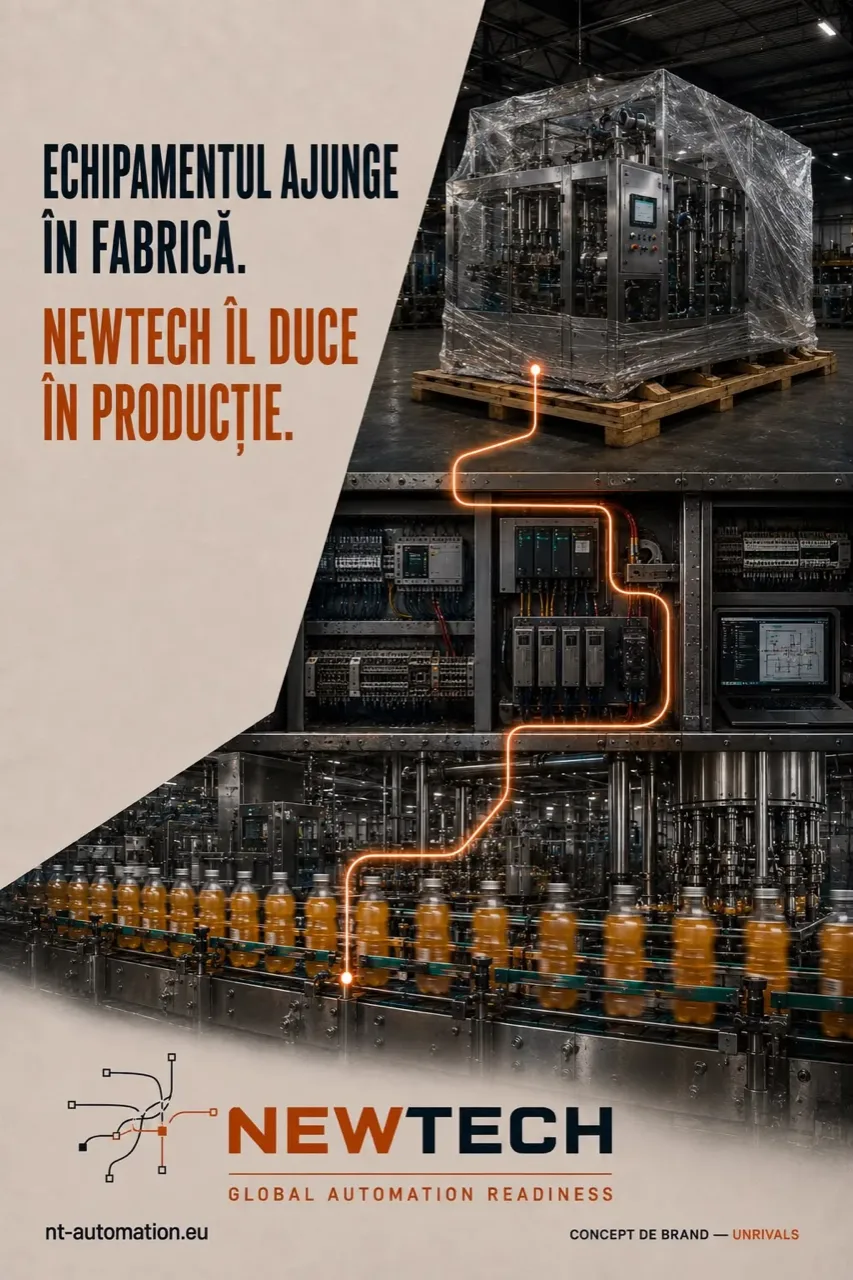
About the company. NewTech Automation is a Romanian industrial automation company, founded in 2003, based in Gorj county. It grew from zero in 2022 to 22.3 million lei in turnover in 2025, with 37 employees reported financially. It has commissioned more than 100 production lines in 55 countries, more than 5,000 publicly claimed interventions and a team of technicians who travel anywhere in the world. It works for international beverage brands, alongside OEM partners, and has three lines of business under the same brand: installation and commissioning of complete lines, in-house built equipment, and BMS/KNX systems.
The mental association built by marketing: NewTech = Production Readiness. The promise, in eight words: a line is not ready when it is installed, it is ready when it produces. The company comes from Târgu Jiu, the city of Brâncuși. The proposed visual identity starts from a digitised Endless Column, and the email signature carries this geography. The goal: growing brand awareness and preference, by dropping the term “Eastern Europe” as a business geolocation and using Brâncuși instead as an origin geolocation.
Role: NewTech Automation Sales Engineer. Context: a conversation with a project director at an international bottling equipment OEM, who needs a commissioning team for a new line, in a factory in Europe. The OEM delivers the equipment but does not want to send its own team for the commissioning phase. Target: OEM project director. SPANCO stage: Prospect → Analysis. Operational stage: qualifying cold call, single objective: agreement to a 30-minute discussion in which mobilisation capacity is validated and time-to-start is measured together.
Role-play
NewTech Automation Sales Engineer: Good afternoon. This is [name], from NewTech Automation. I will take 10 seconds of your time. When you deliver a line in a country where you have no team of your own, who guarantees the line started at optimal parameters? We do exactly that part, in 55 countries.
We are the team that steps in between the equipment delivered and the line that produces. 100 lines commissioned, alongside OEM partners. I am asking for a 30-minute discussion, where we put three things on the table: our mobilisation capacity in that country, the time to start-up on the last three lines we commissioned, and what stays written in your contract if the line does not start on time. If the numbers do not add up, we stop there.
I propose Wednesday or Thursday.
We are from Târgu Jiu, the city of Brâncuși. But more on that another time.
OEM project director: Wednesday, but tell me why I would choose NewTech and not a local team in that country.
NewTech Automation Sales Engineer: Because it is unlikely a local team has commissioned 100 lines in 55 countries, and you do not want to risk a new line with a team that has never seen exactly this type of equipment. We do not learn on your line. We have already seen this equipment, in other factories, in other countries, in other conditions.
Wednesday, what time?
The engineer’s email signature
The confirmation email, sent within 24 hours, carries the brand geography further, without explaining it.
Best regards, [Engineer’s name] NewTech Automation Sales Engineer Târgu Jiu, the city of Brâncuși. A line is not ready when it is installed, it is ready when it produces. [Visual signature: digitised Endless Column]
Addendum: what we did and how
What is sold, and to which category of client. Here, no automation is sold, no software is sold, no PLC is sold. What is sold is production readiness, the state the client’s line reaches after the equipment has been delivered. The client category is the international OEM, who delivers the equipment but does not want to send its own commissioning team into every country. The OEM buys predictability, a single party responsible, the fact that they do not expose their own team to logistical risks and, most importantly, the fact that they do not lose credit in front of their end customer.
The first 10 seconds: Brâncuși, said once, with no explanation. We opened with the differentiator, not with the story. When you deliver a line in a country where you have no team of your own, who signs off that the line started at the right parameters? Then we said what we do: that part, in 55 countries, without competing with the OEM. And only at the end, as an aside: we are from Târgu Jiu, the city of Brâncuși. But more on that another time.
Why Brâncuși, not Eastern Europe, as brand geography. “Eastern Europe” is a term that drags perception down. In the mind of a Western European OEM project director, Eastern Europe means risk, lower cost, uncertain standards, distance. Brâncuși, on the other hand, is a name the entire world recognises as belonging to a world-class artist, born in Romania but belonging to universal heritage.
When you replace Eastern Europe with the city of Brâncuși, you are no longer selling a country, you are selling a cultural origin. And this cultural origin cannot be claimed by any competitor, regardless of price. The purpose of this brand geography is growing awareness and brand preference. Awareness, because people remember a place, not a service. Preference, because when they have to choose between NewTech and a local team, the difference is no longer about price, it is about origin, story and memory.
Why we said Brâncuși only once, at the end. A memorable cold call does not mean a rich cold call. It means a cold call with a single detail that is not forgotten. If you tell someone Brâncuși, cyclicality, the Endless Column, art, redundancy and industry in 10 seconds, they retain nothing. If you just say “we are from Târgu Jiu, the city of Brâncuși” and stop there, the person is left with a name they already know. And that name does all the work in their mind, without needing any explanation. We added “but more on that another time” to leave a door open, a reason to continue the conversation.
The visual identity: the digitised Endless Column. The Endless Column is a structure built from repeating rhombi. Repetition is the essence of redundancy. In the production-line industry, equipment redundancy is exactly what keeps a line from stopping when one element fails. Production readiness essentially means the line has cyclicality and redundancy where it matters. The proposed visual identity, the digitised rhombus column, is not decoration. It is a strategic statement: NewTech does in industry what Brâncuși did in art.
The email signature: the bridge between phone and inbox. After the call, the person receives a confirmation email within 24 hours. If the email just says “thank you for the call”, the memory is lost. That is why the signature repeats the anchor, without explaining it: Târgu Jiu, the city of Brâncuși. And the promise: a line is not ready when it is installed, it is ready when it produces. The email signature is where the brand geography starts working on its own, without the salesperson needing to repeat it on every call.
The real differentiator: global implementation capacity. What takes the company out of comparison with any other automation firm is that it does not sell programming hours. It is the global implementation capacity the OEM calls on when it does not want to send its own people 3,000 kilometres from home. 100 lines in 55 countries is not a pitch figure, it is proof they can enter any country, with any standard, without the OEM taking on the logistical risk.
The new tagline: GLOBAL AUTOMATION READINESS. This replaces the old “Excellence in Every Step”, which described an intention any company could have. GLOBAL AUTOMATION READINESS describes exactly the territory NewTech already occupies, without ever having named it: the state the client’s line reaches after the equipment has been delivered, in any country, under any standard.
The tagline is not a promise, it is a category. It moves the company out of the crowded space of industrial automation, where every competitor says the same thing, into the open space of readiness, where no one else publicly claims the territory between the equipment delivered and the line that produces.
The eight-word promise. A line is not ready when it is installed, it is ready when it produces. These eight words are the differentiator no one else in the automation category can legitimately claim, because no one else publicly works the territory between the equipment delivered and the line that produces. We used it as the closing line in the email signature, so the person could read it the next day, not just hear it on the phone.
Objective reached. We obtained agreement to a 30-minute discussion, in which we validate mobilisation capacity in that country and measure the time to line start-up, on their own numbers. This is a qualifying cold call, with a single objective: the move from Prospect to Analysis. The next step is to put three written cases on the table: which line, in which country, how many days to start-up, what was solved on the spot 3,000 kilometres from home, and to measure together the figures that matter to them: days to start-up, delays avoided, capacity mobilised within a week.
What we actually obtained, beyond agreement to the discussion, is traceability: the same brand memory thread that begins with Brâncuși spoken on the phone, continues in the email signature and reaches the letterhead that enters the OEM’s evaluation. The person who heard the voice finds the same origin geography on every document, and the decision is no longer made on price, but on the fact that the brand is already known to them and preferred before they even compare offers.
Case study 6 · Pescado Grup
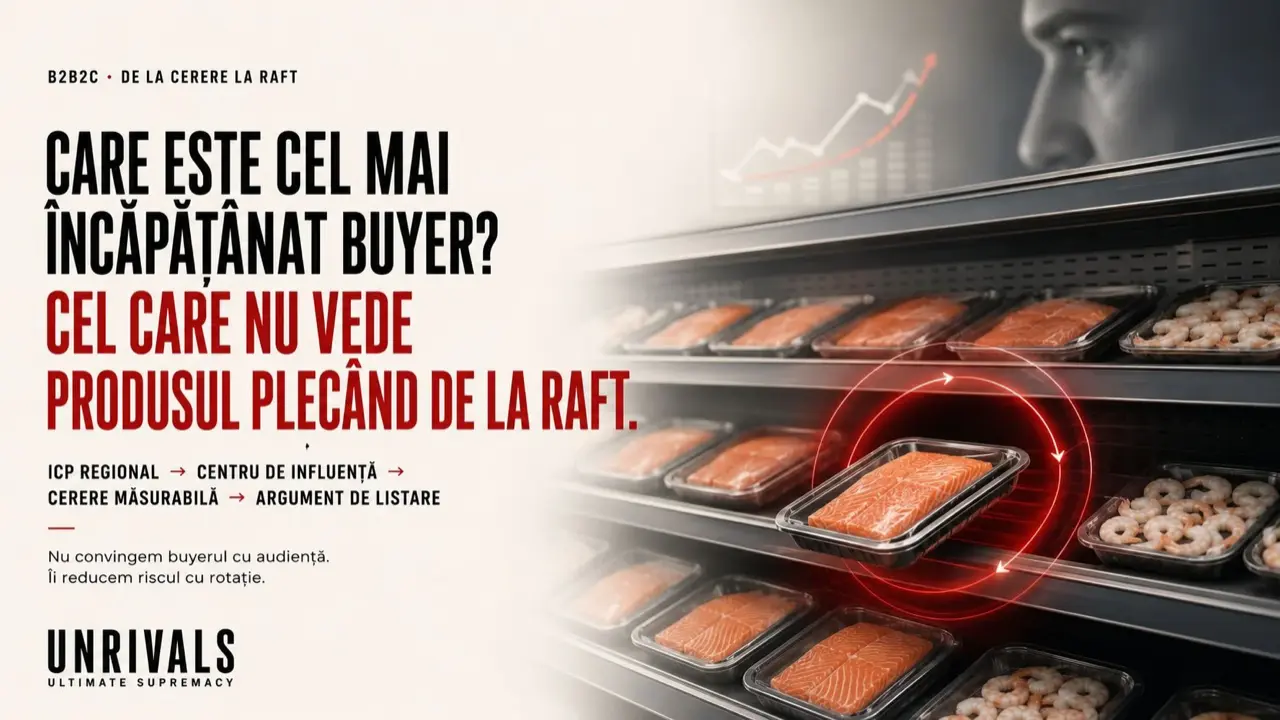
About the company. Pescado Grup is the third-largest fish processor in Romania, with 134.7 million lei in turnover in 2025 and growth every year since 2022. It has two factories, IFS and MSC certifications, and audits carried out by Lidl, Penny and Carrefour France. It owns two proprietary brands, Bonito and Salmaris, and a network of 20 franchise stores across Moldova and Dobrogea. It has produced private label for 16 retailers, for more than ten years, in Romania and France. It has had zero market withdrawals in 23 years.
Role: Pescado Grup Sales Director. Context: listing the Bonito “An evening for two” range (salmon and prawns) in modern retail. Buyer: fish and seafood category buyer, modern retailer. SPANCO stage: Prospect → Analysis. Operational stage: cold call → pilot validation → listing negotiation.
Role-play
Pescado Grup Sales Director: Hi there. I will take 10 seconds of your time, after you tell me whether you still have shelf space free in the fish aisle for around 6 new SKUs on salmon and prawns, designed as a single shopping basket.
Retail buyer: I already have salmon and prawns from other suppliers. Why would I switch?
Pescado Grup Sales Director: I am not asking you to switch. I am asking you to validate a sell-out simulation our marketing team built on real shelf data. I am not coming with an extra product. I am coming with a consumption occasion that is missing from your shelf. We created “An evening for two”: the salmon carries the prawns on its packaging, the prawns carry the salmon on theirs. The person picking up the salmon is not near the prawns today. We move the decision from the shelf to the packaging. The two products currently sit separately on the shelf. We propose putting them side by side, as a single basket. We are not asking for new shelf space, we are asking for rearrangement within proximity.
And there is proof no competitor can copy: zero market withdrawals in 23 years. In a category where recalls make the press, that is the one sentence no one else can say without having actually done it. We put it on the packaging and in the communication. We back the sell-out with a paid campaign around each pilot store. We do not put any cost on you. And you choose the store and the proximity. We measure the rotation together after 30 days. If it works, we expand. If not, we stop. My question: which store do you want us to test, and when can we do the first measurement, Wednesday or Thursday?
Addendum: what we did and how
1. The first 10 seconds: WHY, not WHAT. We did not say “we want to list salmon and prawns”. We said “a single shopping basket”, turning the products into a consumption occasion, “An evening for two”, not a list of SKUs. The WHY is the moment, not the product.
2. The strategic advantages from the deck, made tactical.
- An evening for two: packaging as media, the salmon sells the prawns, the prawns sell the salmon.
- Cross-selling through proximity: rearrangement, not new shelf space.
- Zero withdrawals in 23 years: proof no one else can copy.
- A B2C campaign with geo-targeting: sell-out backed, zero risk for the buyer.
- A pilot project: the buyer chooses the store and the proximity.
3. SPANCO stage: Prospect → Analysis. We did not ask for a listing. We asked for validation of a pilot, Wednesday or Thursday, a choice between two yeses.
4. The subliminal benefit conveyed. The buyer is not buying 6 SKUs. They are buying a bigger basket from the same shelf, with zero risk and control over the pilot. What they hear subliminally: this is not a listing, it is a consumption occasion I am validating, with their own money and their own campaign.
5. The response to the “I already have salmon and prawns” objection. We did not contradict. We moved the conversation from product to shopping basket: we are not replacing anything, we are adding a consumption occasion that grows the basket.
Case study 7 · Lactate Brădet
About the company. Lactate Brădet is a dairy producer from Brădetu, Argeș county, operating since 2005. It had 34.6 million lei in turnover in 2025, 71 employees and a net margin of 1.05%, the lowest among the six comparable producers. It owns a certified traditional smoked cheese, Cașcaval afumat vâlsănesc, at position 702 in the national register, which no competitor can claim.
Role: Lactate Brădet Sales Director. Context: selling the certified Cașcaval afumat vâlsănesc to a premium HoReCa client, through the “Portion of 8” campaign concept. Buyer: owner or chef of a premium restaurant, boutique hotel. SPANCO stage: Prospect → Analysis. Operational stage: in-person meeting at the restaurant, tasting, menu and event discussion.
Role-play
Lactate Brădet Sales Director: Good afternoon. Thank you for having us. I have come with the cheese, not with a presentation. Please taste it first, then we will talk.
This cheese is a certified traditional smoked cheese, Cașcaval afumat vâlsănesc. It is registered at position 702 in the national register of traditional products.
I am not bringing you one more product for the menu. I am bringing you a product that cannot be copied. And that matters for a restaurant like yours, because your menu defends itself through things no one else in town can put on the table. What I am proposing is not a listing. It is a Portion of 8, a campaign concept we built together with our marketing team, and which we are sharing with you.
Behind the certification is a place that belongs only to this product. Brădet Hermitage, documented as early as 14 May 1503. Whoever asks about the story of the cheese on the platter gets a story that begins in 1503 and ends in our factory in Brădetu. Then there is the production. Hand-shaped, the cheese’s belly pulled by hand, a rounded form. An industrial line cannot reproduce the shape. A guest who picks up the piece from the platter and sees the shape immediately understands this is not a supermarket product.
And there is a ritual your kitchen can use exactly as it is: good cold, surprising hot. One form, two experiences. We can suggest how to put it on the menu, as a hot starter or as a cheese platter, without you needing to change your kitchen.
What does this bring you, concretely, as a premium HoReCa business. A product no one else in town has. A large potential additional turnover, because the Portion of 8 sells as an event, not as an ordinary meal. And a niche gastronomic event you can run on top of your usual consumption: an evening of Cașcaval afumat vâlsănesc, with the story of the place, with the two temperatures, with the platter of 8, where the product is the main character, not the side dish.
We back the event with communication and materials. You choose the date, the room and the format. We come with the product, the story and the campaign. If it sells, we repeat it monthly. If not, it stays a single evening. I am proposing something concrete: a pilot evening in the next three weeks, with a tasting for your floor team, so they know what to tell guests. When would suit you to meet and go through the premium HoReCa Vâlsănesc 1503 concept in detail, tomorrow or Thursday?
Addendum: what we did and how
1. The first 10 seconds: WHY, not WHAT. We did not start with the product, we started with the gesture: I came with the cheese, not with a presentation. The WHY is the certified authenticity and the place, not the cheese itself. The premium HoReCa customer is not buying a product, they are buying something no one else in town can put on the table.
2. The Portion of 8 concept: what it is and how it is shared. The Portion of 8 is not a SKU. It is a gastronomic campaign concept: a platter of 8, built around the certified Cașcaval afumat vâlsănesc, sold as an event, not as an ordinary meal. It is shared with the restaurant: we bring the product, the story, the materials and the communication, the restaurant brings the room, the team and the guests. The result is not a listing, it is an event that can be repeated.
3. The strategic advantages from the deck: shown against the premium HoReCa client profile.
- The traditional product certification, position 702, the only holder with its own factory: tells the premium client that their menu is defended by things no one else can copy.
- Brădet Hermitage, documented in 1503: symbolic capital that belongs to the place, turned into a story for guests.
- Hand-shaped, rounded form: a physical differentiator the guest sees at the table, impossible to reproduce industrially.
- Good cold, surprising hot: a consumption ritual that goes straight onto the menu, without changing the kitchen.
- The Portion of 8 and the niche gastronomic event: a large potential additional turnover, on top of usual consumption.
- The pilot evening with a tasting for the floor team: zero risk, the buyer decides.
4. SPANCO stage: Prospect → Analysis. We did not ask for a listing. We asked for a pilot evening within three weeks, tomorrow or Thursday, a choice between two yeses.
5. The subliminal benefit conveyed. The premium HoReCa client is not buying a cheese. They are buying a menu argument, a story to tell at the table, a product the restaurant across the street cannot copy, and an event that brings extra turnover. What they hear subliminally: this is not a new supplier, it is an event only I can hold in this town, with a story that begins in 1503.
6. The response to the “I already have smoked cheese from three suppliers” objection. We did not contradict. We moved the conversation from supplier to event. We are not replacing a supplier, we are adding an evening no one else in town can hold, with a certified product, registered by position.
7. What we actually obtained. We did not sell a cheese. We removed the comparison, because the product has no equivalent. We turned the product into an event, because the Portion of 8 is held for one evening, repeats monthly, and does not resemble usual consumption. We shifted the risk onto us, because they do not pay to see if it works. We left control with them, because they choose the date, the room and the format. And we opened the way to a long-term client, who no longer looks for another supplier in this category, because we entered the menu as an event partner, not as a supplier.
What we gained, concretely: a premium HoReCa client who does not compare us with anyone, because the product has no equivalent. Additional turnover that does not compete with the restaurant’s usual consumption, but completes it. An event that repeats, so recurring revenue, not a one-off sale. A position no other Romanian dairy producer can occupy, because they lack the certification, the place, the hand-made production and the concept. An entry into the premium HoReCa market with no tender, no price negotiation, no supplier comparison.
From buyer performance to reduced risk
Pleuro Ind does not sell sandwiches. It sells the category buyer’s monthly performance. For the retail buyer, a SKU is not valuable because it is new, healthy or well packaged, but because of how fast it rotates, how much revenue it produces from the space it occupies, and how much stock risk it introduces. That is why the commercial conversation moves from “list our products” to sell-out, rotation, revenue per shelf space and category performance. Pleuro is not asking for space; it has to prove it can make the existing space more productive.
Romturingia does not sell a vehicle. It sells a new revenue stream for the dealer. The premium second-hand car dealer does not need to be convinced to believe in ARO or in van life. They need to see they can monetise the same showroom, the same customer base and the same commercial infrastructure through a complementary product, with controlled upfront investment and risk. The physical product is the vehicle; the commercial product is the complementary income.
NewTech Automation does not sell automation. It sells the moment the factory can produce. For an OEM, installing the equipment is not the final result. The result is the line started, stable and running at contracted parameters. NewTech occupies exactly the space between the equipment delivered and actual production. The buyer is purchasing time-to-production, predictability and reduced commissioning risk.
Pescado Grup does not sell salmon and prawns. It sells the value of the shopping basket. For the retail buyer, “An evening for two” should not be presented as one more range of fish products. The products together create a consumption occasion and drive complementary buying: the salmon sells the prawns, the prawns sell the salmon. The commercial unit is no longer the individual SKU, but the basket and the additional value generated by the same store visit.
We do not sell files. We build performance
We do not sell folders of documentation, PDF training files that end up in a folder and get opened twice, brand manuals that grow old on dusty shelves, strategies approved in meetings and abandoned after three months, or packaging designs forgotten in printing houses’ computers. Nor do we sell beautiful presentations that the sales team then has to learn on its own how to turn into a conversation with a customer.
The industry has spent too long separating things that only work together. The branding agency delivers a flawless identity and leaves before finding out whether it ever changed a single buying criterion. The advertising agency takes the photos and buys the exposure. The consultant writes the strategy. The designer draws the mark. The sales training company applies a bit of botox to the sales pitch: smoother, more confident, the same lines and objection-handling techniques. Sometimes botox really is the right product; the problem starts when you try to treat every company with it. In the end, the salesperson receives all these pieces and is sent alone in front of the customer to stitch them together. Strategy says one thing, the brand tries to convey another, the campaign optimises its own results, training gives them a technique, and the salesperson has to turn all of it into a contract on their own.
UNRIVALS starts from the opposite question: if all these disciplines have to produce the same economic result, why would they operate as separate systems?
That is why, within VANGUARD, positioning, brand architecture, manuals, visual identity, packaging design, commercial materials, SPANCO scripts, objection responses, sales team preparation and measurement tools are not services we try to sell separately. They are products included at no separate cost, because they are components the system needs in order to function.
A brand manual is not valuable because it has 80 pages, but if the same positioning reaches the packaging, the advertisement, the offer and the first ten seconds of the salesperson’s conversation. Sales training is not valuable because 20 people received a certificate, but if those people understand what the customer is actually buying, what risk they are trying to reduce, what decision criterion needs to change and what proof can support that criterion. Packaging design is not valuable because it looks good on the designer’s screen, but when it changes perception on the shelf, supports the positioning, increases basket value or speeds up product rotation. And a strategy is not valuable because it was approved by management, but when its effect can be traced through the company’s operations and, ultimately, into revenue.
We do not optimise each piece for its own beauty, and we do not bill separately for every file produced along the way. We build a single system in which every component has to contribute to the operational and commercial performance of the next one. That is why, for UNRIVALS, the final deliverable is not the PDF, the brand manual, the packaging, the advertisement, the training, or even the strategy. The final deliverable is a company that knows more clearly what it sells, why it is chosen, how it proves its value, and how it turns that value into contracts, orders and revenue growth. The rest are the system’s components.
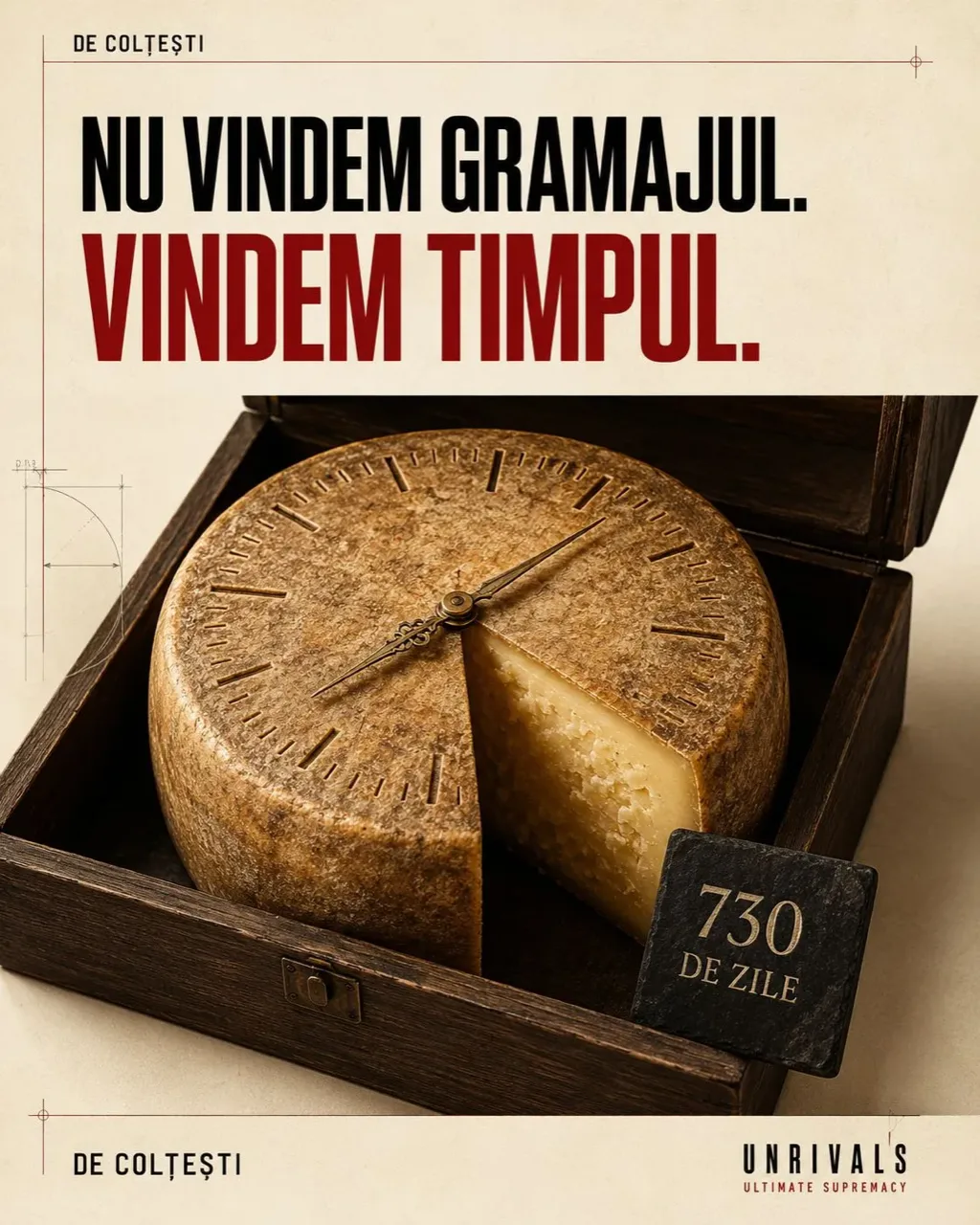
De Colțești does not sell matured cheese. It sells time turned into value. In a category where the buyer first sees types of cheese, weights and prices, De Colțești can change the comparison criterion: the number of days becomes the measure of the product. Time organises the range, explains the differences between products and justifies the move towards higher levels of value. The origin, Colțești, the Trascău Mountains, Apuseni, proves the provenance; maturation builds the value. The customer no longer just chooses “which cheese do I buy?”, but “how much time do I want to buy?” For retail, that means a range that is easier to understand and to differentiate on the shelf.
For HoReCa it means the chance to turn cheese from an ingredient into a product with a story, an origin and a level of maturation that can support the value of the dish. For the consumer it means something very simple: the longer time has worked on the product, the more value the choice carries.
Discover the De Colțești case study
Vision → Strategy → Positioning → Brand → Communication → Sales → Operations → Revenue. This is the logic of VANGUARD, built by Daniel Roșca.
Frequently asked questions
What does SPANCO mean?
SPANCO is a commercial methodology describing a buyer’s journey in six stages: Suspect (unqualified contact), Prospect (qualified potential client), Analysis, Negotiation, Contract and Order. Its practical value comes from the fact that each stage has its own objective: you do not ask for the order at the Suspect stage, you only ask for the move to the next stage.
How does SPANCO UNRIVALS™ differ from classic SPANCO?
Classic SPANCO describes the stages a buyer goes through. The UNRIVALS extension adds eight steps that run beforehand: diagnosing the company, exposing the perception gap, removing generic claims, finding the open territory, reframing value, creating the decision criterion, proving it and systematising. The result is that the salesperson does not enter the conversation with a script, but with a decision criterion their company can prove, and the competition cannot claim.
How does positioning reach the sales conversation?
Through the decision criterion. Positioning establishes what the company should be compared against; the salesperson introduces that criterion in the first ten seconds, in the form of a question or observation that concerns the buyer directly. It is visible concretely in the cases above: at Fereastra ADF, the criterion is certified durability; at NewTech, the time to line start-up; at Pescado, the value of the basket, not the price per SKU.
Why does sales training on its own, separate from strategy, not work?
Because training improves the form of the conversation, not its premise. If the salesperson enters the conversation with the same generic claims any competitor could make, innovation, quality, flexibility, experience, the comparison returns to price, no matter how well the line is delivered. Strategy decides what is said; training only decides how.
What is actually measured in a SPANCO system?
The customer’s move from one stage to the next: from unqualified contact to qualified prospect, from analysis to negotiation, from negotiation to contract, and from contract to order. What matters is not just visibility or the number of leads, but the conversion rate between stages and the duration of each transition, because that is where you see whether the commercial argument is working or not.