
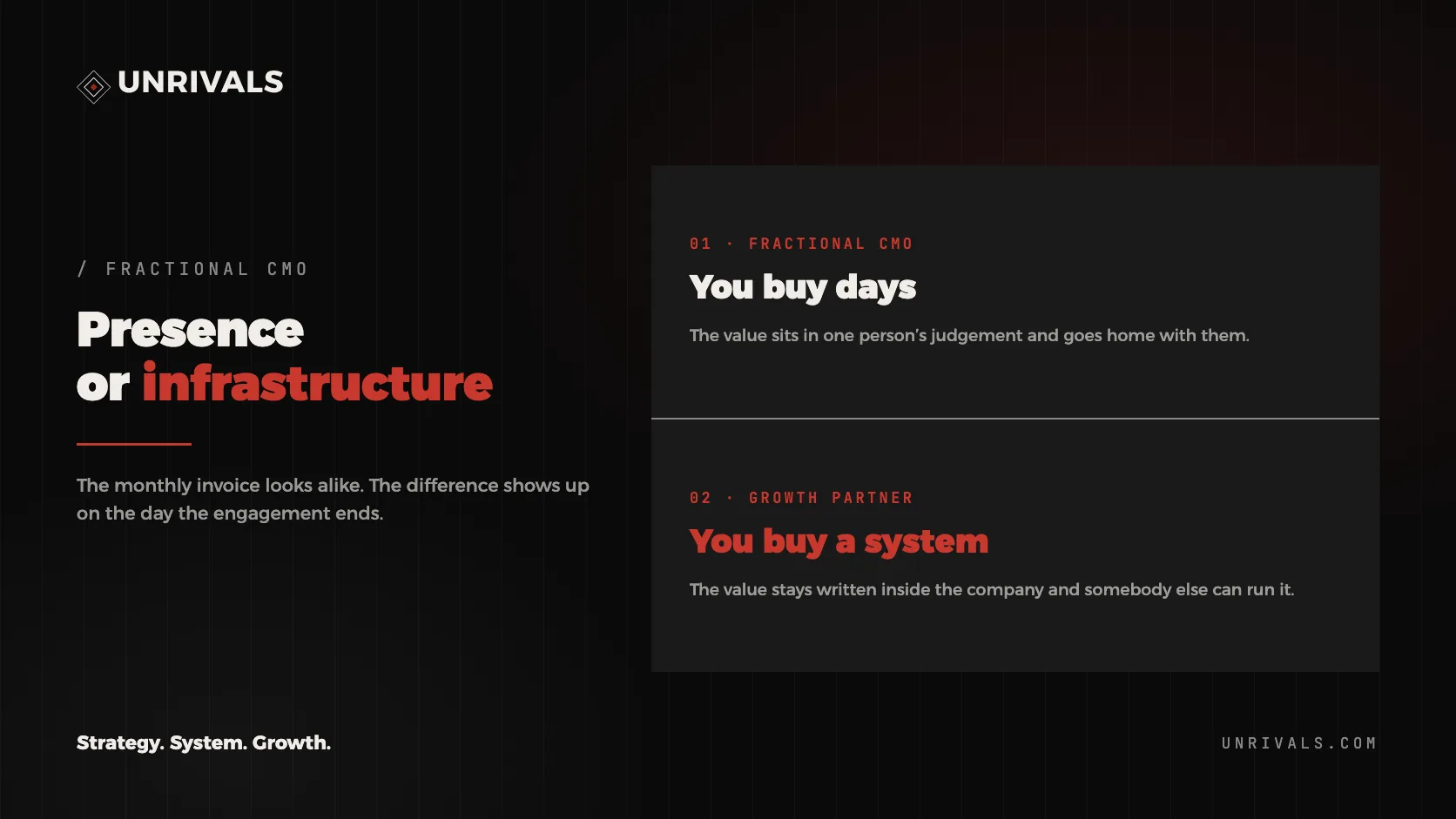
TL;DR. A fractional CMO is a marketing director you rent by the day or by the month, meaning a senior operator who steps into the company a few days a month and fills the seat nobody is sitting in. A growth partner sells something else, because that partner does not fill the seat, but builds the system that makes the seat matter less. The difference does not show up on the monthly invoice, where the two look alike. It shows up on the day the engagement ends, when you look at what is still inside the company.
Founders of companies between three and thirty million in revenue tend to arrive at the same question. They need someone to run marketing, they cannot justify a full-time director, and they are not convinced there is enough work to keep one busy. The question is a fair one. The usual answer, a fractional CMO, solves the budget problem without solving the underlying one.
What you actually buy when you hire a fractional CMO
You buy the time and the judgement of one person, measured in days per month. The model works because that person brings experience the company cannot otherwise afford, and you take it in portions. The market for these services reaches USD 2.28 billion in 2026 and grows at roughly 9% a year through 2031, according to Mordor Intelligence, with small and mid-market businesses accounting for 78% of revenue in 2025.
Those numbers describe the buyer precisely. Companies choosing this format have outgrown the stage where the founder runs marketing personally, yet they have not reached the volume that justifies a director on payroll.
All of that is rational. The question is what gets built during those months, because someone working four days a month spends almost all of that time on current decisions, meaning approving campaigns, correcting messages, pushing vendors and putting out fires. The work is useful, and it lives in that person’s head, which means it leaves when they do.
How much does a full-time marketing leader cost?
More than the salary line suggests, because recruiting time, ramp-up and the risk of a bad hire all sit on top of it. In the United States, marketing managers earned a median annual wage of USD 161,030 in May 2024, with the top 10% above USD 239,200, according to the U.S. Bureau of Labor Statistics. A genuine head of marketing for a mid-market company sits in the upper half of that band, before benefits and employment costs.
Against that figure, a fractional CMO looks like an obvious saving. The saving, however, is calculated on the invoice, while the risk is calculated on what happens afterwards.
Why do marketing leaders stay in the role such a short time?
Because the role changes faster than any other seat in the leadership team, and the people who hold it generally move upward. Average CMO tenure at Fortune 500 companies was 4.3 years in 2024, below the 4.9-year C-suite average, according to the Spencer Stuart CMO Tenure Study, which analysed 329 sitting marketing leaders. The same research found that 34% of Fortune 500 companies have no enterprise-wide marketing leader at all.
Richard Sanderson, who leads the marketing, sales and communications practice at Spencer Stuart, reads the number without alarm. “Low tenure is not a sign of failure. Many marketing leaders are being promoted into bigger and better roles,” he says in a Deloitte Digital episode from June 2025.
His point changes how the data should be read. If even large companies replace the person running marketing every four years, then a mid-market company has no business building its growth on the presence of one individual, however good that individual is, and whether they work four days a month or twenty.
What is the real difference between a fractional CMO and a growth partner?
The difference sits in what is being delivered. One delivers qualified presence, the other delivers infrastructure. Both may be called consultants, both send a similar monthly invoice, and both can field excellent people. At the end of the engagement, though, one of them kept the machine running, while the other left the machine behind.
| Fractional CMO | Growth partner | |
|---|---|---|
| What you buy | Days from an experienced operator | A system of positioning, message and distribution |
| Where the value sits | In that person’s judgement and relationships | In documents, processes and data, inside the company |
| How it is measured | Hours allocated, campaigns approved, meetings held | Positioning written down, channels that run on their own, cost of acquisition |
| What happens on exit | The company returns close to where it started | The company keeps the foundation and can operate it |
| Main risk | Dependency on a single person | The system is never adopted internally |
| Who it suits | A company with a clear strategy and an execution gap | A company executing a great deal without a direction it can defend |
The row that matters most is the second to last. The risk with a fractional CMO is dependency, which is the very problem the founder was trying to solve by asking for help. The risk with a growth partner is non-adoption, meaning a well-built system the company never uses. The second risk can be managed through handover and training, while the first one deepens with every month of the engagement.
What stays in the company after the engagement ends?
Whatever was written down, structured and handed over stays, and the rest goes home with the person. This test is the only one that separates the two models without ambiguity, because it does not ask how good the work was, but where the work was deposited.
The right-hand column is built deliberately, because none of it appears as a side effect of a good working relationship. A brand platform is written, argued and handed over. Marketing architecture is designed before campaigns rather than after them. A sales system is documented so that somebody else can run it.
Choosing between the two models closely resembles the choice between an in-house team and an external partner, where the useful question is not who executes, but where the strategy lives once everyone has gone home.
On our side this part is infrastructure rather than a promise. Everything we produce for a client goes into an AI brain that holds the company context, the client profiles and the way we deliver, so that knowledge does not depend on what one person remembers on a busy day.
How to choose between the two
Choose on what you are actually missing, not on what each option costs. A founder who already has clear positioning, tested messages and channels that work needs someone to run execution, and there a fractional CMO is both the right call and the cheaper one.
A founder growing on momentum, competing on price and unable to explain in two sentences why the market picks them has a different problem. That founder is not short of hands, but short of a direction they can defend, and someone rented four days a month cannot build that direction and install it in the company as well.
The practical test is short. If you stopped the engagement tomorrow, what part of last year’s spend would remain inside the company as a document, a process or a channel that produces on its own? If the answer is “that person’s experience”, you bought presence. If the answer can be opened, read and handed to someone else, you bought infrastructure.
Checking costs nothing and commits you to nothing. Ask for a strategic diagnostic and you get, in writing, where your positioning stands today and what makes you easy to compare on price.
Frequently asked questions
How much does a fractional CMO cost?
Rates are set per day or as a monthly retainer and vary widely with seniority and company size. The useful benchmark remains the alternative, since a full-time marketing manager in the United States earned a median of USD 161,030 a year in May 2024, per the U.S. Bureau of Labor Statistics. A fractional arrangement typically costs a fraction of that, in proportion to the days allocated.
Can a fractional CMO build the strategy as well as run execution?
They can, though they rarely get to. The allocated time is consumed by current decisions, while strategy demands documentation, market research and writing, which is exactly the kind of work that does not fit into four days a month filled with meetings. If you want strategy too, contract it separately, with named deliverables.
What happens if the growth partner leaves?
What was handed over stays, meaning the written positioning, the messages with their proof, the processes and the data. That is the criterion the model should be judged on, and an engagement that leaves nothing behind was an execution engagement, whatever it was called.
Are large companies dropping the CMO role?
Some are. According to Spencer Stuart, 34% of Fortune 500 companies had no enterprise-wide marketing leader in 2024, and the role increasingly appears merged with other functions. The trend does not show marketing mattering less, rather that it is moving closer to commercial leadership.
Where do I start if I have neither a strategy nor a person?
Start with positioning, because it decides everything downstream. Without the criterion the market chooses you on, anyone hired, rented or contracted will optimise channels pointing in a direction nobody ever set.