TL;DR. In a reBranding, keep what already produces recognition and trust. Amplify the evidence that proves differentiation. Give valuable assets a new role if they fragment the system, and remove what blocks the category and future direction.
Start by assessing the value of each asset. Look at every name, symbol, product or association against five criteria: recognition, the trust it supports, compatibility with future strategy, how difficult it is to copy, and its effect on buyer choice.
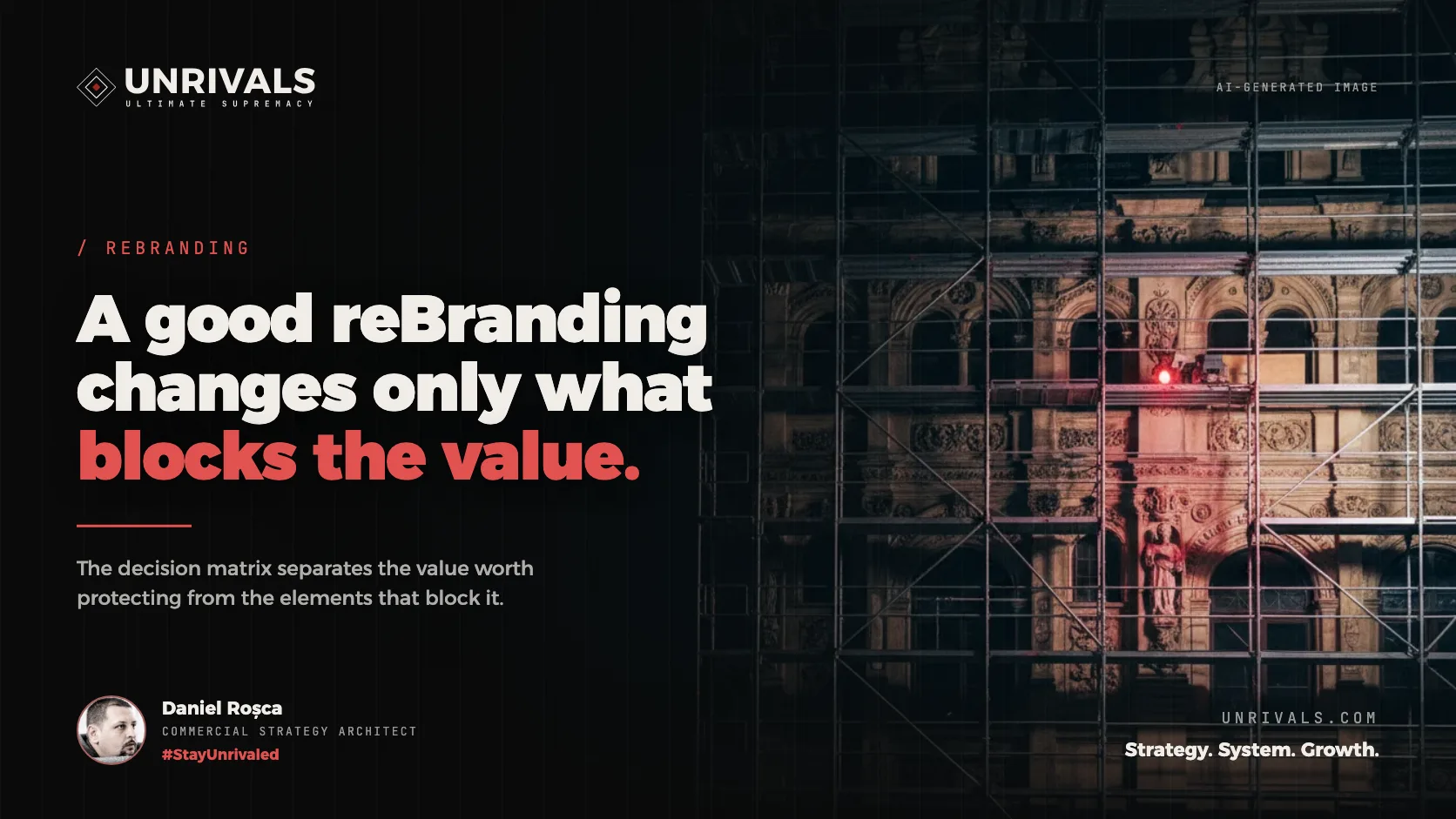
A good reBranding protects the recognition and trust the company has built while addressing what limits its future direction.
A reBranding starts with what already exists: the company has a name, products, customers, a reputation, search history, contracts, referrals and a specific place in the market’s memory.
Even a brand perceived as weak has accumulated something. It may have a name known within a niche, a product searched for directly, a strong relationship with distributors, a recognizable symbol, an industrial history or a founder the market trusts.
The problem is that these assets do not carry the same value.
Some must stay. Others need to be amplified. Some can stay with a different role. Others consume attention, fragment the portfolio, or keep the company in a category it has already outgrown.
Before a reBranding, decide what value to keep, what value to transfer and what obstacles to remove. Those answers guide the visual identity.
Why shouldn’t everything change?
A complete change can seem like proof that the company is starting a new chapter. It can also be the fastest way to lose the capital it has already built.
The company name may already exist in thousands of documents, backlinks, searches, referrals and sales conversations. A product may carry more recognition than the company behind it. A color may work as a recognition signal. A geographic name may transfer authenticity. A founder’s story may lower the risk a customer perceives.
Removing all these elements at once may make the company look new without making it any clearer.
Novelty holds attention for a short while. Brand Equity is built through recognition, consistency, experience and repetition.
Each change needs a reason: the value it protects or the problem it solves.
The company already has four versions of the same brand
To decide what to keep and what to change, compare four versions of the brand.
The brand the company builds is made of products, technology, people, processes, intellectual property, infrastructure and the real capacity to deliver.
The brand the company expresses shows up on the website, packaging, sales decks, offers, taglines and communication materials.
The brand the market reconstructs is what customers, distributors, the press, search engines and AI systems take from its public signals.
The customer’s reason to choose is the answer to why they buy the company’s product or service, accept its price, recommend the supplier or put it on the shortlist.
These four versions rarely line up.
A company may see itself as a manufacturer while the market treats it as a distributor. It may invest in research and technology and still be chosen on price alone. It may promote a full product range while customers remember only one of them.
A rebranding has to close the gap between what the company is and how the market sees it. It rests on the company’s reality.
The decision matrix: keep, amplify, change the role or eliminate?
Put every important brand element into one of four categories.
| Decision | Control question | Cost of a wrong decision |
|---|---|---|
| Keep | If we remove this element, what do we lose beyond internal familiarity? | Buyers may have to relearn something they already knew, and the company risks losing awareness, traffic and trust. |
| Amplify | Does this asset explain an advantage the customer is actually buying? | The factory, the lab or the tenure stay presentation details, and the real differentiation never reaches the buying decision. |
| Change the role | Which brand should the public remember, and which name only guarantees? | All the names survive with no hierarchy, and the budget ends up funding several islands of awareness instead of one. |
| Eliminate | What commercial effect does this element produce? | The positioning stays diluted, and customer attention splits between extensions that bring neither customers nor category. |
Keep
Keep the elements that already produce recognition, trust and continuity.
What can be kept:
- the company name;
- the main symbol;
- recognizable colors;
- products with their own demand;
- well-known range names;
- the founder’s reputation;
- distributor relationships;
- the domain and organic visibility;
- certifications;
- the industrial history;
- the associations the market considers relevant.
An element is worth keeping if removing it would make the market relearn something valuable, regardless of its age.
Ask: if we remove this element, what do we lose beyond internal familiarity?
If the answer is awareness, trust, traffic, reputation or commercial access, protect the element or transfer its value with great care.
Amplify
Some assets are valuable but underused.
The company may run an advanced factory that its website barely mentions. It may control a complete process but present itself as a supplier of a single operation. It may have decades of experience without showing why that continuity matters today.
This category can include:
- proprietary technology;
- production capacity;
- the lab;
- the service network;
- the team’s experience;
- the product’s origin;
- the time invested in manufacturing;
- process integration;
- certifications that are hard to obtain;
- documented customer results;
- a product that can become proof of the whole system.
To amplify an asset, give it a role in positioning. Explain how it helps the product or service solve the buyer’s problem.
A factory matters when it explains an advantage such as yield, control, speed, consistency or reduced risk.
Change the role
This is the category most often overlooked.
In a rebranding, an element can take on a different function. It can leave its current form without disappearing.
A geographic name can stop being the dominant mark and become proof of origin instead. A founder’s name can become the signature of the main brand. A well-known product can become a range. A sub-brand can become a descriptor. A company can remain the legal guarantor while a trademark becomes dominant.
Changing its role lets you transfer the value without carrying over the confusion.
The useful questions are:
- Which brand should the public remember?
- Which mark guarantees the product?
- Which name describes the range?
- Which element proves the origin?
- Which mark should accumulate the future Brand Equity?
- Which element has awareness but should not lead the system?
Many brand problems come from a lack of hierarchy between names. The market is left without a clear signal about which one matters most.
Eliminate
Some elements consume more value than they produce.
What can be eliminated:
- sub-brands with no distinct customer or category;
- internal names that accidentally turned into brands;
- generic taglines;
- symbols that signal an outdated category;
- ranges that compete needlessly with the main brand;
- messages that cannot be demonstrated;
- associations that attract the wrong customer;
- extensions that dilute the positioning;
- names that block international expansion;
- visual elements that cannot be applied consistently.
There needs to be a commercial reason to remove something. Its commercial effect is the argument, while the creative team’s preference stays in the background.
An element can be unattractive and still valuable. Another can be elegant and completely useless.
How do you evaluate whether an asset deserves to be kept?
Every asset can be checked against five criteria.
Is it recognized? Do customers identify it without help? Is it searched for directly? Does it appear in referrals or in how distributors talk about the company?
Recognition is capital. Measure it before giving it up, and check whether it reflects preference.
Does it transfer trust? A known name can lower perceived risk. A certification, an origin or a long-standing relationship can do the same.
If the asset helps put the company on the shortlist, it has commercial value.
Does it support the future direction? An element can be valuable today and incompatible with the strategy of the coming years.
The name of an old category can generate traffic while limiting access to a higher category. In that case, transfer the value rather than ignore it.
Can it be owned? A word like “quality” is easy to use and impossible to occupy without distinct evidence. A process, a technology, an authentic origin or a measurable result are harder to copy.
An asset becomes strategic when a competitor would have to change its own business to claim it credibly. That is when differentiation starts to become cognitive ownership.
Does it produce behavior? The most important test is whether the asset changes the choice, the referral, the price accepted, retention, or commercial access.
If people inside the company value an element but it does not influence any external decision, reconsider it.
What must be kept before changing your identity?
There is no universal list, but a few assets should never be removed before you measure them.
Demand for the brand name
Analyze brand searches, direct traffic, backlinks, mentions and the phrases people use to find the company.
Changing the name or domain can affect accumulated visibility. Treat the migration as a transfer of digital capital, a job that takes more than technical work.
Products with their own recognition
Sometimes people know the product but cannot name the company. Removing the product name would destroy demand. Keeping it as a fully independent brand can also leave the portfolio fragmented.
Changing its role can solve this: the product stays recognizable and starts transferring value to the dominant brand.
Historical evidence
History matters when it explains a competence that still holds today. Age on its own is not a positioning.
The continuity of people, accumulated know-how, the development of a process, or experience within a category can become evidence that is hard to replicate.
Distinctive signals
Color, packaging shape, symbol, typography or a verbal expression can work as cognitive shortcuts.
Evaluate them separately from management’s aesthetic preferences. A visual change that goes too far can reduce recognition even if the new system looks more elegant.
Commercial relationships
A reBranding also affects how distributors, partners and the sales team present the company.
If these groups do not understand what stays and what changes, they will keep telling the old story. The market will receive two positionings at once.
When is a refresh enough?
A refresh makes sense when the brand’s meaning still works, but its expression has become inconsistent, dated, or hard to apply.
What can be updated:
- typography;
- color palette;
- logo proportions;
- the layout system;
- iconography;
- photography;
- the website;
- usage guidelines;
- commercial and digital formats.
In a refresh, the positioning stays stable. The name does not change, the category does not change, and the core promise is not replaced.
A refresh updates how a brand expresses a meaning that is already clear.
If the market does not understand why it should choose the company, a refresh stays insufficient and makes the same lack of differentiation more visible.
When repositioning is necessary
Repositioning becomes necessary when the brand’s category is the problem.
The company may be perceived as an executor even though it controls the full outcome. It may be treated as a distributor even though it produces and develops. It may be compared on the price of one operation even though it removes a much more valuable risk for the customer.
In this situation, the name can stay, and the identity can keep its distinctive elements. The following still have to change:
- the category claimed;
- the priority customer;
- the central problem;
- the benefit the customer is buying;
- the associated attribute;
- the evidence;
- the criterion for comparison;
- the sales conversation.
Repositioning is the work of positioning: deciding what the brand should mean in the market’s mind. A reBranding makes that decision visible and consistent.
When the brand architecture needs to be reorganized
Sometimes the company has valuable assets spread across too many names.
Every product, range, sub-brand and geographic name competes separately for the customer’s attention. The marketing budget ends up building awareness in several disconnected places.
Hierarchy solves that problem. Redesigning logos comes later. The decisions are:
- which mark becomes dominant;
- which mark guarantees the portfolio;
- which names stay products;
- which names become ranges;
- which elements work as descriptors;
- what role the origin plays;
- where the memory should accumulate;
- how each launch contributes to Brand Equity.
Brand architecture does more than set the order of names. It shows which mark you invest in and which one you want the market to remember.
If people remember the product but cannot name the company, that capital stays isolated. If every product reinforces the same mark and attribute, the portfolio starts investing in its own growth.
When is a full reBranding process justified?
A complete change is justified when the existing name, positioning and identity block the company’s future direction.
Situations can include:
- a change in the business model;
- entry into a new category;
- a merger or the integration of several companies;
- international expansion;
- a negative association that cannot be corrected;
- severe fragmentation of the portfolio;
- incompatibility between the name and the future offer;
- the impossibility of legal protection;
- the move from executing a process to owning a full outcome.
Even in a full rebranding, the company keeps some of its assets after assessing them.
History can remain as evidence. Well-known products can carry the transition. A symbol can be reinterpreted. The old name can appear temporarily as a sign of continuity. Commercial relationships and digital capital need a controlled transfer.
“Full” describes the scale of the new system, not an obligation to destroy everything that came before.
What does the decision look like in practice?
The same matrix can lead different companies to different decisions.
Zeelandia Romania
Zeelandia Romania supplies bakery ingredients in Romania as part of a multinational group. Its factory, lab, technology, portfolio and competence built up in the bakery industry are assets worth keeping.
Zeelandia Romania has plenty to show. If it describes its offer only in generic terms such as ingredients, solutions, quality or innovation, customers may miss those strengths.
The strategic direction puts YIELD at the center: the result a bakery can get by combining the products, technology and expertise.
Membership in a multinational group already provides a brand framework. The proposed direction connects Zeelandia’s offer to the outcome its bakery customers want and adapts the parent brand’s communication to the local market.
De Colțești
De Colțești is a Romanian producer of matured cheese from the Apuseni Mountains region. Its authentic origin and matured products are real assets.
The Trascău Mountains and the origin stay as provenance, alongside De Colțești, which keeps the customer’s attention.
De Colțești can become the dominant mark. Origin becomes evidence. MATURATION becomes the central attribute, and time expressed in days can organize the range and justify the differences between products.
Nothing valuable is erased. Each element gets a clearer role.

Romturingia
Romturingia is a Romanian vehicle-transformation company, built on the ecosystem of ARO, Romania’s historic off-road vehicle brand. Its professional heritage from that ecosystem is proof of competence.
That history has to connect to Romturingia’s present-day ability to transform vehicles for distinct missions.
TRANSFORMATION can become the central attribute. The continuity of the people and the industrial experience remain evidence. Instead of listing coachwork types and operations, Romturingia can use a more valuable category built around the final outcome.

reBranding without losing Brand Equity
Brand Equity is spread across the name, products, experiences, reputation, searches, symbols and relationships. Transferring it takes a plan.
Name transfer
If the name changes, set a period when the old and new names appear together. Its length depends on the buying cycle, distribution and existing awareness.
Digital transfer
Before launch, inventory domains, redirects, indexed pages, social profiles, listings and backlinks.
Changing the identity without transferring its digital capital can reduce visibility just when the company needs more clarity.
Commercial transfer
Decks, offers, signatures, catalogs, packaging and sales conversations have to make the continuity clear.
Customers need to understand quickly what changed and what remains guaranteed.
Distributor transfer
Distributors and partners need a story they can use, alongside the files with the new logo.
If they keep describing the company in the old category, the reBranding never reaches the market.
Internal transfer
Employees need to be able to say:
- what we keep;
- what we change;
- why we change it;
- what the market needs to believe;
- what evidence supports the new position;
- what should no longer be promised.
Without this clarity, every department will interpret the change differently.
What should be measured before and after a reBranding process?
Evaluation starts before launch. Depending on the category, you can track:
- searches for the brand name;
- direct and organic traffic;
- spontaneous and prompted recognition;
- the reasons offers are won or lost;
- the discount needed to close a sale;
- margin by product and category;
- recognition of the main mark;
- association with the desired attribute;
- referrals;
- retention rate;
- the time needed to explain the offer;
- consistency between the website and the sales conversation;
- how search engines and AI systems describe the company.
Track the same indicators after implementation, accounting for seasonality, distribution, media investment and product changes.
A rebranding is evaluated on the recognition, clarity, preference and pricing power it produces. Any gains that follow should be attributed with care.
Kantar’s BrandZ methodology tracks the relationship between Meaningful, Different and Salient: relevance, differentiation and presence in the buyer’s mind.
The global Kantar BrandZ 2026 edition values the top 100 brands at a combined 13.1 trillion dollars, using data from 4.6 million respondents.
These figures show that Brand Equity can be evaluated against demand, pricing power and growth potential.
The ISO 20671 standard describes brand evaluation through strength and performance, using several dimensions and indicators.
These benchmarks complement research specific to the company and help management avoid decisions based only on aesthetic preferences or internal impressions.
The mistakes that destroy value in a reBranding
A reBranding can look great and still create commercial confusion.
The most frequent mistakes are:
- changing recognizable elements without measuring them first;
- removing well-known products to artificially simplify the portfolio;
- keeping every historical name with no hierarchy between them;
- mistaking a visual refresh for repositioning;
- changing the tagline without changing the buying criterion;
- launching the new identity before preparing the sales team;
- changing the domain without migrating the SEO capital;
- inventing an attribute the business cannot actually demonstrate;
- communicating a break where customers needed continuity;
- treating the launch as the end of the process.
You can launch a logo in a day. Transferring and building Brand Equity takes time.
Frequently asked questions
Do you have to change the logo in a reBranding?
Not always. You can keep, adjust or replace the logo, depending on the recognition it has built and how well it fits the new positioning. Make that decision alongside the name, category and portfolio architecture.
What is the difference between a refresh and a reBranding?
A refresh updates the visual expression of a brand whose meaning is still correct. A reBranding can change the positioning, the category, the name, the architecture, the identity, and how the company is introduced to the market.
When should the company name be kept?
Keep the name when people recognize it, it transfers trust, it can be protected, and it does not limit future strategy. If the problem lies in the positioning or expression, changing the name can add costs without fixing the cause.
When should the brand name be changed?
A change can be justified when the name limits expansion, describes an outdated category, creates confusion, cannot be protected, carries negative associations, or cannot support the future portfolio’s integration.
What do you do with products that are more famous than the company?
These products can stay within an architecture that gradually transfers value to the main mark. Decide what role each name plays before redesigning the identity.
How do you protect Brand Equity during the change?
Inventory the assets, measure recognition, plan the transition, migrate the digital capital, prepare distributors, and keep using the evidence that built trust in the first place.
Can an analysis show that a reBranding is not necessary?
Yes. The company may only need a refresh, a repositioning, a reorganized architecture, or a more consistent implementation of the brand it already has.
A good reBranding changes only what stops value from reaching the market
The company brings its past into a reBranding: products, reputation, customers, searches, relationships, symbols and experiences it has already accumulated.
Some of these support the future. Others limit it.
The matrix helps you assess how each element contributes to recognition, trust and buyer choice.
We keep what produces recognition and trust. We amplify what proves the differentiation. We change the role of valuable elements that fragment the system. We eliminate what blocks the category and the direction ahead.
A reBranding should make the value a company can actually deliver easier to understand and easier to choose. Making the company look new is not enough.
Keep reading
The decision behind what a brand should mean before the new identity gets built: brand positioning explained.
The decision about the dominant mark, the portfolio, and where Brand Equity should accumulate: brand architecture.