
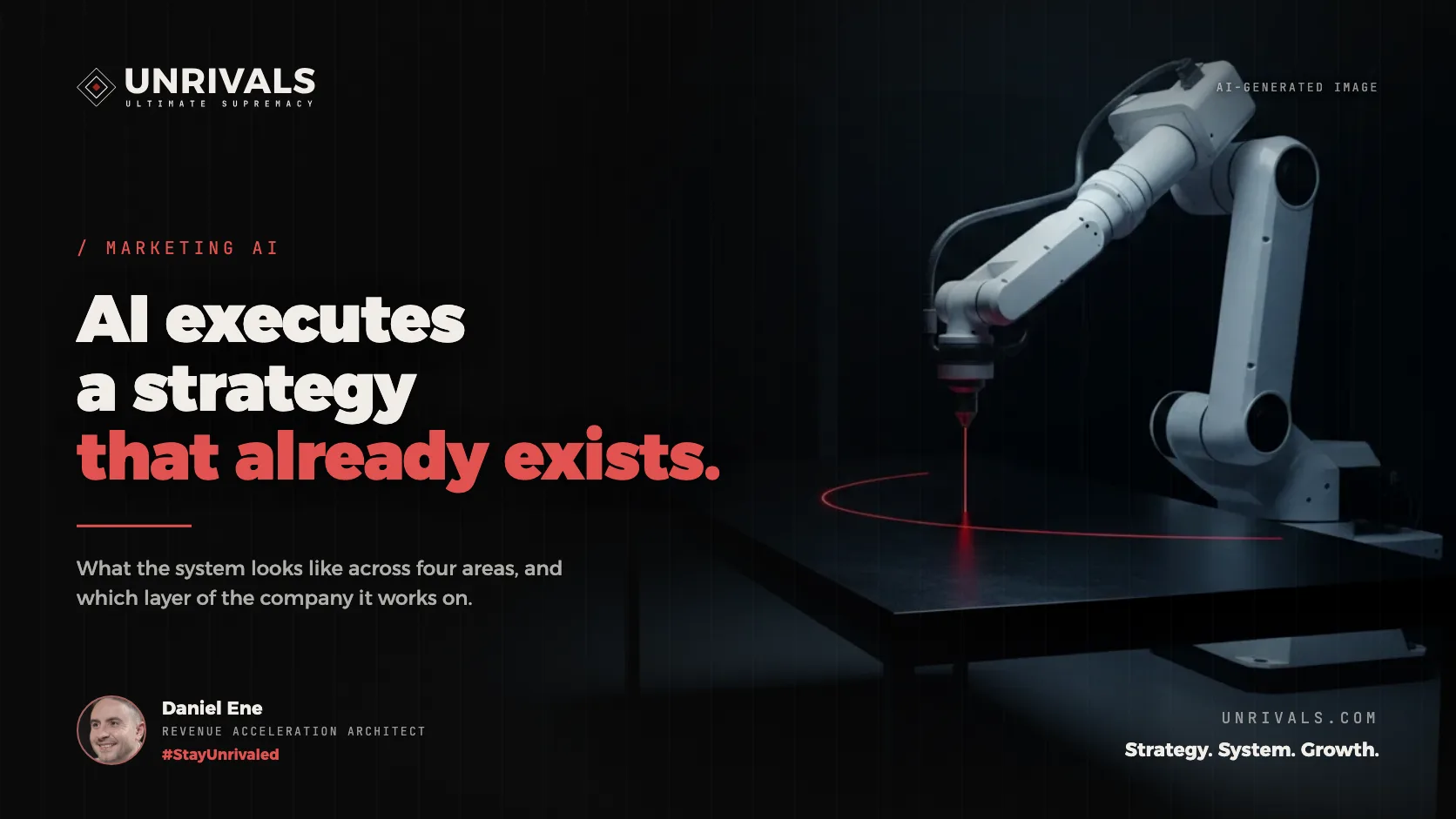
Marketing AI is the use of artificial intelligence as a layer of execution and decision on top of a marketing strategy that already exists. It works from written rules and from context specific to the company. At every important step, a person validates what the model produced.
What separates it from a ChatGPT subscription and a few generated posts is the system, meaning that the model knows who you are, who you are talking to and what you are not allowed to promise, and you know what it produced and why.
TL;DR. AI amplifies whatever strategy it finds. On a clear position it executes in a few hours the work a team would need weeks for, and on an unclear one it multiplies the noise. We run it across four areas, research, decision, content and reporting, with the method written down and a person who signs off at the end.
Why does the order of strategy and AI matter?
The order matters because AI adds speed to any direction it is given, including a wrong one. A company that knows what sets it apart gets faster execution of the same idea. A company that is still searching for itself gets, instead, more versions of its own confusion, produced at almost no cost.
Budgets have already moved in this direction, and readiness has stayed behind. According to the Gartner 2026 CMO Spend Survey, marketing leaders allocate an average of 15.3% of their marketing budget to AI initiatives.
The same survey, run from January to March 2026 among 401 marketing leaders in North America, the United Kingdom and Europe, also shows the other side. In 2026, 70% of them acknowledge that their internal marketing processes are not yet mature enough to implement and scale AI.
Ewan McIntyre, VP Analyst and Chief of Research in the Gartner Marketing practice, put the gap into words in the release that announced the survey. “CMOs recognize AI’s potential as a force multiplier for growth, efficiency and transformation, but most marketing organizations are not yet built to capture that value.”
The same release gives a figure that points to where the difference lies. The more AI-ready marketing organizations allocate 21.3% of their budgets to AI, according to Gartner’s 2026 data, and McIntyre attributes their lead to budget agility and operating discipline rather than to the spending itself.
This is also the reason we write about AI in marketing at all. The UNRIVALS method starts from the idea that a company which has created real value deserves to be seen for it, and the distance between the value created and the value perceived is where margin and the founder’s time get lost.
AI can close that distance at scale only after the value has been named. Until then, it produces plausible text about a company that nobody, the model included, has defined.
What is marketing AI, and what is it not?
Marketing AI is a working system in which language models and analysis tools receive precise tasks, derived from strategy, and execute them at a volume a team cannot sustain by hand. What falls outside the definition is the choice of direction, the promise made to the customer and the accountability for that promise, all of which stay with people.
In our methodology Codex, the first pillar that touches the subject is called AI as a cognitive processor and extension. Its statement reads that “AI is not a brain, it is a processor or extension, and the quality depends on how precisely you tell it where to think”.
The rule that follows is operational, because it tells you what to do on Monday morning. You train a methodology file, give point-specific context for every task, run the output back several times and check it by hand against hallucination. Garbage in means, in practice, hallucination out.
Ethan Mollick, author of Co-Intelligence, described the same way of working in a November 2025 interview with Insight Partners. “Increasingly, I assign a task to the AI. I use my expertise to decide what that task is. I evaluate the results, correct my approach, and if that still doesn’t work, I do it on my own.”
His sentence shows where the value sits in an AI marketing strategy, because the person decides the task, the model executes it, and the person evaluates the result and corrects the approach. Remove the first and the last step, and what remains is a text generator working without knowing for whom.
We cover the processor idea on its own, across the full role AI plays inside a company, in the piece on AI in marketing as a cognitive processor. Here the focus is strictly marketing, meaning how that processor connects to strategy and to the channels through which the company reaches its buyers.
Why do so many companies use AI in marketing the wrong way?
The mistake almost always takes the same shape, AI treated as an idea generator opened from scratch every week, with no written instructions and no memory of earlier decisions, which produces plausible and generic text.
That text sounds like any competitor’s and never accumulates into anything reusable, however often it is generated.
Adoption is growing fast, and it is uneven. Eurostat data published in December 2025 shows that 20.0% of EU enterprises with at least ten employees used AI in 2025, up from 13.5% in 2024. Denmark led with 42.0%, while Romania, where we work, sat last at 5.2%.
Marketing is one of the first places AI arrives, and according to Eurostat, in 2025, 34.70% of EU enterprises using AI applied it to marketing or sales.
The same statistics explain why so many attempts stall halfway. Eurostat measured in 2025 that among companies which had considered AI and did not adopt it, 70.89% cited a lack of relevant expertise, far ahead of any other reason.
The missing expertise rarely concerns the tool, and the tactical pattern is easy to recognise. Someone opens a chat window, asks for five LinkedIn post ideas, gets something generic, publishes one or nothing, and the following week repeats the exact same move without having kept anything from the previous one.
The quality of what comes out depends directly on what goes in. The model needs to know who you are, who you are speaking to, what you want to achieve and what you never do. Without that it produces plausible text, and plausible text can be wrong, irrelevant and free of any trace of the brand at the same time.
A company that wants real results from AI in marketing needs a set of instructions calibrated on its brand, run consistently and corrected after every iteration. The difference shows after a few months, when some teams have a library of rules that keeps improving and others have only a long history of conversations.

What does an AI marketing strategy look like across four areas?
An AI marketing strategy works across four distinct areas, research, decision, content and reporting, and each has a part the model does and a part that stays with a person. The table below shows the split as we use it, with the artefact that holds each area together.
| Area | What AI does | What stays with a person | The artefact that holds it |
|---|---|---|---|
| Research and profiling | extracts language patterns from reviews, forums, transcribed calls and public sources | chooses the pattern that matters for positioning | the customer language bank and the profile built from it |
| Decision | structures data, models scenarios and flags where data is missing | decides and owns the decision | strategic analysis on public figures, with the source of every figure |
| Content at scale | produces variants for each funnel stage, from a single angle | picks the angle and reads every piece before it goes public | written production procedures and the register check |
| Reporting and calibration | aggregates sources and flags anomalies | interprets the cause and recalibrates | the weekly report and the quarterly AI mirror |
1. Research and profiling
Research is the area with the fastest return. AI reads in a few hours volumes of text a team would need weeks for. Competitor reviews, customer comments, niche forums and transcribed calls become raw material for a single question, how the buyer talks about the problem you solve.
A summary helps little here, because you are looking for language patterns, the words people repeat about their problem, recurring fears and the phrasing in competitors’ negative reviews. Headlines, sales messages and ad copy built from those patterns sound like the buyer, because they are made from the buyer’s own words.
In our work, research for a positioning analysis starts from public sources and every figure carries its source. In the analyses we have published, financial statements come from the public API of Romania’s tax authority, and visibility measurements come from DataForSEO and Ahrefs, with the extraction date written under each slide so anyone can redo the calculation without us.
2. Decision
Decision is the area used least often and with the highest impact. Before you spend budget, AI can structure your data, show the implications of each option and tell you where it lacks the data to be confident, which is sometimes worth more than the recommendation itself.
Which keyword you prioritise this month, which segment gets the ad budget, which offer you test first are questions a well-fed model answers with compared scenarios, while the final word and the accountability for it remain yours.
Our method gives decision a fixed rule. We show the order of magnitude of what is at stake, calculated from public figures, and we promise no result. AI helps us calculate the stakes faster and across more scenarios, but it is not allowed to turn a scenario into a promise.
3. Content at scale
Content is the area everyone thinks of first and where mistakes are most common. AI produces consistent content at volume only when it has a specific brief. The brief states the concrete problem you solve, for whom, which funnel stage the reader is in and what action you want to follow.
A content cascade starts from a single strategic angle. The model produces variants for each stage, an article for people just discovering the problem, a few posts for people who recognise it, a retargeting ad for readers of the article and a short email sequence for those who downloaded a resource. You choose, adjust and publish.
The choice of angle stays with a person, because what you say, to whom and why now come from strategy. A person also reads every piece before publication, because you know things about your customers that the model does not have and cannot infer.
4. Reporting and calibration
Reporting is the area that moves marketing from reaction toward predictability. AI aggregates data from ads, analytics, CRM and social and produces a weekly report with anomalies flagged. For each anomaly it proposes a likely cause, which a person confirms or rejects.
Once a quarter, it is worth running an AI mirror as well. You ask the same model a few category questions, the kind a buyer would ask before purchasing, and note whether you appear, who appears instead and which sources the model cites. It is a simple measurement that shows exactly where the buying decision starts today.
Which layer of the company does marketing AI work on?
AI works on layer L3 of the company, the orchestration and memory layer, where the AI Brain lives, and from there it connects the other three layers. In the UNRIVALS method a company has four working layers, from L1 to L4, and a marketing problem gets solved only on the layer where it started.
L1, performance marketing. This is the layer that captures attention and brings qualified traffic now, measured in acquisition cost, cost per lead and return on ad spend. Content at scale works here, with ad variants and copy for every funnel stage. In our method, a correct position shows up on this layer as a falling acquisition cost.
L2, revenue and the commercial process. This is the layer that turns strategy into pipeline and revenue, through the offer, sales and the pace at which a lead becomes a customer. Decision lands here, since the chosen segment and offer show up directly in the pipeline. A model that knows the sales stage writes differently for each stage.
L3, orchestration and memory. This is the layer where the written methodology, the procedures and the memory of decisions live. AI here is the engine that connects the layers, runs scenarios and keeps the optimisation loop going, and reporting and calibration happen here too. Without this layer, every working session starts from zero.
L4, positioning and category architecture. This layer decides what place the company holds in the market’s mind and how it is compared. Research and profiling feed this layer, because the buyer’s language and the open space in the category come before the first message. The decision here stays with the founder, and AI brings the data.
Building happens bottom up, traffic, then revenue, then position, with L3 optimising at each step, while the message is derived the other way, from positioning to offer and only then to the ad. An AI asked to write ads without a defined L4 works on the bottom layer without knowing what it is holding up.
For the full picture of the layers and the order in which they are built, we wrote separately about marketing architecture, and for what happens strictly on the memory layer, about the AI Brain explained for founders.

What does an AI marketing strategy look like on a real company?
On a real company, an AI marketing strategy has two sides. One is the AI that works for the company, in the four areas above. The other is the AI a buyer asks before purchasing, and on that side a company can be completely absent even when it has everything it needs to be chosen.
This pattern has a name in our methodology, “invisible in AI engines”. At diagnosis it shows up as zero citations in model answers, sometimes with crawlers blocked in the robots.txt file, and the move we propose is the same each time. The company needs pages that answer the questions buyers ask before purchasing, so the machines have something to cite.
The first example comes from the positioning analysis we published for Doctor SKiN, a network of dermatology and aesthetic clinics in Bucharest, Romania. We measured the figures on 10 September 2026, with DataForSEO and Ahrefs, on the site’s public files.
The clinics had 2,970 Google reviews at an average rating of 4.85 across seven locations at the time, and their robots.txt file blocked nine AI crawlers by name, including GPTBot, ClaudeBot and Google-Extended. All of it is in the analysis published in September 2026.
The consequence showed directly in the answers. Asked about the best dermatology and aesthetic clinics in Bucharest, ChatGPT named sixteen clinics in our test of 10 September 2026, none of them Doctor SKiN, and it did not mention the company in the second category question we tested either.
Our proposed next step asked for no new budget and no new name. Our wording was to keep the name, the clinics and the team, and to change who gets to say what they are. In the terms of this article, that means an open door for crawlers and pages that state clearly what the clinic does.
The second example comes from the positioning analysis we published for Therezia, a dairy producer from Pănet, in Romania’s Mureș county. Our Ahrefs measurement of 10 September 2026 found the company cited twice in AI platform answers, against 128 citations for a processor from the same county.
The move proposed there was to make the village collection system visible, with figures, and to add pages that answer the questions buyers ask before purchasing. The solution makes visible an advantage that already existed and puts it in a form a model can cite.
Both cases show the same thing about an AI marketing strategy, namely that the part where you use AI matters, yet the part where AI uses you as an answer matters more and more, because that is increasingly where a buyer’s shortlist begins.
How does a marketing AI system learn from one week to the next?
A marketing AI system learns only if decisions, corrections and rules are written somewhere the model rereads in every session. Without written memory, each conversation starts from zero and quality stays at the level of day one, however good the model is.
The second pillar in the Codex, AI learns from dialogue, describes exactly this mechanism. Its statement reads that “the methodology settles into the AI from accumulated dialogue; AI trained on the corpus extracts the recurring principles by itself and produces reusable IP”.
For us, this pillar produced the Codex itself, because the internal discussions between the two founders, the written notes and the strategy documents went into a single corpus, and the principles of the method came out of it, each with a counter showing how often it was reinforced. This article reads its pillars from that same file.
The system all of this runs on has a size we measured on 29 August 2026, with 5,077 notes in text format, 138 executable procedures and 312 separate memories kept per client. The figures are ours and describe our working vault on that date.
Tactical use of AI looks different week to week. Each session, you re-explain in every session who you are, what your brand is and who you are talking to, and the output varies without you knowing why. You cannot reproduce what worked either, since the rule that produced the good result was never written anywhere.
In a system, the instructions already exist and are calibrated on your methodology, your customer data and your brand’s position. The output becomes consistent because the rules are coded, and every correction made today is kept for tomorrow’s session. On top of them sits a person who stress-tests the work before any text goes public.
Where do companies go wrong when they start with marketing AI?
The most expensive mistake is often made before the first model is opened, when AI starts on top of a foundation that does not exist yet. The third pillar in the Codex, infrastructure before marketing, explains why this happens and in what order it gets fixed.
Its statement reads that “the client rarely has a marketing problem, they lack infrastructure (systems, channels, positioning, brand foundation), and marketing on a weak base burns money”. The operational rule asks for a diagnosis before any ad, covering channels, salespeople and brand clarity, and whatever is missing becomes the work, in that order.
Applied to AI, the pillar explains four typical mistakes of a rushed start.
Prompts without brand context. A task given without explaining who you are, who you are speaking to and what you never do produces generic text. An experienced decision-maker senses at once when a text does not come from someone who understands their situation. The fix is a context file written once and reread for every task.
Automation without human review. A workflow that generates and publishes directly lets invented statistics, wrong claims and promises the company cannot keep slip through. Once published, such a text costs far more to repair than reading it first would have. Human review is part of the system, just like the model.
AI placed on top of an unclear position. If you do not know what sets you apart, AI will produce more content carrying the same vague message. An unclear brand costs more than it seems at acquisition, because you pay for ads that do not convert and content nobody remembers. The fix sits on L4, before any model.
AI treated as a strategist. The model executes tasks with clear rules well, but answers poorly when asked which direction the brand should take or which offer is worth building. Here you get plausible answers that risk nothing, because only the person accountable for the result knows the stakes. Strategy stays with you, and AI executes it.
All four share the same root, namely that the orchestration layer was switched on before the positioning layer, and AI was asked to build a house without being told where the land is.
Is it legal to use AI for marketing?
Yes, it is legal to use AI for marketing, provided you follow the transparency and data protection rules that apply to any content and any processing. In the European Union the main framework is the AI Act, and the transparency obligations for generated content sit in Article 50.
What must be labelled, and from when, is covered in our guide to the EU AI Act and the content that must be labelled. Outside the EU the rules differ by jurisdiction. Our internal rule is stricter than the legal minimum, since nothing generated by AI goes public until a person has read it in full.
What are the best AI marketing tools?
The tool matters less than the context you give it. Two teams with the same tools get very different results depending on how well they have written the strategy they feed into them. The right list of tools is chosen by area, research, decision, content or reporting, and by the data you already have.
For research and measurement we use tools that read the market from public data, and in the analyses we publish the sources are named on each slide, DataForSEO for model answers and search data, Ahrefs for traffic and citations. The language model works on top of them and uses their data as raw material.
For content, any large language model produces good text when it gets a good brief, and the real difference comes from the context file. That file holds a precise description of the problem you solve, examples of good and bad copy, your customers’ language and clear limits on tone and on promises.
The useful question, before choosing a tool, is which process you want AI to take off your team’s shoulders. A clear answer narrows the list to two or three tools, which you can test on real data within a single month.
Where do you start with marketing AI in your company?
You start with a single marketing process you currently run by hand, repetitive and low on judgement, such as the weekly report, content briefs or review analysis. You build the instructions for it, test and adjust. Only after the first works consistently do you move to the next one.
Our method has a rule for launching a position, one product, one channel, ninety days, and only then generalising. The same logic works for introducing AI, since a single process followed for three months shows you what you gain, while ten processes started at once make measurement impossible.
Before the first process there is a step that is easy to skip. Write on one page who the buyer is, what problem you solve for them and why they would choose you. If that page does not come together, the work to do is your marketing strategy, and AI can wait a few weeks at no cost.
The worst starting point is to install every marketing AI tool on the market and hope they connect by themselves, while the companies that succeed start small, with one specific process, and build systematically from there, with rules written down after every correction.
Frequently asked questions
How do we use AI in marketing strategy?
You start with the strategy, meaning a clear position, a defined buyer and a core message. Only then do you add AI as an execution layer. In practice you use it for research and voice-of-customer analysis, for scenario-based decisions, for content produced from a specific brief and for aggregated reporting, each with written instructions and a person who validates.
Does AI in marketing deliver results, or is it just hype?
The result depends on how it is used, because as an idea generator it produces little and inconsistently. As a system, with calibrated instructions and specific context, it cuts execution time and makes communication more consistent, and Gartner’s 2026 data suggests that organisational readiness, more than budget, separates the companies that gain from it.
Does AI replace the marketing team?
AI shifts the team’s work from raw production toward judgement, rules and review, so hours of repetitive execution go down while hours of strategic thinking stay the same or grow. A small team with well-integrated AI can cover the volume of a larger one, while the decision structure stays human.
Which marketing processes can be automated with AI?
You can automate audience research, competitor analysis, content production from a brief with human review, reporting from several sources and measuring your presence in AI model answers. Strategy decisions, the choice of angle and the final review before publication stay manual.
If you want to see which layer is holding your company’s marketing back today and how it shows up in AI model answers, ask for an audit.
For the step that comes before any execution layer, read about how to grow without depending on ads.