
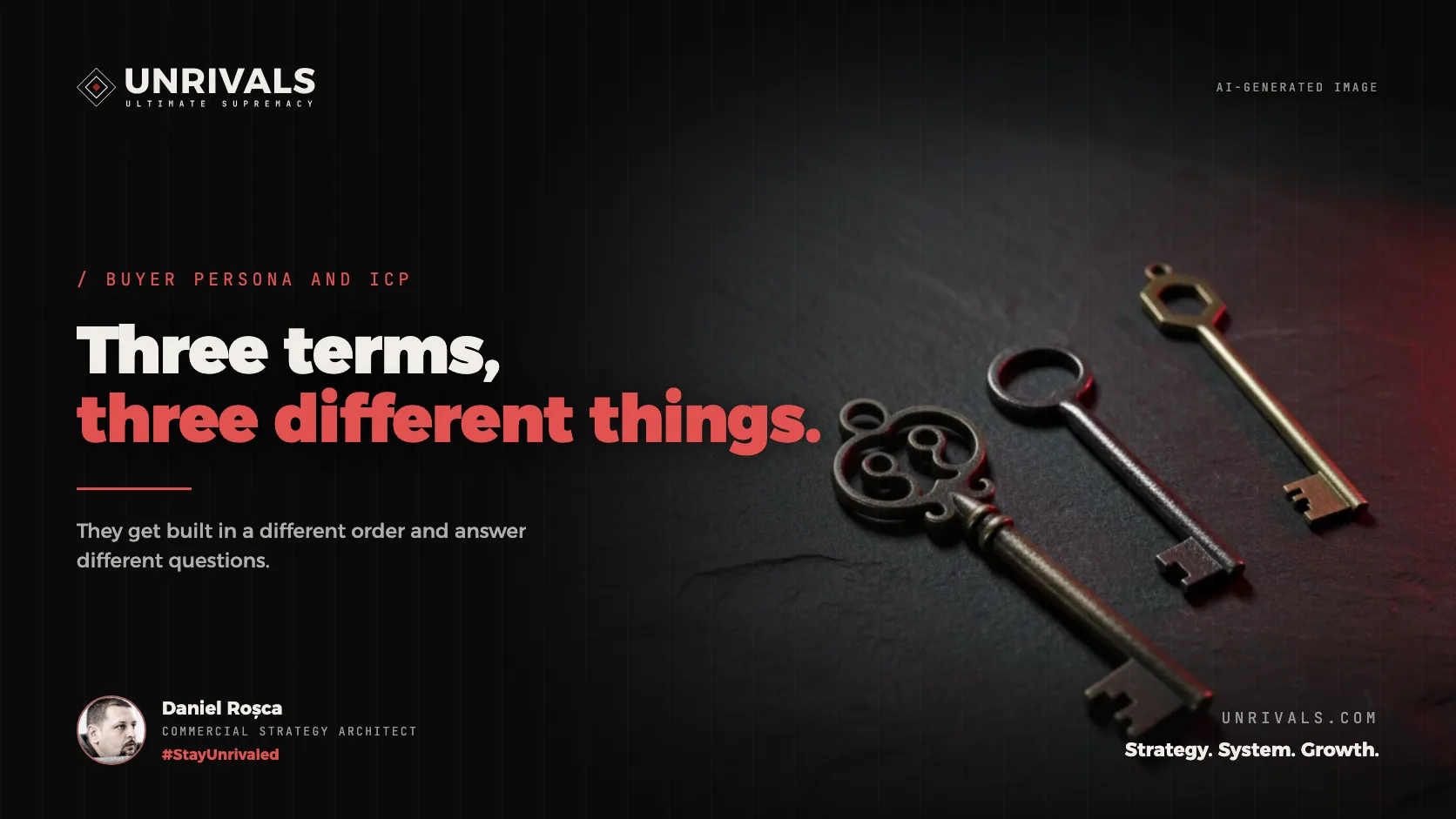
The ideal customer profile, known as the ICP, describes the type of company worth pursuing. A buyer persona describes a role involved in the purchase and how that person contributes to the decision.
Customer avatar is another name for a buyer persona, used especially in direct response marketing. It may start with assumptions that need validation. The useful distinction is between the company targeted by the ICP and the people described by a persona or avatar. Between the latter two, the research method matters more than the label.
TL;DR. The ICP answers “which companies do we pursue?” A persona or avatar helps explain the people who use, influence, approve or block the purchase.
For B2B prospecting, we start with a hypothesis about suitable companies and then research the people involved in buying. Interviews may change that initial hypothesis. A document full of demographic detail but no account of a decision offers little help in choosing customers.
What is the difference, briefly?
| ICP | Buyer persona | Customer avatar | |
|---|---|---|---|
| What it describes | a suitable company | a role in the buying group | a role in the buying group |
| The question it answers | which companies do we pursue | which criteria and barriers matter to this role | which goals and objections matter to this role |
| Level of information | need, budget, context, fit criteria | tasks, decision criteria, barriers | tasks, goals, objections |
| Data source | sales, interviews and market data | interviews and observed purchases | hypotheses tested through data and interviews |
| How we use it | filters companies | prepares evidence for a role | prepares evidence for a role |
The most useful distinction remains the one HubSpot put in a single sentence. “Personas tell you who you’re talking to. ICPs tell you which companies are worth talking to in the first place.”
Where does each concept come from?
Personas also have a history in software design. Alan Cooper describes using them as an interaction design tool.
In the same text, Cooper separates his concept from what marketers were already doing, noting that product marketing professionals had used similar entities for years to define demographic segments. The two traditions have been separate since the origin. That separation explains a good share of today’s confusion.
The marketing variant was systematised by Adele Revella, through the Buyer Persona Institute. She draws a distinction worth keeping, between the buyer persona and what she calls the “buyer profile”.
The profile describes a person’s characteristics and reveals little about how you influence them, while the persona reveals the buyer’s attitudes, concerns, decision criteria and journey. Her framework was published in the book Buyer Personas, in 2015. It is built on five information areas, meaning priority initiatives, success factors, perceived barriers, decision criteria and the buying journey.
The ideal customer profile comes out of the software-as-a-service world.
Lincoln Murphy defines it as “the type of customer that, within a clearly defined timeframe, you will dedicate sales and marketing resources to acquire”, and he is also the one who states the ordering rule, saying that persona development has to come after ICP development.
The customer avatar is the term used in direct response marketing, where it is treated openly as a synonym for the persona.
What separates it from Revella’s school is the method. The classic instruction in copywriting manuals says to not wait for surveys or interviews and to make assumptions where you have no data.
The approach can help when you can test hypotheses quickly with a broad audience. In a B2B sale that may take months, untested assumptions can misdirect prospecting and messaging.
Why do we start from WHY rather than from demographics?
A description of a person does not, by itself, explain a buying decision. The useful question is which problem that person needs to solve for their company and why they would choose your product or service.
Our communication therefore starts with WHY: the reason the offer matters to the buyer. A description of the service becomes relevant once that connection is clear.
The structure is called the Golden Circle and it orders three rings, meaning WHY, HOW and WHAT. We wrote at length about how it works in the article on Simon Sinek’s Golden Circle.
Applied to the client profile, the rule changes what you look for in an interview. You ask what the person is trying to achieve, what stands in the way, and what they have already tried without success. Job title, age and city may help selection, but do not explain the decision criteria on their own. A role can indicate responsibilities relevant to the message; interviews check what matters in the specific purchase.
The difference may show in the material that comes out. A list of services can sound much like other offers in the category. Understanding why the customer buys may help you write about the customer’s problem; then check whether a competitor could make the same claim.
The test is mechanical and takes a minute. You take the document, delete your company name, and hand it to somebody in your market. If they cannot guess who it is about, you have described the category.
How do we build the client profile, step by step?
The method combines market research with an assessment of the company’s ability to deliver.
Start with a commercial hypothesis. Write down which companies you believe need your offer, then test that hypothesis through market research.
Then assess your team’s capabilities and the methodology you use. Ask which customers would benefit most from them, looking beyond the existing portfolio.
The ICP nucleus sits in the intersection of the two. What appears in both lists stays as a decision. What appears in only one goes into the test zone, with a small budget and a short deadline.
The principle we apply here reads as follows. You look for patterns of clients with a recurring need, and for the place where those decision makers are already gathered, so that you compress the time to the first clients.
The second half matters more than it sounds on a first reading.
A correct ICP, defined without knowing where those people gather, gives you a list and no channel to reach it through.
This comparison led us to a working threshold: companies with revenue above three million euros. We do not set an upper revenue limit. Size starts the assessment; fit depends on need, budget, accountability for the outcome and the ability to work together.
Our principle client-ideal-la-mijloc asks us to balance what a customer needs with what we can deliver. A large company may fit, and a smaller one may have the budget and structure to make a decision. Revenue alone does not decide the relationship.
In our assessment, we look for budget, internal structure and someone accountable for the result. These help us plan the work, although they do not guarantee payment on time.
A possible mismatch is a company asking only for ads while refusing to discuss positioning when the problem calls for that analysis. We check the specific situation before turning down the project.
What breaks when you confuse them?
The confusion can affect budget allocation. Consider a hypothetical profile, “Andrew, 42, procurement director, enjoys fishing”, which a company uses to decide where to invest. It does not identify what the director needs to buy, which business problem the purchase should solve or how suppliers will be compared. Age and hobbies cannot replace that information.
Clayton Christensen describes the limit of demographics this way: “The fact that you’re 18 to 35 years old with a college degree does not cause you to buy a product.”
A descriptive profile needs evidence about the purchase before it can guide a campaign.
The second consequence appears at list level. A company that skips the ICP and starts directly with the persona ends up addressing the same job title at companies of completely different size and situation. The same message goes to a two-million company and to a hundred-million one.
If the reply rate is weak, examine the list and the message separately. A poor-fit segment may contribute to the result, but the rate alone does not establish the cause.
In what order do they get built?
The ICP gets built first, from your data rather than your wishes. You look at the clients who stayed longest, brought the highest margin and required the least delivery effort. Then you find what they have in common in size, industry and situation.
The persona gets built second, from interviews with people who went through a real decision, including those who chose somebody else.
Interviews with people who chose another supplier may reveal criteria your offer did not meet.
The third step is to write down what does not fit your offer. An ICP needs inclusion and exclusion criteria, but it does not necessarily need an upper revenue limit. If the document does not help you turn down a poor-fit opportunity, revisit its criteria.
How many messages do you need when thirteen people decide?
A message that ignores each role’s concerns can leave the group without the arguments needed for a shared decision.
The rule we apply is called a different message per decision-maker, and it starts from a simple observation. In B2B several people buy, each carrying a different fear, and every fear has its own source and its own vocabulary.
We applied it at Bigal, a Romanian manufacturer of aluminium façades.
In an internal sample of 19 NACE 2512 companies selected at the time for analysis using 2024 financial statements, Bigal ranked fifth by net margin and fifteenth by revenue. Those are ranks within our sample, not across the whole market. The company’s public figures were included in that comparison.
The second contrast sits on their own website, in plain view.
The company has executed more than 1,300 projects, of which 22 are published in the portfolio on its own site, all of them anonymised, with no building name and no developer name.
In this case, completed projects gave the company material for more concrete communication. The team first had to check which results and names it could publish as evidence.
We proposed adapting the arguments to three decision-making roles in a façade project while keeping the company’s positioning consistent.
The interview hypotheses differed by role: design intent for the architect, a predictable site schedule for the contractor and the façade’s contribution to property value for the developer. We would verify these priorities rather than assume everyone in each role decides alike.
One mistake is using only company size or industry to build the message without checking the roles in the decision. These criteria help select companies, but do not reveal which argument each decision-maker needs.
A second reference point comes from our audit of ADF, a joinery manufacturer. In DataForSEO estimates read on 17 June 2026, the query “fereastra adf” had around 390 monthly searches and “qfort” around 4,400. These are different queries, not the total search volume for either brand.
Our recommendation is to adapt the arguments for the installer, architect and owner paying the bill, since they look for different benefits. This is a proposed direction, without a guarantee that it will close the branded-search gap. We covered the mechanism in the article on branding in B2B.
What do you do when thirteen people decide?
A profile of one person cannot describe the entire buying group. Forrester reported in January 2026 that a typical buying decision involves thirteen internal stakeholders and nine external influencers. Procurement has a decision-making role in 53% of the cycles in that study.
The research therefore needs to include the relevant roles in the group.
Gartner proposes tracking the group’s tasks alongside individual profiles. Its framework, published in 2019, describes six “buying jobs”: problem identification, solution exploration, requirements building, supplier selection, validation and consensus creation.
Individual profiles need to connect to the tasks the group must complete together. For each task, prepare material that helps decision-makers move towards a shared choice.
Consensus creation is one task a team can overlook.
Someone who supports your offer may need to explain it to others in the company. Material that addresses their objections can help the group reach a decision. We wrote about this step in the article on the real buying journey as well.
Which layer of the company does the client profile sit on?
Our methodology has four layers, including L3, which preserves context and coordinates work with AI. The client profile plays a different role in each layer.
L1 is performance marketing, where cost per lead and return on budget get measured. L2 is the revenue layer, meaning the commercial process and how an opportunity turns into a contract. L3 is AI orchestration, meaning the infrastructure that holds the company’s context. L4 is positioning and category architecture.
The ICP gets decided at L4, because it states which category you play in and who you refuse.
The persona supports L2 by helping the team understand how to conduct the sales conversation.
The cost of a poorly chosen ICP may appear in the advertising budget at L1 long after the segment was selected. Over a hypothetical interval of two or three years, the connection between the original choice and weak results becomes harder to trace.
L3 is where the document becomes useful to a machine.
An ICP needs explicit criteria to become a usable filter for prospecting and lead qualification. Those criteria can be recorded in plain text, provided they are clear enough for people or a system to apply.
If you allocate channel budgets before defining the segment, you risk paying for poor-fit traffic. Check who buys and why, then compare channel performance.
What does it look like written down?
A useful ICP states clear inclusion and exclusion criteria. The hypothetical example below illustrates how a supplier targeting industrial companies might define them; the criteria must be validated for that supplier’s offer.
In this hypothetical example, the supplier looks for a Romanian manufacturer with its own production, export sales and a margin that has declined in two consecutive financial years. These criteria suggest a problem to investigate; the supplier must check whether its offer can address it.
In the same example, distributors without their own production fall outside the chosen segment. An internal marketing department does not automatically disqualify a company: the supplier checks what that team can do and which needs remain unmet.
The second part, meaning the list of those you refuse, is the part that produces the saving. It speaks on the day a company that looks good and does not fit picks up the phone. It tells you the correct answer is no.
The corresponding hypothetical persona is the founder or managing director who signs off on the purchase. They built the company through relationships and product expertise, have little time for theory and judge the work by its lasting commercial value.
Their priority right now is to stop the margin decline without cutting quality. Their main barrier is that they have already worked with somebody who promised results and delivered reports, so they arrive with justified distrust. Their decision criterion is whether they can see a mechanism or a list of services.
Notice what is missing from the description above. There is no age, no city and no mention of weekend hobbies, because none of those elements change how you write to them or what you show them.
How do you test whether your document is good?
Through three questions, all with verifiable answers.
First. Can the document say no? If it does not produce at least one category of client you refuse, then it describes a wish.
Second. Do the document’s criteria reflect your offer, capabilities and sales data? Two competing companies can have the same valid ICP. This check asks whether the profile selects customers who fit your company; it does not require the uniqueness of a positioning message.
Third. Has the document changed a decision in the last month? An ICP that is written and unused has the same value as one never written. The practical test is to look at the last five opportunities that came in and check whether anybody ran them through the filter before investing time.
If a document does not support these decisions, review more than its format. Check its assumptions against sales data and interviews, then check whether the team uses it to select opportunities.
What does it look like at a 3M+ EUR company?
Simpler than it appears, provided you do not copy templates. You need an ICP written in two lines, stating the size, industry and situation of the company you pursue, plus the list of those you refuse.
You can start with the person approving the purchase and the roles that may block it. Check who influences each buying process; the functions involved differ across companies.
Start with information already held by your company.
Recent won and lost proposals may reveal which customers choose the company and why. Compare them with interviews and market data; internal records alone may not explain the buyer’s decision.
The document becomes useful when it changes a decision: pursuing a suitable opportunity, turning down a poor-fit one or adapting evidence for a role in the buying group.
The connection between this clarity and how the market perceives you is described at length in the article on cognitive ownership.
Frequently asked questions
How many personas do I need?
Start with the buying decision you need to understand and document the relevant roles. You can keep different arguments for each role in one decision file. Separate profiles when interviews reveal materially different decisions or criteria.
Can I use demographic data at all?
Yes, when information about the person is relevant to the decision. Company size and industry are firmographic data and help select companies. Demographic data describes people. Interviews check which information about the person helps explain the problem behind their need for your product or service, the choice criteria and the barriers to purchase.
Is that statistic about 71% of companies exceeding targets with documented personas real?
The figure is attributed to a Cintell study from 2016. Without its methodology and sample, we do not use it as evidence that documenting personas causes companies to exceed sales targets.
How long does it take to build the ICP?
It depends on the quality of the data and the interviews needed. You can draft an initial hypothesis quickly, but its criteria need to be checked against real opportunities and revised when they fail.
Are ICP and target market the same thing?
No. The target market describes the whole space where you could sell, while the ICP describes the part of that space you choose to pursue now, with the resources you have.
How do I know whether I need separate messages per decision maker?
Look at who signs and who can block the project. If their objectives differ, as an architect’s and developer’s do, adapt the evidence for each role within a consistent message about the company.
To define your ideal customer profile using existing sales information, you can request a positioning analysis. It connects the customers you choose to pursue with how you want the market to understand your company.