
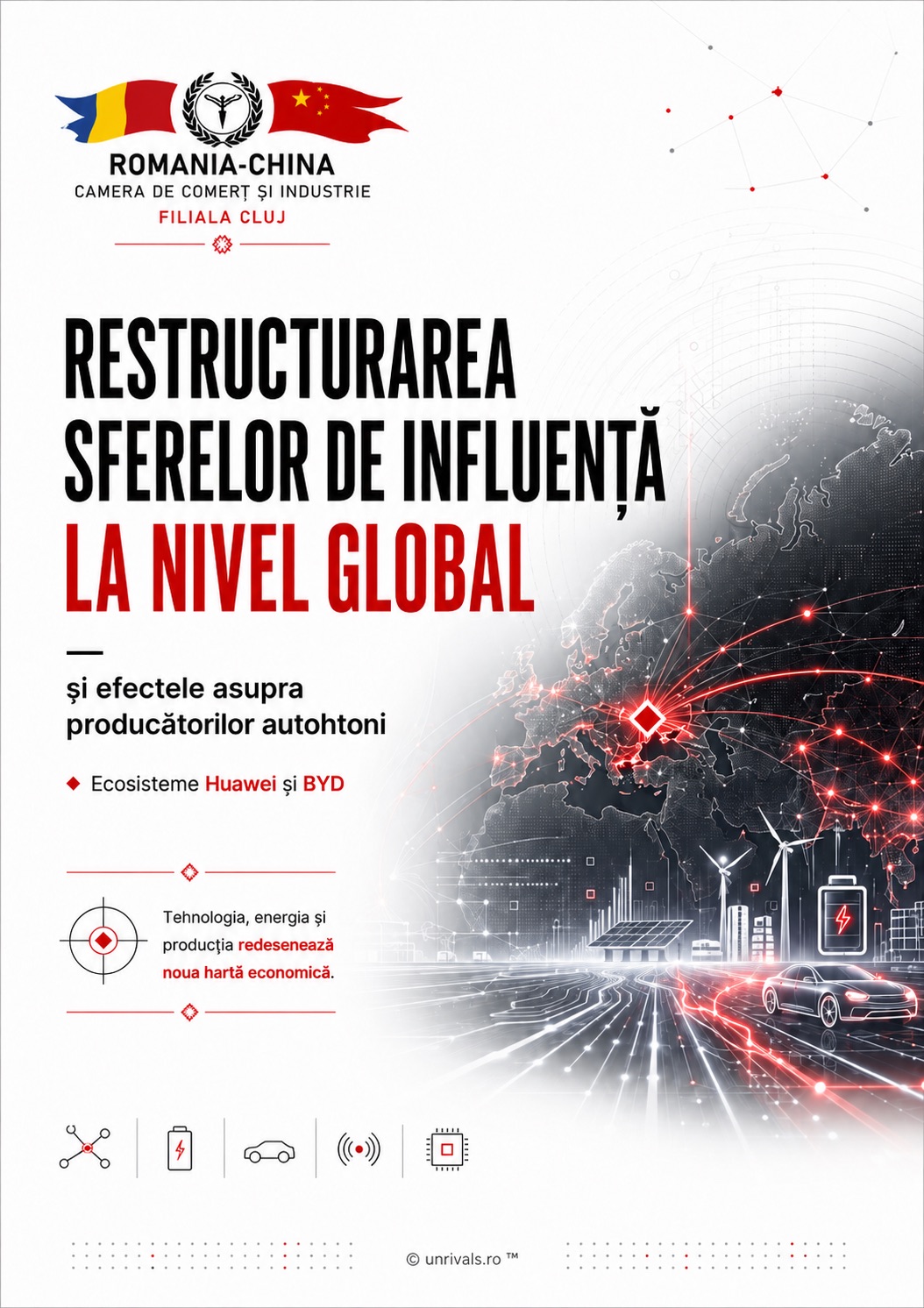
Over the coming years, the competitiveness of Romanian manufacturers will no longer rest on labour costs or the price of energy. It will rest on the position they hold in the new industrial ecosystems built around digital infrastructure, energy and integrated production. Huawei and BYD are two of the companies defining that shift.
The world is reorganising, not deglobalising. A new economic architecture is taking shape around us, one in which technology, digital infrastructure, energy, production and market access no longer operate independently but form a single interconnected system. Two decades ago, competitive advantage was built almost entirely around costs and production capacity. Today, what separates the economies that will generate value from those that will remain consumer markets is the position they hold inside the new global ecosystems.
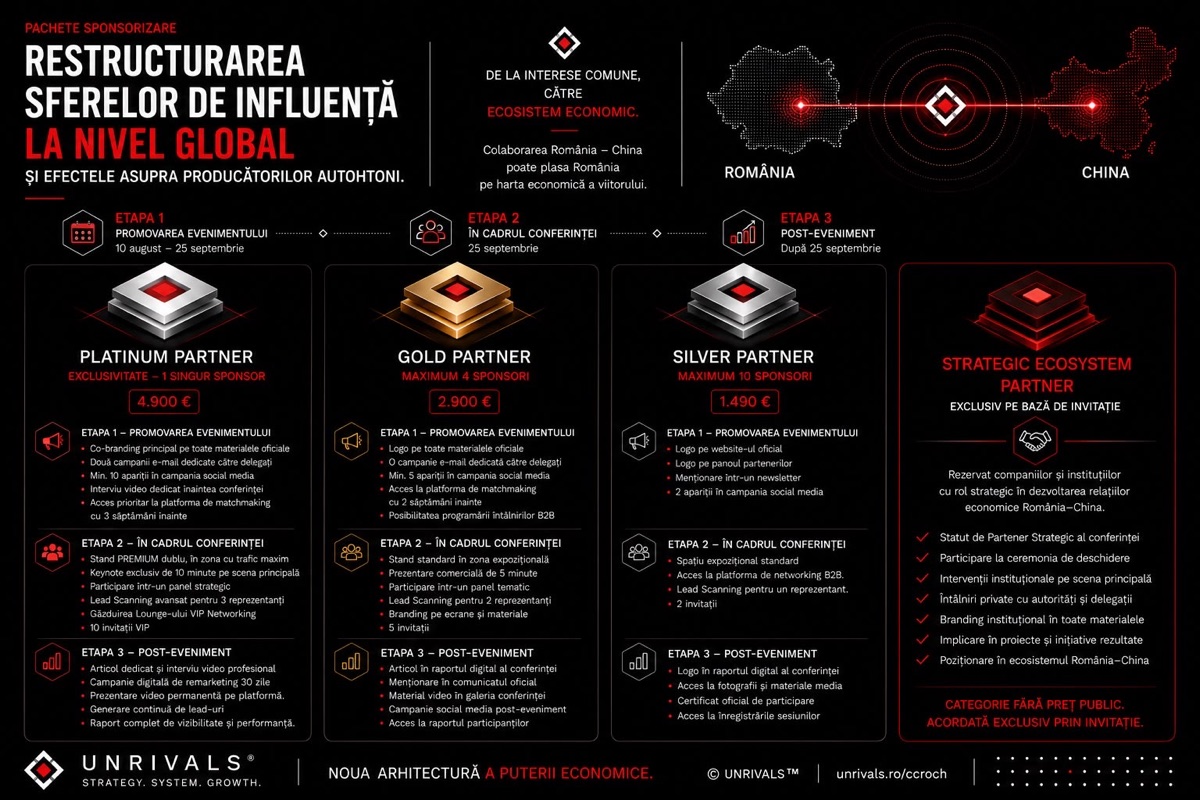
This is the central idea behind the conference “The Reorganisation of Global Spheres of Influence”, organised by the Romania–China Chamber of Commerce and Industry, Cluj branch, through a strategic positioning built together with UNRIVALS.
The event does more than analyse economic relations between Romania and China. It sets out to explain how the world economy is being redrawn, and what role Romania can play at a moment when digital infrastructure, artificial intelligence, energy and industry converge into a new model of economic development.
In this context, Huawei and BYD are two working examples of how integrated economic ecosystems are built today, not simply two landmark companies of the Chinese economy. That is why the Romania–China Chamber of Commerce and Industry, Cluj branch, together with its strategic partner UNRIVALS and with the involvement of Dr. Eng. István Szőke, Vice President of the Chamber, propose a shift in perspective: Romania should look at these companies less through the investments they can make, and more through their capacity to redefine how global value chains and industrial competitiveness actually work.
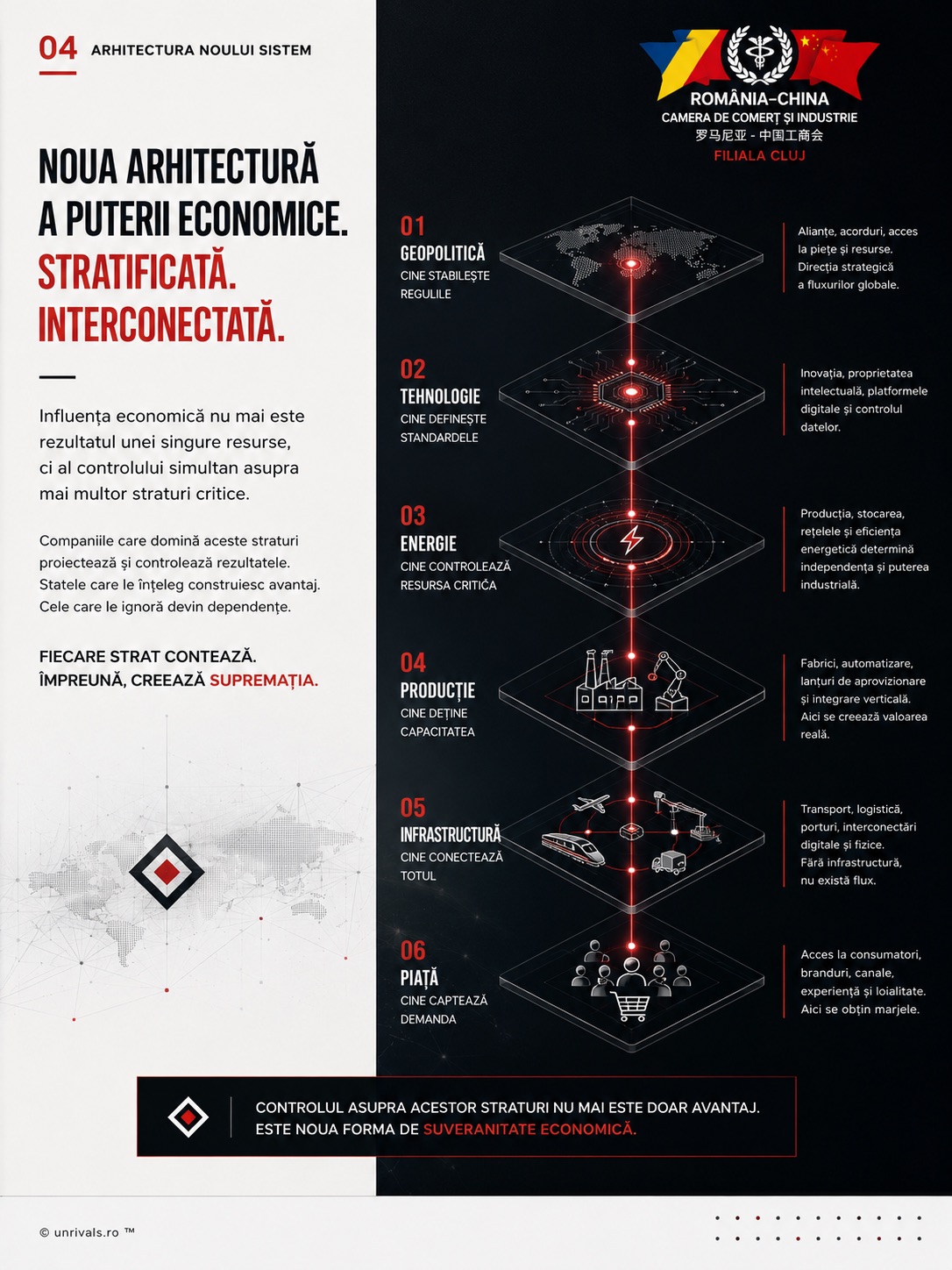
The new economic power: simultaneous control across six layers
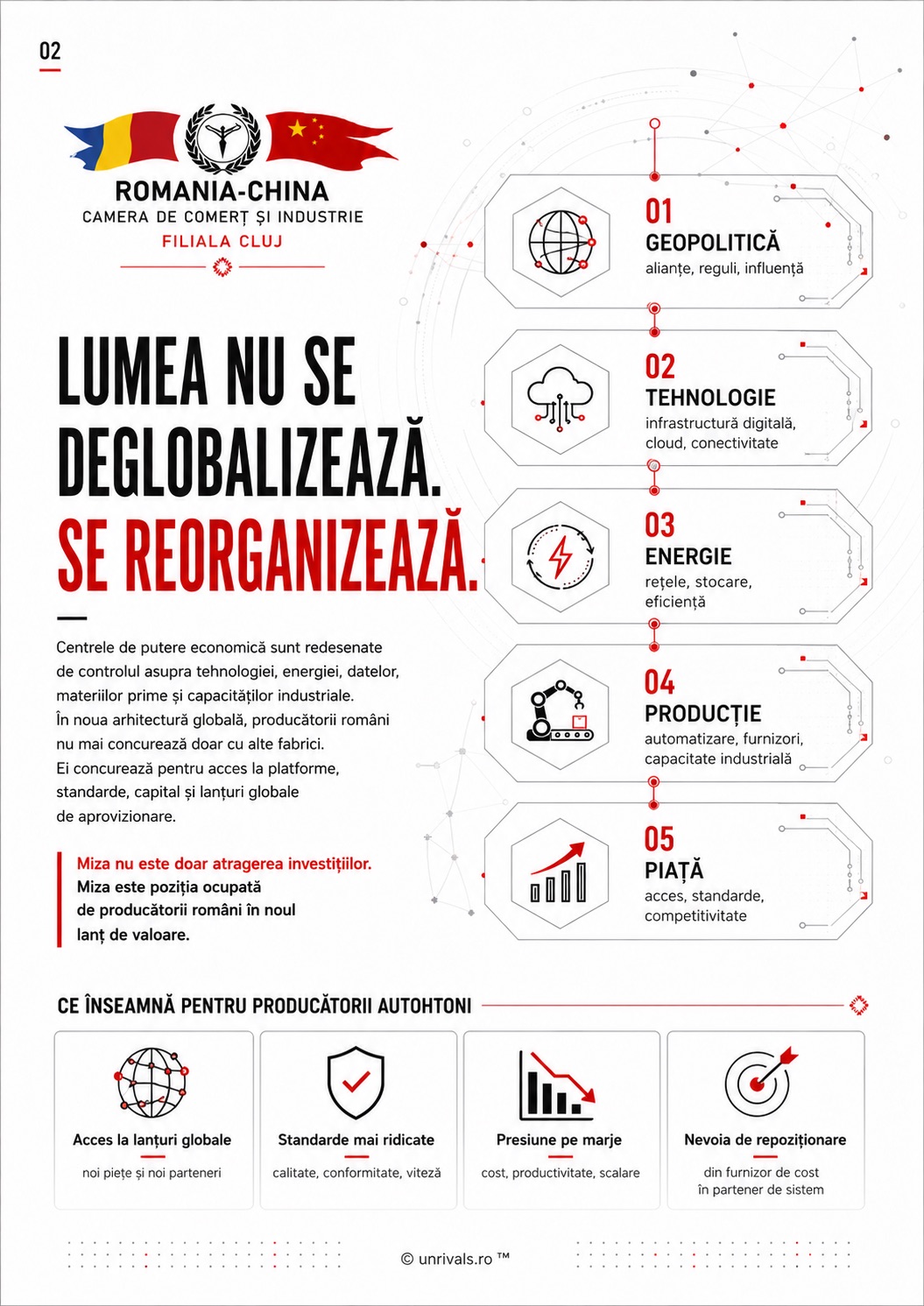
For decades, economic influence was tied almost exclusively to the size of an economy, its industrial capacity or its access to natural resources. The analysis presented at the conference shows that this framing no longer holds. Economic power today belongs to those who manage to control several levels of the same ecosystem at once, each one reinforcing the next and producing an advantage that is difficult to replicate.
The first layer is geopolitics, which sets alliances, trade rules and the direction of the major economic flows. The second is technology, where digital standards, data platforms and the information infrastructure of the modern economy are defined. The third layer is energy, without which digitalisation and industry cannot function sustainably. Then comes production, where knowledge and technology are turned into economic value, followed by infrastructure, which connects physical and digital flows and keeps the whole system running. The final layer is the market, where demand forms and where the value created ultimately settles.
Taken separately, each of these levels explains only part of today’s economy. Taken together, they describe how spheres of economic influence are being reorganised globally, and why competition no longer happens between companies or states alone, but between ecosystems capable of integrating all these dimensions at once.
Huawei and BYD, two strategic ecosystems rather than two companies
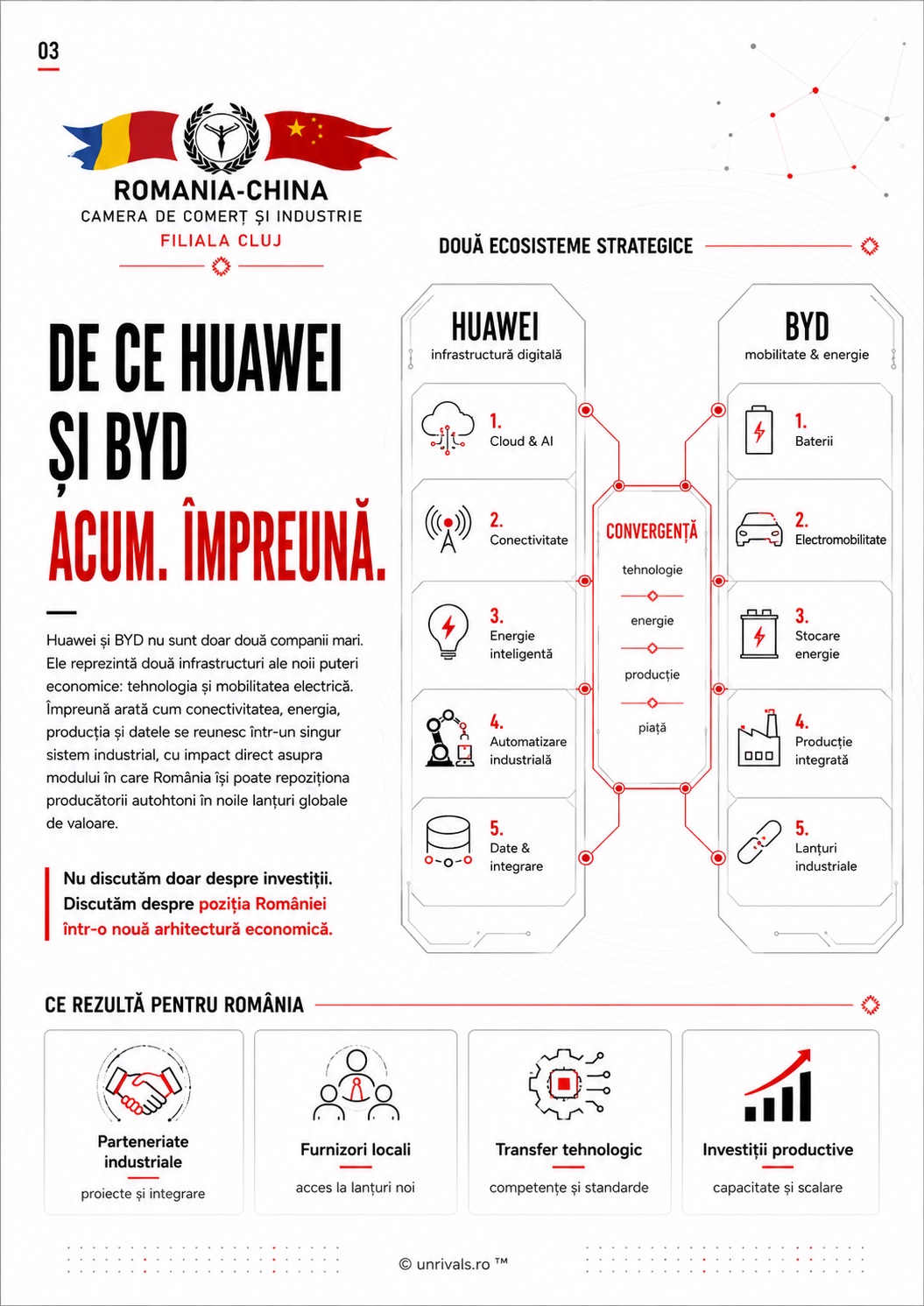
In this equation, Huawei and BYD are no longer seen as ordinary multinationals. They are two strategic ecosystems operating at different levels of the same economic architecture.
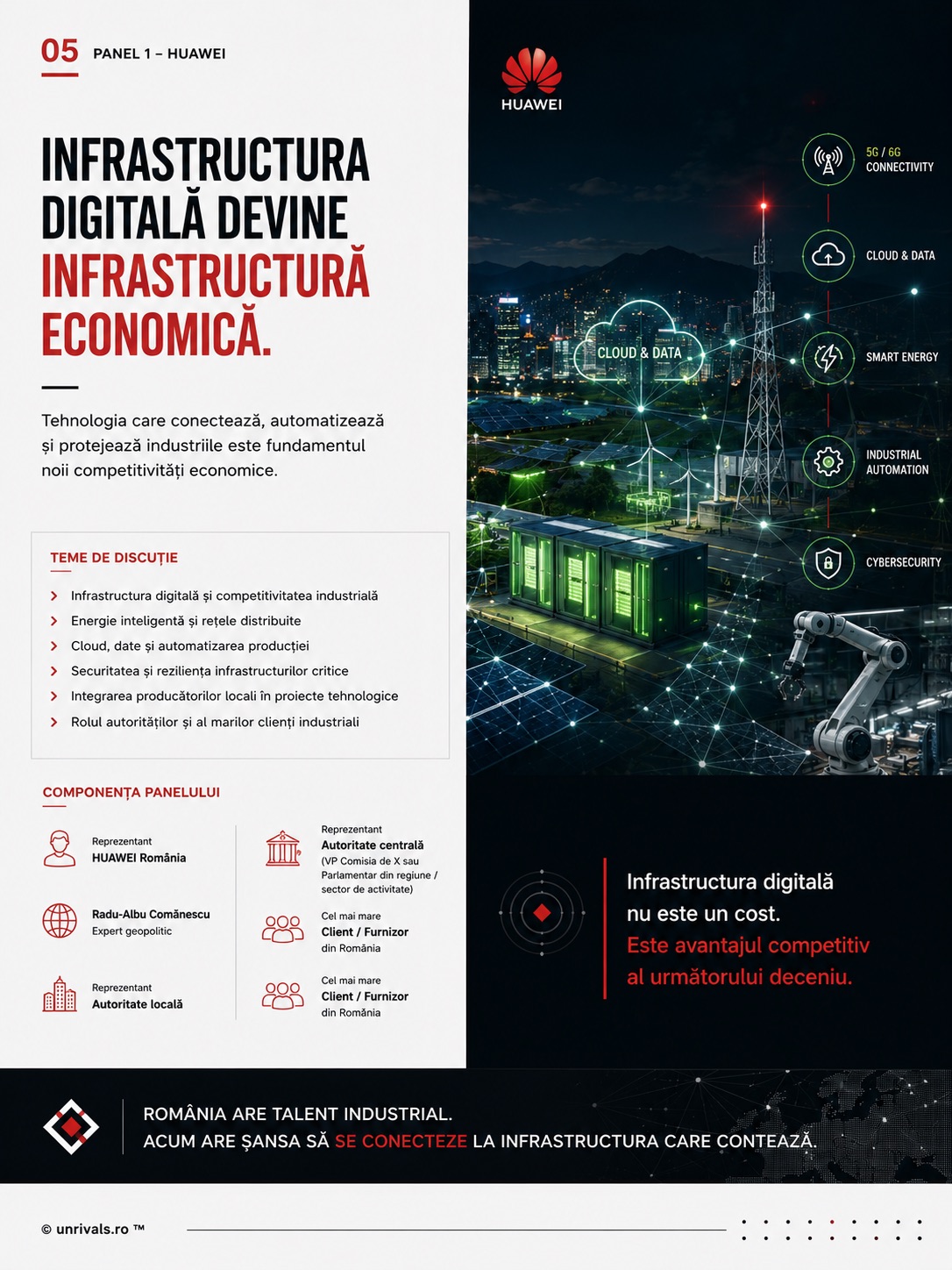
Huawei represents the backbone of digital infrastructure. The cloud, artificial intelligence, connectivity, smart energy and industrial automation the company develops are more than commercial products. They are components of an infrastructure that allows the digital economy to function. In the new economic context, digital infrastructure stops being an IT investment and becomes economic infrastructure. The same logic is at work in major Western economies, where data centres, communications and artificial intelligence are treated as critical infrastructure for future competitiveness.
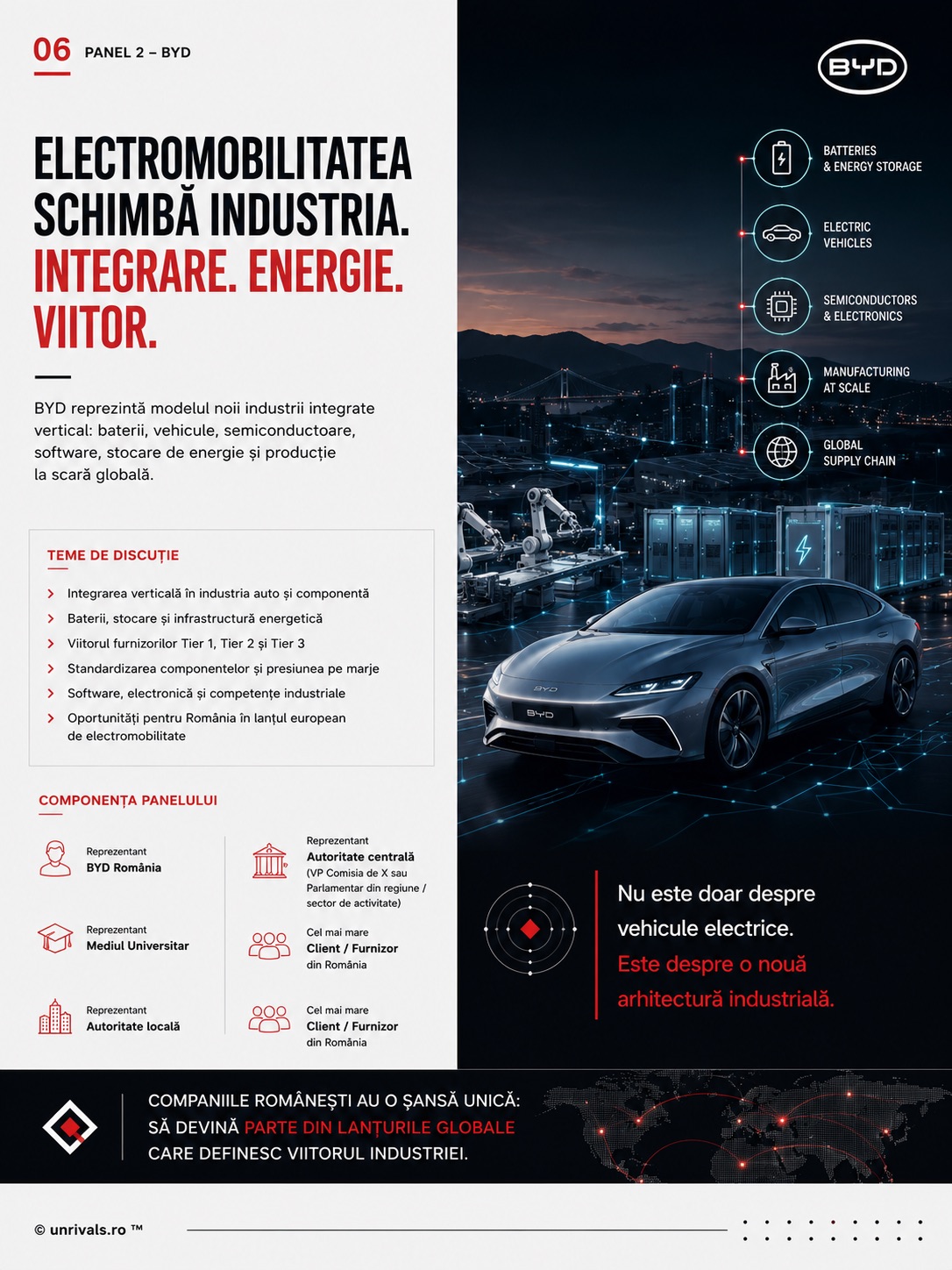
BYD defines another level of that architecture. Beyond the public image built around electric vehicles, the company has developed an ecosystem around batteries, energy storage, integrated manufacturing and electromobility. The electric car is only the visible expression of a far more complex industrial system in which energy, power electronics, software, advanced materials and production work together. This convergence between digital infrastructure and industrial infrastructure explains why Huawei and BYD are presented at the conference as two complementary examples of the new global economic architecture.
What this means for local manufacturers
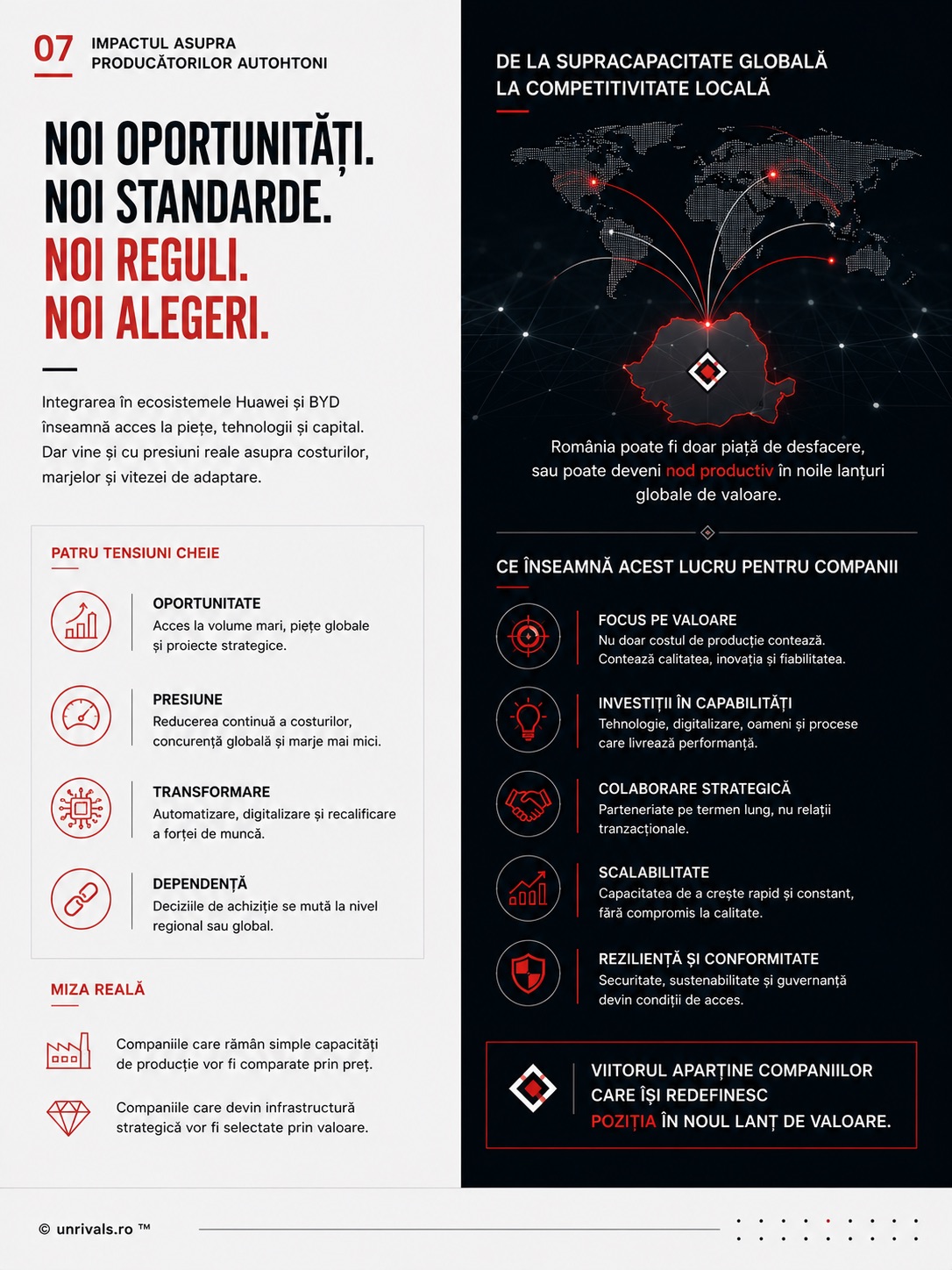
The message for Romanian entrepreneurs and manufacturers is direct: the stake is no longer only about attracting investment or landing individual commercial contracts, but about the position held in the new global value chain. What separates a supplier from a strategic partner is no longer cost or production capacity alone, but the degree of integration into an economic ecosystem that generates value over the long term.
This shift matters for Romanian industry. Companies that keep competing on price alone will stay permanently exposed to cost pressure and to production moving elsewhere. Companies that adopt international standards, invest in digitalisation, build technological competence and integrate into complex industrial ecosystems will take part in a different category of projects, where advantage is built through collaboration, interoperability and trust.
The strategic partnership between UNRIVALS and the Romania–China Chamber of Commerce and Industry, Cluj branch, starts from exactly this idea. The role of a chamber of commerce is no longer limited to facilitating dialogue between companies. It extends to building a framework in which local manufacturers understand the structural changes in the economy and can adapt their strategies before those changes turn into unavoidable pressure on their competitiveness.
Romania, at the intersection of digitalisation and production
Romania has a chance here to move past its traditional role as a cost-driven economy and become a relevant actor in the new European economic architecture. Its geographic position, the industrial base built over recent decades, European Union membership and the experience accumulated in automotive, industrial components, IT, energy and advanced manufacturing create the conditions for a strategic repositioning, at a moment when the major economic ecosystems are reconfiguring their supply chains and industrial partnerships.
Seen from this angle, the conference sets out to open a dialogue about how Romania can take part in this reorganisation of global spheres of influence, drawing on the relationship between digital infrastructure, industrial production, energy and human capital, not to discuss Huawei or BYD or present individual commercial opportunities.
That approach is what distinguishes the strategic positioning built together by the Romania–China Chamber of Commerce and Industry, Cluj branch, and UNRIVALS. It moves the conversation from a single event towards an analysis of the structural transformations that will define economic competitiveness over the next decade.
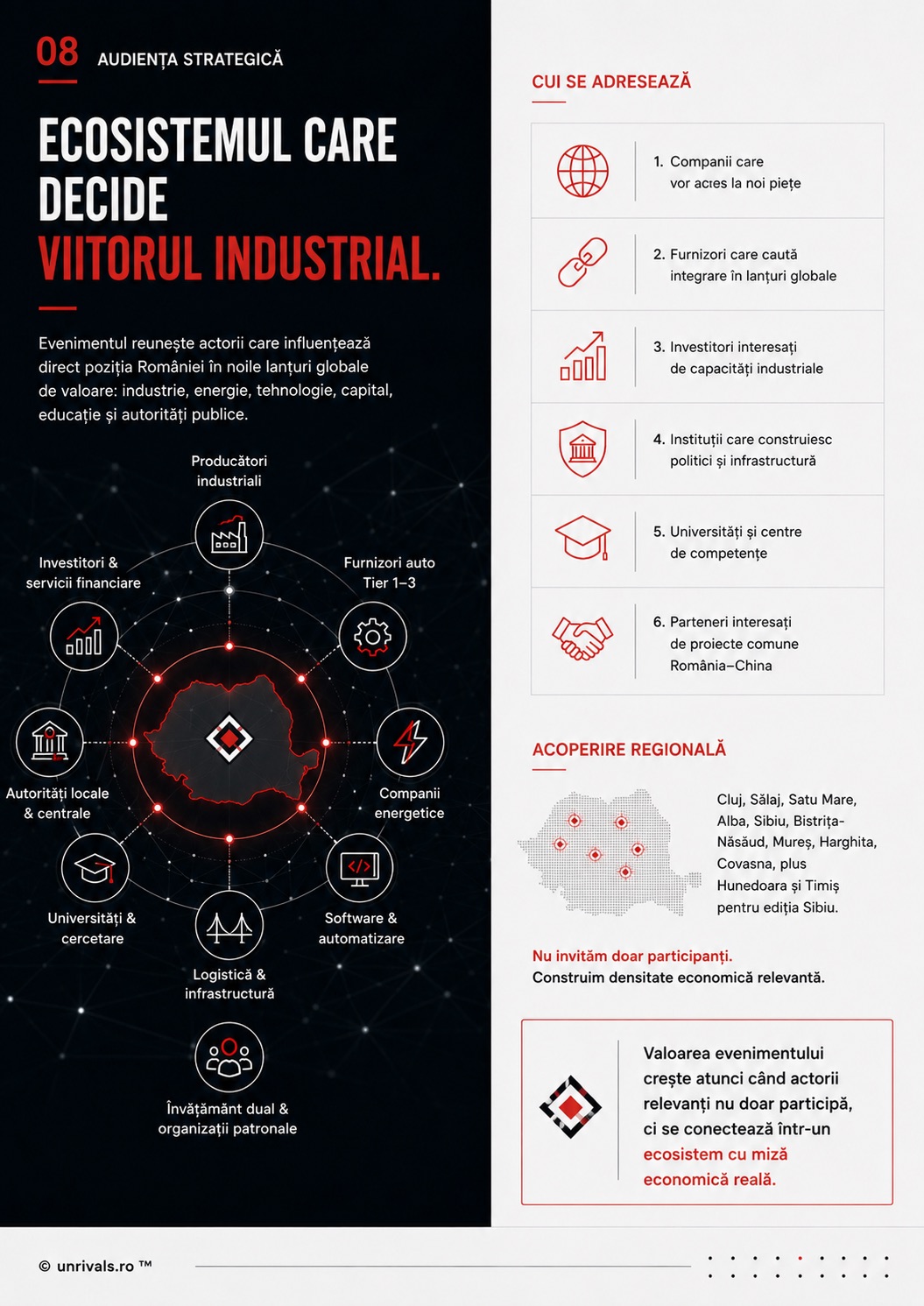
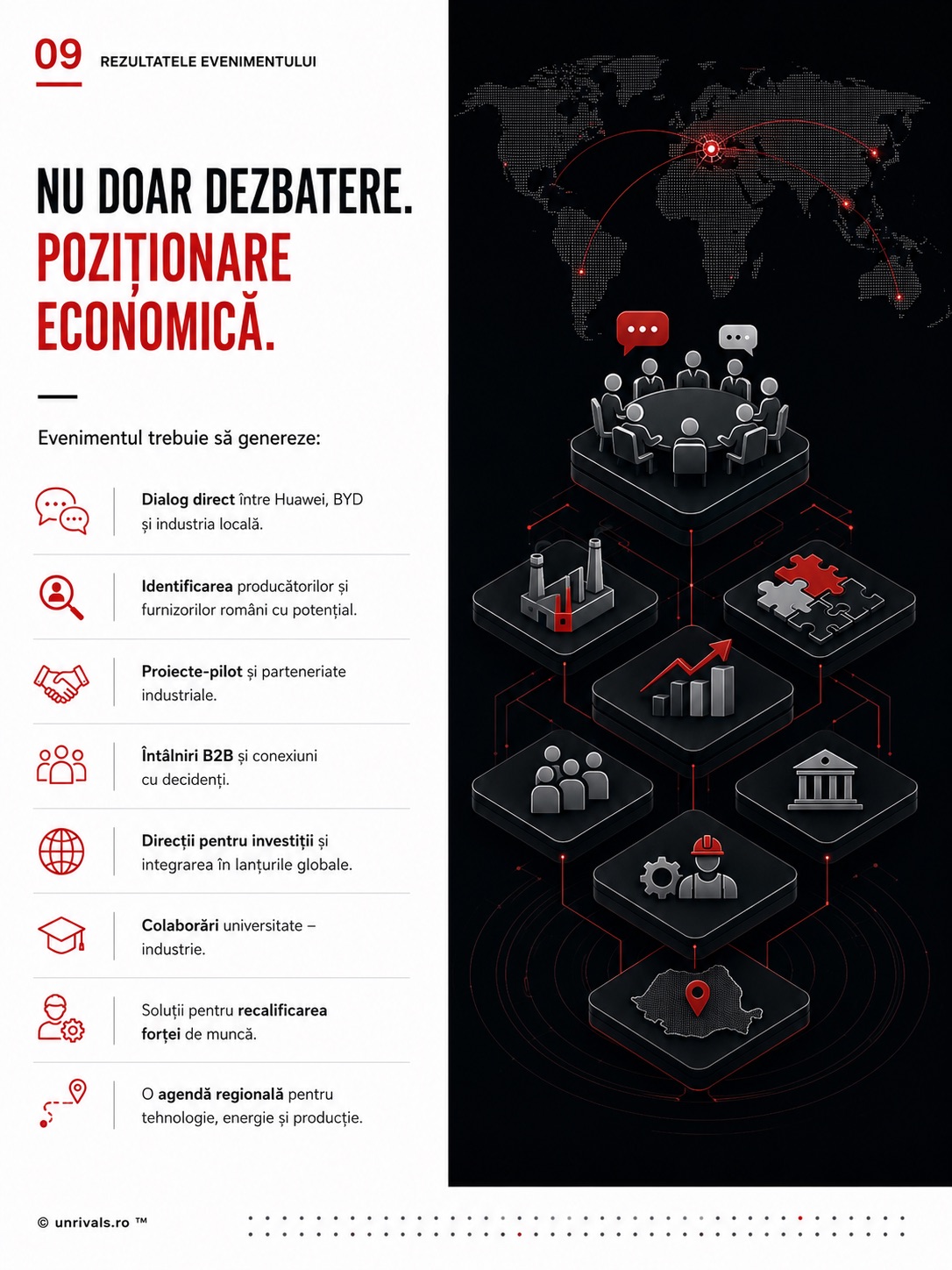
The event also creates the setting for direct meetings between industry representatives, academia, public authorities and technology ecosystems, with the aim of identifying concrete directions for collaboration.
Pilot projects, B2B meetings, skills transfer and the development of industrial partnerships are only the first stages of a broader process, one in which Romanian manufacturers can move from supplying components to becoming integrated partners in global economic ecosystems.
From cost supplier to system partner
Perhaps the most important conclusion drawn from the analysis presented at the conference is that future competitive advantage will no longer be built on low costs or installed production capacity alone. Those elements still matter, but they are no longer sufficient in an economy where value comes from integrating technology, infrastructure, energy and production into a coherent system.
For local manufacturers, this shift means that investments in digitalisation, automation, standardisation and technological skills are no longer modernisation projects. They are conditions for participating in the new global value chains. Companies that grasp this transformation will be able to access higher value-added projects and become part of stable industrial ecosystems, while organisations that keep competing on price alone will face growing pressure on margins and competitiveness.
In that sense, Huawei and BYD represent more than two industrial success stories. They illustrate how ecosystems are built to integrate research, digital infrastructure, energy, production and market into a development model that generates value over the long term. The lesson for Romanian industry is not to replicate these models, but to understand their logic and identify its own role inside a global economy going through rapid reorganisation.
The role of the strategic partnership between the Romania–China Chamber of Commerce and Industry and UNRIVALS
Behind the conference sits a strategic positioning process built together by the Romania–China Chamber of Commerce and Industry, Cluj branch, and UNRIVALS, starting from a simple idea: before an organisation communicates an event, it has to build a context that gives that event relevance and continuity.
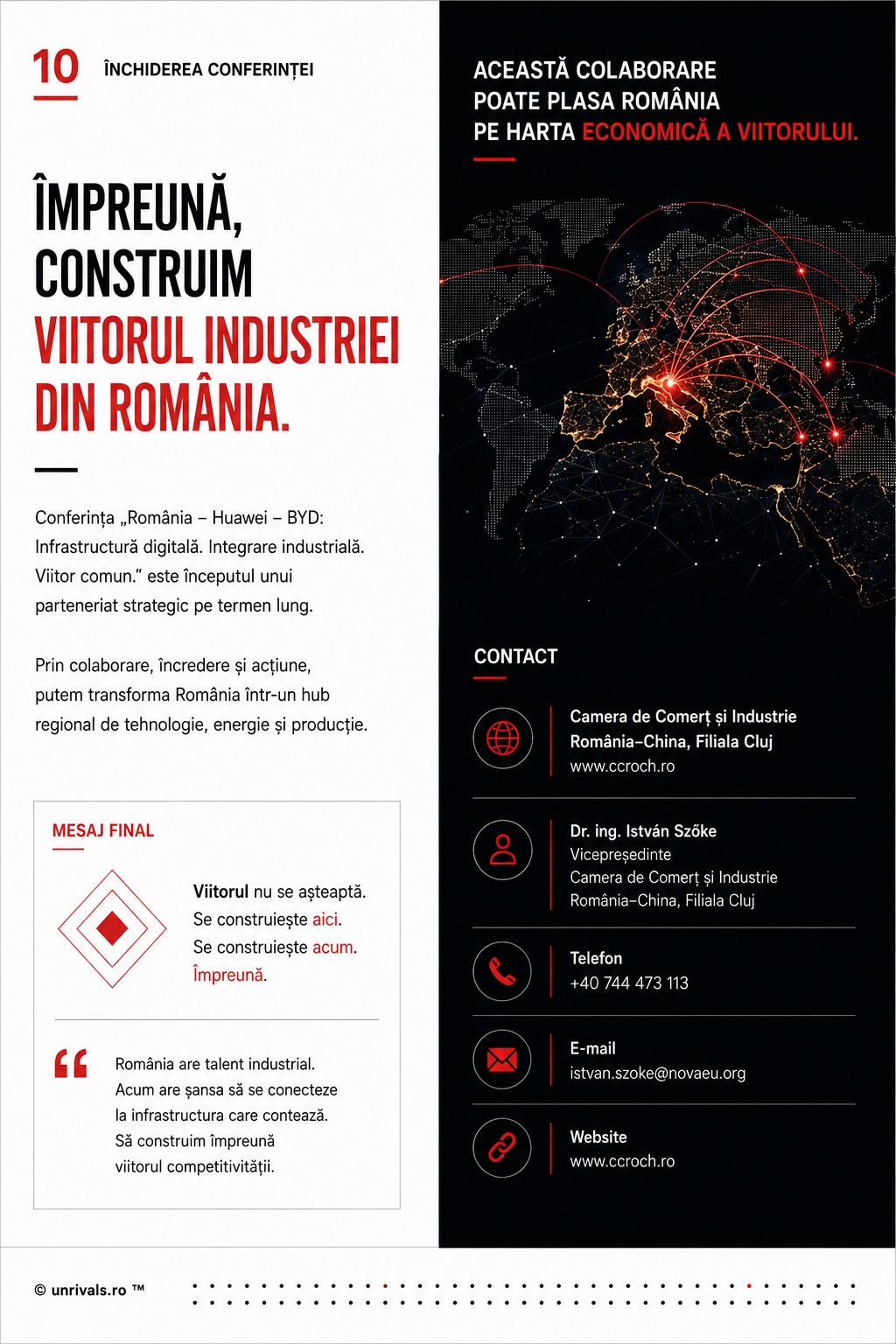
For this reason, the event brochure follows a logical thread rather than a traditional presentation structure: it starts from the reorganisation of global spheres of influence, explains the new architecture of economic power, introduces the Huawei and BYD ecosystems as case studies, and arrives at the concrete implications for Romanian manufacturers and for building durable economic partnerships. Each chapter adds to that construction, and together they offer a coherent perspective on how Romania can capitalise on the opportunities created by the transformation of the world economy.
The contribution of Dr. Eng. István Szőke, Vice President of the Romania–China Chamber of Commerce and Industry, Cluj branch, completes the approach by connecting the strategic perspective with practical business experience. The message is a balanced one: Romania’s competitiveness has to be built through partnerships, through infrastructure development, through raising the technological level of industry and through integrating Romanian manufacturers into economic ecosystems capable of generating long-term value, not through isolation or by simply waiting for investment to arrive.
Conclusion
The reorganisation of global spheres of influence is neither an abstract trend nor a concept reserved for geopolitical analysis. It describes a concrete transformation in how investments, infrastructure, industrial chains and economic partnerships will be built over the coming years. For Romania, this change is both a challenge and an opportunity: the challenge of moving past a model built on costs, and the opportunity of becoming a relevant partner in an economy built on technology, infrastructure and collaboration.
Huawei and BYD are two examples of this transformation, but the message of the conference reaches further. The stake is understanding that future competitive advantage will belong to ecosystems capable of connecting geopolitics, technology, energy, production, infrastructure and market into one coherent and sustainable system, not choosing between economic models. In that process, Romania has a chance to move from participant to active partner in the new global economic architecture.
For a deeper look at the strategic positioning built together by UNRIVALS and the Romania–China Chamber of Commerce and Industry, Cluj branch, and at how this approach applies to developing economic partnerships between Romania and China, read the full case study on reindustrialisation, digital infrastructure and building the new economic ecosystems.
The strategic positioning gallery