
The 4Ps of marketing are the four decisions through which a company takes its offer to the customer, namely product, price, place and promotion. The model was formulated by E. Jerome McCarthy in 1960 and has remained, ever since, the most used map of marketing decisions, because it shows a manager exactly what they can control directly.
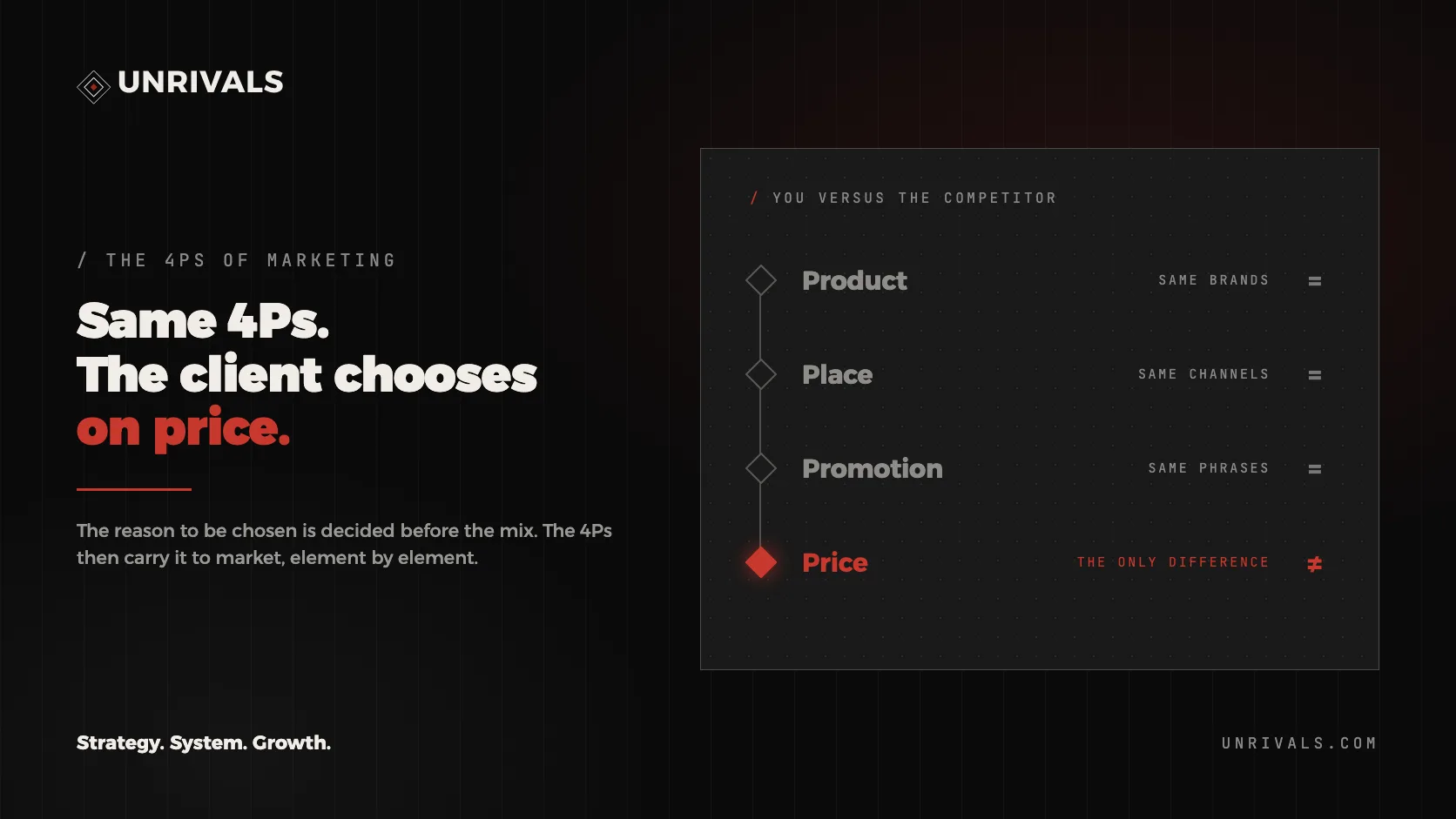
The map has a limitation the textbooks rarely mention, though. The 4Ps describe what the company does, and two competitors can fill in the same four boxes in an almost identical way. At that point the customer has no other criterion left to choose by, so they choose on price.
TL;DR. The 4Ps model organizes marketing decisions, but it does not produce the reason a company gets chosen. That reason is decided earlier, in positioning, and the 4Ps then carry it into the market, one element at a time.
Without that reason, a company’s mix ends up looking like its competitor’s, and the comparison shifts to the one figure that still differs, the price. This article shows the mechanism on three Romanian companies whose audits we have published, and it ends with an exercise you can run on your own company in half an hour.
On the marketing mix as an execution tool, with the 4Ps and the 7Ps applied to five Romanian companies, I wrote a separate guide to the marketing mix in B2B. Here I deal with the limitation I left open there, namely the question the 4Ps cannot answer on their own.
What are the 4Ps of marketing?
The 4Ps of marketing are product, price, place and promotion, four categories of decisions a company controls directly.
Product covers what you sell and in what form, price covers how much you ask and under what conditions, place covers where and through whom the offer reaches the customer, and promotion covers what you say about the offer and on which channels.
The value of the model lies in the discipline it forces. A decision that does not fit into any of the four boxes usually ends up with no owner. A manager who runs the offer through the 4Ps quickly sees where something is missing, from an undefined price for large customers to a channel nobody actually chose.
McCarthy built the model for the American consumer-goods market of the late 1950s. Products were easier to tell apart from one another, and distribution channels were few and stable. In a market like that, a good decision on each of the four Ps produced, almost automatically, an offer different from the competitor’s.
The market has changed since then, and criticism of the model came early. In 1990, Bob Lauterborn wrote in Advertising Age, on 1 October, that “It’s time to retire McCarthy’s famous Four P’s”, and proposed four terms formulated instead from the customer’s point of view.
His proposal moved the focus toward the customer, but it kept the same structure of four boxes filled in by the company. The problem described below is not solved by changing the model’s letters. It comes down to the order in which decisions are made and the question that has to be asked before them.
What are the limitations of the 4Ps of marketing?
The main limitation of the 4Ps model is that it describes a company’s decisions without saying why anyone would prefer them. Four correctly filled boxes can produce an offer identical to the competitor next door, because the model checks whether each decision exists, but it does not check whether the decisions together give the customer a reason to choose.
This limitation matters more than it seems, because the perceived difference between brands is small in almost every category. Customers see far less difference than companies think they do.
Jenni Romaniuk, Byron Sharp and Andrew Ehrenberg measured the phenomenon in their 2007 study on perceived differentiation, and across the categories analyzed only about one in ten current customers considered their brand different or unique.
In B2B, where the buyer compares offers in writing and has more time, the picture is similar. The 2013 research by CEB and Google, presented on Adobe’s blog, found that only 14% of business decision-makers see a difference between suppliers that they value enough to pay for.
When the difference cannot be seen, the customer looks for a criterion that can be, and the simplest one to see is price. This is where the real cost of a 4Ps mix with no reason behind it shows up. A company with no reason to be chosen negotiates its margin on every single offer.
The lever it loses is the strongest one in the whole mix. Michael Marn and Robert Rosiello showed, in Harvard Business Review, in 1992, that a 1% increase in the price actually collected raised operating profit by an average of 11.1%. One percentage point given up on price can take away more than 10% of profit.
- 1 in 10customers see their brand as different or uniqueRomaniuk, Sharp, Ehrenberg
- 14%of B2B decision-makers pay for the difference between suppliersCEB and Google
- 11.1%rise in operating profit for a 1% improvement in priceMarn and Rosiello
Sources · Romaniuk, Sharp and Ehrenberg, 2007 · CEB and Google, 2013 · Marn and Rosiello, Harvard Business Review, 1992
Read together, the three figures describe a chain. The customer sees little difference, only a small share of buyers pay for the difference they do see, and the price given up because of that hits profit directly. The red card shows how expensive the last step of that chain really is.
Can two competitors have the same 4Ps?
Two competitors can have the same 4Ps, and the situation comes up often. Two distributors who sell the same brands through a showroom, a website and a marketplace, and who promote their range on the same channels, end up with practically the same mix.
Each one made correct decisions on all four Ps, and the customer still has no reason to prefer either one.
The clearest example is NordicaMoto, a distributor of enduro motorcycles, ATVs and equipment based in Odorheiu Secuiesc. In the positioning analysis published for NordicaMoto, the company shows RON 73.55 million in turnover in 2025, the third largest in the market it serves. The public ANAF financial statements also show sales 4.29 times higher than in 2022.
The company’s 4Ps look like those of any well-run distributor. The product comes from KTM, Husqvarna, GasGas, CFMOTO, Beta, Leatt or Alpinestars.
Place means the showroom in Odorheiu Secuiesc, a location in Sfântu Gheorghe, the website and eMAG, and promotion puts the manufacturers’ products on the first screen, along with the label “Magazin moto” (“moto shop”), written into the title and the H1 of the home page.
The product belongs to the manufacturers, and eMAG is a channel open to anyone. On price, public data does not yet allow a conclusion about margin, and the audit left the question open, for validation. Promotion remains the one element the company fully controls, and that is exactly where NordicaMoto describes itself with the words of the entire category.
The competitor test from the same audit makes the problem visible. We took the phrases NordicaMoto uses to present itself and checked, for each one, whether a competitor was already using it.
"Magazin moto" ("moto shop")
nordicamoto.ro, home page title
- BBmoto, MotoMus, MxEnduro, Motoemotionthe same label, already in their titles
- Moto24"echipamente moto premium" ("premium moto equipment"), next to "produse premium și consultanță de specialitate" ("premium products and specialist advice")
- BBmoto"peste 7.000 de produse" ("over 7,000 products"), next to "cea mai completă gamă din regiune" ("the most complete range in the region")
Every tested phrase could be signed tomorrow by a competitor
Every row in the figure holds a correct phrase, and every phrase already belongs to someone else. The effect shows up in AI engines.
In a test run on 29 September 2026, when asked “de unde cumpăr echipament de enduro în România” (“where do I buy enduro equipment in Romania”), ChatGPT recommends BBMoto first, and NordicaMoto is missing from all three tested answers, even though Google ranks the company first for “casca enduro” (“enduro helmet”).
The audit states the strategic question directly. Why would a customer buy from NordicaMoto, if the same brands and products exist in other stores? The answers the market gives today are proximity, price, availability, range, relationship and authorized-dealer status.
These are real commercial assets, but none of them builds a preference that is hard to copy. What a competitor cannot easily copy sits in things the website does not show, in hard-enduro experience, in race-day service and in a selection of products tested on the ground, at Red Bull Romaniacs.
The proof already exists inside the company, it is simply missing from its promotion.
What happens when the 4Ps work separately?
When the 4Ps are not tied to a shared reason, each element sends the customer a different message, and the customer keeps only the message that is easiest to compare.
The mix can be rich on every single box and still remain a list of options, read like a menu, from top to bottom, with the eyes fixed on the price column.
The Crystal Dental Clinic audit shows the mechanism on a company with solid arguments. The Bucharest clinic had RON 23.5 million in turnover in 2025 and has 2,011 reviews with an average rating of 4.9.
In the reviews, the word “încredere” (“trust”) appears 18 times and “doctor” 15 times, while “preț” (“price”) and “tehnologie” (“technology”) do not make the top ten words.
Patients choose for trust and for the doctor, while the clinic’s mix talks about something else. The services page lists twenty-one procedures one under another, and everything the clinic communicates publicly about money is discounts, from “Promoțiile lunii” (“this month’s promotions”), the second button on the home page, to “10% la prima vizită” (“10% off your first visit”).
The membership plans are also lists of percentages.
Promotion is teaching the patient to look for exactly what did not bring them to the clinic in the first place. The related searches on Google say the same thing, “clinică stomatologică ieftină București” (“budget dental clinic Bucharest”) or “dentist București prețuri” (“Bucharest dentist prices”), and the audit’s conclusion is that, in the absence of a reason, price decides.
In the audit we described the situation through the image of a restaurant menu. All four levers of the mix exist, but they work separately, and the patient is left with a single unit of measurement, the price of the procedure. A strong offer, presented as a list, invites comparison.
The pattern is not specific to dentistry. We have found it in at least five published audits, at Cablero, Tamos, Pescado, Therezia and De Colțești, companies from industries that have nothing in common. Every time, the company described its offer through quality, fair price and fast delivery, the minimum definition of the category it competes in.
At Tamos, the company declared five principles, and the market retained only one, price, as shown by the Tamos positioning audit. At Cablero, the direction proposed in the audit moved the discussion from the cable, as a product, to the risk the cable protects against in the customer’s installation, meaning the part that is not allowed to fail.
What do companies usually try when their mix looks like the competition’s?
When the mix looks like the competition’s, companies usually try to differentiate themselves from inside the 4Ps, through price, through range or through more promotion. All three are visible, fast moves, and all three can be copied by a competitor within the same month, which is why none of them changes the reason the customer chooses.
The first move is a price cut. It brings orders quickly, but those orders are paid for out of the company’s margin, following the arithmetic from Marn and Rosiello’s study. Worse, the discount teaches the customer that price is the right criterion for comparison, and on the next offer they will ask the same of the competitor too.
The second move is widening the range. “Cea mai completă gamă din regiune” (“the most complete range in the region”) and “peste 7.000 de produse” (“over 7,000 products”) are the phrases caught by the competitor test above, on two different players in the same market.
A bigger range can be bought, so it can also be copied. A range presented as a list also reinforces the menu effect seen at Crystal Dental.
The third move is increasing the promotion budget behind the same message. The extra budget buys impressions for a phrase the customer does not link to any particular company, so every impression has to explain the offer from scratch.
In our methodology we call this effort a cognitive tax, and it is paid at every contact, in cost per click and in cost per lead.
The three moves have one thing in common. All three work on what the customer can measure easily, namely price, range and volume of messaging, and leave untouched the question that decides the choice, which is what the company actually stands for.
What has to be decided before the 4Ps of marketing?
Before the 4Ps, you decide the reason a customer should choose your company, phrased so that a competitor cannot sign it. That reason is positioning, and the 4Ps then become four places where it gets demonstrated, each one with its own proof.
I formulated this idea in my writing on industrial marketing. In a market where suppliers can end up being compared mainly on specifications and price, marketing has to create a second dimension of comparison, namely what the company stands for. The 4Ps work on the first dimension, while positioning is what opens up the second.
This is where the pillar we call cognitive ownership comes in. In our methodology, the end goal is to own the mental space of the category, so that when the need arises the market comes to you automatically, and you no longer have to compete on ads and price. Cognitive ownership is built before the customer starts looking for anything.
The moment the choice gets won comes, most of the time, before the search itself. John Dawes, of the Ehrenberg-Bass Institute, estimated in a study for the LinkedIn B2B Institute, presented by Marketing Week in July 2021, that around 95% of B2B buyers are not in the market at any given moment.
“People operate using their memory”, Dawes said in the same article.
Source · John Dawes, Ehrenberg-Bass Institute for the LinkedIn B2B Institute, 2021
The five lit diamonds in the bottom corner represent the buyers directly reached by this month’s price, offer and promotion. The other ninety-five will buy later, and when they do, they will remember the company that left a clear reason in their mind.
That is why the reason starts from WHY, in the sense of Simon Sinek’s Golden Circle model, which I explained in the article on the Golden Circle applied to B2B companies. Communication starts with the meaning of the offer, and the description of the service comes after.
With a clear WHY, every one of the 4Ps can be judged, because each decision either strengthens the reason or weakens it.
The practical form the reason takes is a central attribute, a word or a short phrase carried through the name, the tagline, the offer and the proof. In our methodology, a single attribute has to propagate through everything, the way Volvo came to mean safety.
For NordicaMoto, the audit proposed the attribute “ANDURANȚĂ & CONTROL” (“endurance and control”), drawn from what the company already does at races.
A central attribute also reduces the effort a customer needs to understand the offer. A mix subordinated to a single attribute is understood faster, so its promotion has less to explain.
How the position gets chosen is something I showed in the guide to brand positioning, and how a company becomes first in the customer’s mind is what I explained in the article on cognitive ownership.
What do the 4Ps look like when they serve a reason?
The 4Ps, once subordinated to a reason, each answer the same question, namely what that element proves about the reason to choose. The table below puts side by side, for three of the companies discussed, what the mix shows today, what the market remembers and the reason the audit proposed, or found already inside the company, unused.
| Company | What the 4Ps show today | What the market remembers | The reason to choose, from the audit |
|---|---|---|---|
| NordicaMoto | the manufacturers’ brands, “Magazin moto” in the title, showroom, website and eMAG | the manufacturers’ brands, and ChatGPT recommends a competitor | ANDURANȚĂ & CONTROL, proven through hard enduro and race-day service |
| Crystal Dental Clinic | twenty-one procedures listed, promotions, discounted membership plans | the price of the procedure | trust in the doctor, already named by patients in reviews |
| Cablero | quality, fair price, fast delivery | comparison on price | what is not allowed to fail in the customer’s installation |
The middle column shows why order matters. In all three cases, the market retained exactly what was easiest to compare. The right-hand column adds no new activity, because the reason already existed inside the company, in race-day experience, in the relationship with the doctor or in the role the product plays for the customer.
For NordicaMoto, the audit translated the attribute into two of the four Ps. In product, the company’s value becomes the selection made for terrain, skill level, risk and real use, and in promotion the communication moves from the manufacturers’ products to its own criterion, namely what holds up, what works and what gives control in the field.
On price, the audit deliberately left a question open, namely whether service, race parts and rentals produce a different margin from the vehicles themselves, because public data does not allow a conclusion.
The sentence that closes the audit’s 4Ps page sums up the move. NordicaMoto does not have to produce everything. It has to know what holds up, what fits and what is worth recommending.
On which layers does the link between the 4Ps and the reason to choose break?
The link between the 4Ps and the reason to choose usually breaks at the positioning layer, but it shows up first on the layers below, in ads and in the offer.
That is why we read every mix problem across the four layers of our methodology, starting from L1, performance marketing, up to L4, positioning and category, with AI Brain sitting on L3.
- L4 · Positioning and categoryThe reason to choose is missing, so the mix has nothing to prove
- L3 · AI Brain, orchestrationAI engines read the generic label and recommend someone else
- L2 · Revenue and commercial processThe offer gets compared on price, and margin pays for growth
- L1 · Performance marketingEvery impression explains the offer from scratch
The figure reads from bottom to top, in the order a company feels the problem, and the red layer at the top shows where it actually begins.
L1, performance marketing. At Crystal Dental, the audit found zero purchased search keywords, in a category where a click on “implant dentar București” (“dental implant Bucharest”) costs a dollar. A new budget would buy attention for a list of discounts, so it would pay the cognitive tax on every single click.
L2, revenue and commercial process. At the same clinic, turnover grew 9.8%, while the team grew 27%, from 51 to 65 people, which brought the revenue produced per person down from RON 420,411 to RON 362,344. When the offer gets compared on price, growth is paid for out of margin.
L3, AI Brain, orchestration. AI engines repeat what a company says about itself and what others say about it. NordicaMoto presents itself as “Magazin moto”, and ChatGPT cites pages that have “Enduro” in the title, so it recommends other distributors on exactly the category where the company has the most experience.
L4, positioning and category. The symptoms on the first three layers start here. Without a formulated reason to choose, the 4Ps have nothing to prove, and the fixes applied on the lower layers, better ads or a lower price, only redistribute the same comparison on price.
How do you check whether your company’s 4Ps have a reason behind them?
The check takes about half an hour, done on a sheet with three columns, one for your company and one each for two real competitors. The competitors should come from the same industry code and the same turnover band, because those are the companies your customer actually compares you to.
For each of the four Ps, write in the columns the phrase each company uses publicly, on its website, in its offer or in its catalogue. Then run the sheet through three questions, in order.
- Could a competitor sign your phrase tomorrow, without changing anything about their offer? If yes, the phrase describes the category, and your company does not appear in it.
- Which of the four Ps truly belongs to you? The product may come from the manufacturer, the price may be set by the channel, and the channel may be available to anyone. What is left is the element you control in full.
- Why would the customer buy from you, if the same product or service also exists somewhere else? This is the question from the NordicaMoto audit, asked this time of your own company.
If the answers to the third question are proximity, price, availability, range or relationship, you have commercial assets, but you still do not have a reason to choose. The reason is the answer only your company can give and prove.
Once you find it, write it down as a central attribute and run every P through it. The product has to contain it, the price has to reflect it, place has to make it accessible, and promotion has to repeat it with proof.
An element that cannot be tied to the attribute is either a decision worth revisiting or a piece of proof not yet stated.
If you want to see the exercise done from the outside, on your own company’s public figures, you can ask for a diagnostic, which gives you a score from 0 to 100 in two minutes.
The 4Ps remain the best tool for checking whether marketing decisions are complete. Order matters, though, because a mix filled in before the reason produces a correct company, one the customer compares on price, while the same mix filled in after the reason produces four proofs of the same thing.
Frequently asked questions
What do the 4Ps mean in marketing?
The 4Ps are product, price, place and promotion, the four categories of decisions a company controls directly when it takes its offer to the customer. The model was formulated by E. Jerome McCarthy in 1960 and is the basis of what is called the marketing mix.
Who invented the 4Ps model?
The 4Ps model was proposed by E. Jerome McCarthy, an American marketing professor, in 1960. He built on the idea of the marketing mix, formulated in the 1940s and 1950s at Harvard, and grouped the mix’s ingredients into four easy-to-remember categories.
Are the 4Ps of marketing still relevant?
The 4Ps are still useful as a map of marketing decisions, because they show what the company can control and where a decision is missing. Their limitation shows up when they are used as a strategy, because the model does not produce the reason a customer chooses the company.
What is the difference between the 4Ps and positioning?
Positioning establishes the reason a customer should choose the company and the place it wants to occupy in their mind. The 4Ps are the decisions through which that reason reaches the market, through product, price, place and promotion. Positioning comes first, and the 4Ps execute it.
How do you find out if your mix looks like the competition’s?
You put your company’s public phrases side by side with two real competitors’, element by element, and check whether a competitor could sign your phrase without changing anything about their offer. If they can, your mix describes the category, and the customer will compare the offers on price.